
One of the biggest reasons students choose VLSI is long-term career growth.
Unlike many careers where growth becomes limited after a few years, semiconductor engineering offers:
- strong technical progression
- specialization opportunities
- global demand
- leadership pathways
- architecture-level roles
But many students entering VLSI still have questions like:
- “What happens after my first VLSI job?”
- “How does career growth happen in semiconductor companies?”
- “Can freshers eventually become architects or technical leaders?”
- “How many years does it take to grow in VLSI?”
The good news is, VLSI has one of the clearest long-term technical growth paths in engineering.
A fresher who starts with:
- RTL coding
- verification tasks
- timing analysis
- physical design support
can eventually grow into:
- senior engineer
- module owner
- team lead
- SoC architect
- technical architect
- semiconductor consultant
However, this growth does not happen automatically.
It depends heavily on:
- technical depth
- debugging ability
- consistency
- learning attitude
- project exposure
This blog explains:
- The complete VLSI career growth path
- Roles at different experience levels
- Expected skills at each stage
- How engineers transition into architect-level positions
Why VLSI Offers Strong Long-Term Career Growth
Semiconductor engineering is different from many short-term technology domains because, expertise compounds over time.
As engineers gain experience, they develop:
- debugging maturity
- timing intuition
- architecture understanding
- optimization strategies
- system-level thinking
These capabilities become more valuable with experience.
Modern semiconductor companies highly value experienced engineers because advanced chip development requires deep technical judgment.
Typical VLSI Career Growth Path
While company structures vary slightly, the general semiconductor growth path usually looks like this:
- Trainee Engineer / Intern
- Junior Engineer / Design Engineer
- Senior Engineer
- Lead Engineer / Module Lead
- Staff Engineer / Principal Engineer
- Technical Architect / SoC Architect
- Distinguished Engineer / Technical Fellow
Let’s understand each stage in detail.
Stage 1: Trainee Engineer / VLSI Fresher
This is where most students begin.
Freshers usually work on:
- basic RTL coding
- verification support
- debugging assistance
- scripting tasks
- timing analysis basics
- physical design support activities
At this stage, companies mainly evaluate:
- fundamentals
- learning ability
- debugging mindset
- adaptability
Freshers are not expected to know everything.
But they must show:
- strong basics
- willingness to learn
- problem-solving attitude
Skills Required at Fresher Level
Students entering VLSI should focus on:
- digital electronics
- Verilog/SystemVerilog
- basic scripting
- timing concepts
- Linux basics
- debugging fundamentals
Project exposure becomes extremely important at this stage.
Stage 2: Design Engineer / Verification Engineer
After gaining 1–3 years of experience, engineers usually start handling:
- independent modules
- debugging responsibilities
- block-level ownership
- regression analysis
- synthesis and timing tasks
- implementation challenges
This is where engineers begin moving from learning workflows to contributing actively to projects.
Growth During This Stage
Engineers gradually improve in:
- coding quality
- debugging speed
- tool understanding
- design optimization
- verification strategy
This stage builds the foundation for long-term career growth.
Stage 3: Senior Engineer
After approximately 4–7 years, engineers typically become technically stronger and start handling:
- complex modules
- advanced debugging
- timing closure challenges
- optimization strategies
- customer interaction
- cross-team coordination
At this stage, engineering maturity becomes very important.
Senior engineers are expected to:
- solve difficult problems independently
- mentor juniors
- understand complete design flows
Companies increasingly value engineers who can debug efficiently and handle ownership responsibilities.
Key Skills Needed for Senior Roles
Engineers must develop:
- strong debugging ability
- architecture awareness
- timing expertise
- communication skills
- project ownership mindset
Stage 4: Lead Engineer / Module Lead
At this stage, engineers begin managing:
- complete IP blocks
- project planning
- team coordination
- delivery timelines
- technical reviews
The role shifts from only technical execution to technical leadership.
Lead engineers guide:
- junior engineers
- debugging strategy
- implementation decisions
- optimization approaches
This stage requires both technical depth and people coordination skills
Why Leadership in VLSI Is Different
In semiconductor engineering, technical respect matters more than designation alone.
Strong leads usually have:
- deep technical understanding
- strong debugging history
- architecture knowledge
- project experience
This is why technical depth remains critical even for leadership growth.
Stage 5: Staff Engineer / Principal Engineer
This is where engineers become recognized technical experts.
Responsibilities often include:
- architecture-level decisions
- advanced optimization
- methodology development
- complex problem-solving
- cross-functional guidance
Engineers at this stage often influence:
- company-wide technical standards
- flow improvements
- performance optimization strategies
These roles require:
- deep specialization
- broad system understanding
- long-term project experience
Stage 6: Technical Architect / SoC Architect
This is one of the highest technical growth stages in VLSI careers.
Technical architects work on:
- SoC architecture
- system integration planning
- power-performance trade-offs
- IP integration strategy
- scalability decisions
- next-generation product planning
At this stage, engineers influence entire chip development directions.
Architects combine:
- technical expertise
- business understanding
- system-level thinking
- product strategy
Modern AI hardware and advanced semiconductor products increasingly require strong architecture-level engineering expertise.
What Makes Someone Ready for Architect Roles?
Technical architects usually develop:
- deep domain expertise
- strong debugging maturity
- complete flow understanding
- optimization thinking
- architectural vision
This level often requires:
- 10–15+ years of consistent engineering growth
- exposure to multiple tapeouts
- experience across complex projects
Common Career Paths Inside VLSI
Students should also understand that VLSI offers multiple specialization tracks.
1. RTL Design Path
Growth areas:
- RTL Engineer
- Senior RTL Engineer
- SoC Architect
2. Verification Path
Growth areas:
- Verification Engineer
- UVM Lead
- Verification Architect
Verification continues to be one of the largest semiconductor engineering domains today.
3. Physical Design Path
Growth areas:
- PD Engineer
- Timing Closure Specialist
- Physical Design Architect
4. STA and Signoff Path
Growth areas:
- STA Engineer
- Signoff Specialist
- Timing Architect
5. DFT Path
Growth areas:
- DFT Engineer
- ATPG Specialist
- Test Architect
How AI Is Changing Career Growth in VLSI
AI-assisted chip design is changing workflows, but not eliminating technical growth.
In fact, engineers who understand:
- debugging
- system architecture
- optimization
- automation integration
are becoming even more valuable.
Mistakes That Slow Down Career Growth
1. Focusing Only on Tools
Tools change frequently.
Engineering thinking matters more long-term.
2. Ignoring Fundamentals
Weak fundamentals limit growth beyond junior roles.
3. Avoiding Debugging
Debugging expertise strongly influences long-term career value.
4. Staying Limited to One Small Task
Engineers should gradually understand:
- complete flows
- system interaction
- cross-functional dependencies
How Students Can Accelerate Growth
1. Build Strong Fundamentals Early
Master:
- digital design
- RTL
- timing
- verification basics
2. Work on Real Projects
Projects build practical maturity.
3. Learn Complete Flows
Understand how: RTL → Synthesis → STA → PD → Verification connect together.
4. Improve Communication Skills
Technical communication becomes increasingly important in senior roles.
5. Stay Consistent
Long-term VLSI growth rewards:
- patience
- continuous learning
- technical depth
Final Verdict
The VLSI career path offers strong long-term technical growth because semiconductor engineering values:
- Experience
- Problem-solving
- Debugging maturity
- Architectural understanding
- Engineering depth
A fresher who starts with strong fundamentals and continuous learning can eventually grow into:
- technical leadership
- architecture roles
- semiconductor innovation positions
Do not think of VLSI as “just getting the first job.”
Think of it as: building long-term engineering expertise.
Because semiconductor careers reward engineers who:
- learn deeply
- solve problems consistently
- understand systems thoroughly
- keep improving over time
And that is why many VLSI engineers continue growing technically and professionally for decades, from fresher-level debugging to architect-level innovation.
For more semiconductor career guidance, VLSI learning strategies, and industry-focused preparation resources, explore detailed content on VLSIFirst.com.

How to Test Your RTL Before Simulation: A Practical Pre-Simulation Checklist for Beginners
Learn how to test your RTL before simulation with a practical pre-simulation checklist. Improve Verilog quality, reduce debugging time, and build industry-ready RTL skills.
From Logic Diagram to Verilog Code – Complete Workflow
Learn the complete workflow from logic diagram to Verilog code, including specifications, RTL architec ture, coding, simulation, debugging, verification, and documentation.
Common Mistakes While Writing Verilog Code
Learn the most common Verilog coding mistakes beginners make and how to avoid them. Improve RTL coding, simulation, debugging, verification, and interview readiness.
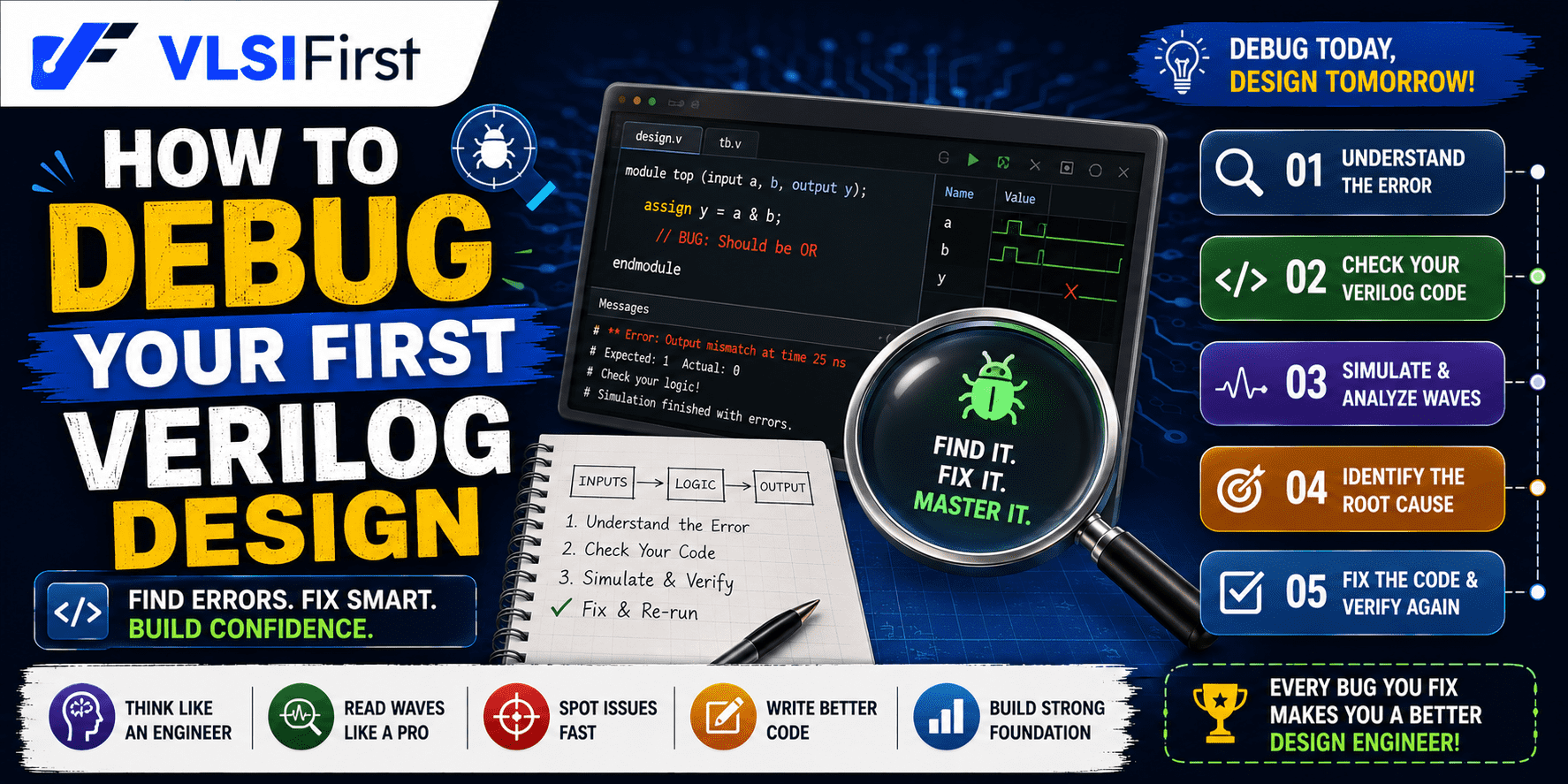
How to Debug Your First Verilog Design
Debugging your first Verilog design with practical RTL debug techniques, waveform analysis, testbench tips, FSM debugging, and common beginner mistakes. Read now!
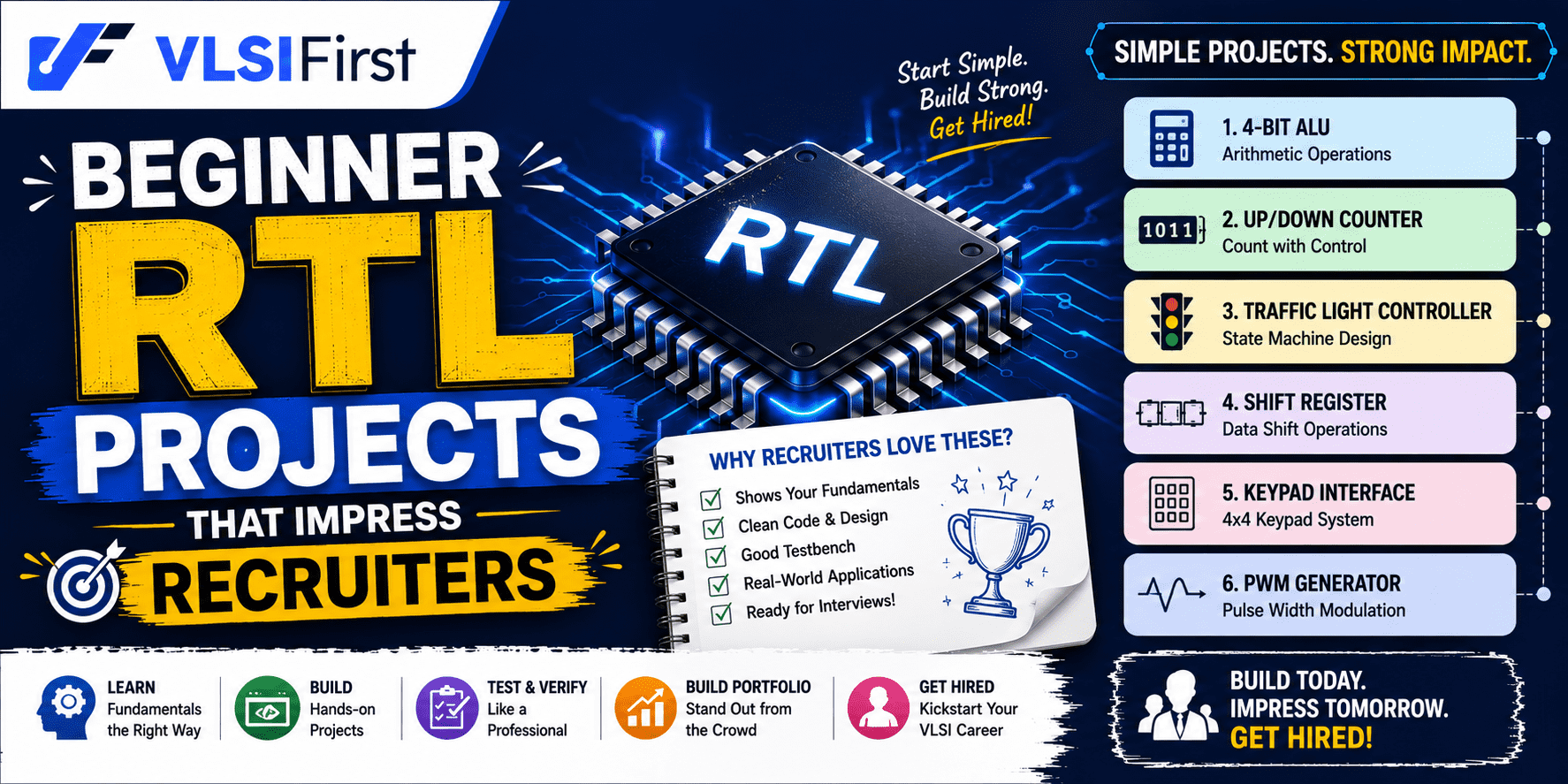
Beginner RTL Projects That Impress Recruiters
Discover beginner RTL projects that impress VLSI recruiters. Learn which Verilog projects build practical skills, strengthen your portfolio, and improve interview success.


Hours
2-98/1, Gurram Guda Road, Gurram Guda, Hyderabad, Rangareddy, Telangana, 501510
Copyright 2025 © VLSI Technologies Private Limited
Designed and developed by KandraDigitalCopyright 2025 © VLSI Technologies Private Limited
Designed, Developed & Marketing by KandraDigital