
The journey into VLSI is exciting, but it can also be emotionally challenging.
Many students begin their VLSI learning journey with enthusiasm. They enroll in training programs, start learning Verilog, explore Physical Design or Verification, and dream about building a successful semiconductor career.
However, after a few weeks or months, something unexpected starts happening.
They begin comparing themselves with others.
Suddenly, questions start appearing in their minds:
- "Why is my friend understanding SystemVerilog faster than me?"
- "Why did someone else get an internship before I did?"
- "Everyone on LinkedIn seems to be getting placed."
- "I'm still struggling with timing analysis while others are working on projects."
- "Maybe I'm not good enough for VLSI."
This feeling is known as comparison anxiety, and it affects far more students than most people realize.
The good news is that comparison anxiety is not a sign of weakness. It is a natural response that can be managed effectively. More importantly, overcoming it can help you stay focused, confident, and productive throughout your VLSI learning journey.
What Is Comparison Anxiety?
Comparison anxiety occurs when you constantly measure your progress against the achievements of others.
Instead of focusing on your own learning journey, your attention shifts toward:
- Other students' skills
- Placement results
- Certifications
- Project portfolios
- Social media updates
- Training progress
The problem is not comparison itself.
The problem arises when comparison starts affecting:
- Confidence
- Motivation
- Learning consistency
- Self-belief
- Career decisions
Many capable students leave VLSI training not because they lack potential, but because they become convinced that everyone else is doing better.
Why Comparison Anxiety Is Common in VLSI
VLSI is a highly technical field.
Students often learn complex topics such as:
- Digital Electronics
- Verilog HDL
- SystemVerilog
- Static Timing Analysis
- Physical Design
- DFT
- FPGA Design
- Verification Methodologies
Since these concepts require time to master, progress is rarely linear.
Some students may excel in coding.
Others may understand digital design faster.
Some may have prior project experience.
Others may have stronger academic backgrounds.
As a result, comparing your journey with someone else's often creates an inaccurate picture.
The Hidden Problem with Social Media
Platforms like LinkedIn can unintentionally amplify comparison anxiety.
You may see posts such as:
- "Placed in a top semiconductor company."
- "Completed an advanced VLSI project."
- "Received multiple job offers."
- "Started my VLSI career."
What you rarely see are:
- Failed interviews
- Months of confusion
- Project mistakes
- Learning struggles
- Career uncertainty
Social media often shows highlights rather than the complete journey.
Comparing your daily reality to someone else's success highlight is rarely fair.
Every VLSI Learner Starts from a Different Point
Imagine three students:
Student A
- Strong Digital Electronics fundamentals
- Good academic background
- Prior coding exposure
Student B
- Average academic performance
- No programming knowledge
- Limited practical experience
Student C
- Career gap of two years
- Transitioning from another domain
- Starting VLSI from scratch
If all three begin training together, their learning speeds will naturally differ.
This does not mean one is destined for success while others are not.
It simply means their starting points are different.
Why Learning Speed Is Overrated
Many students believe that understanding concepts quickly guarantees success.
In reality, semiconductor companies care about:
- Problem-solving ability
- Practical skills
- Conceptual clarity
- Debugging capability
- Project experience
A student who learns slowly but develops strong understanding often performs better in interviews than someone who rushes through concepts.
Comparison Creates Unnecessary Pressure
When students constantly compare themselves with others, they often:
- Rush through concepts
- Skip fundamentals
- Avoid asking questions
- Fear making mistakes
- Lose confidence
Ironically, this pressure slows down learning instead of improving it.
VLSI requires deep understanding.
Trying to match someone else's pace can weaken your own foundation.
Focus on Progress, Not Position
One of the healthiest mindset shifts is changing your focus from:
"Am I ahead of others?"
to
"Am I improving compared to last month?"
For example:
- Do you understand Verilog better than before?
- Can you solve more problems now?
- Have you completed additional projects?
- Are your fundamentals stronger?
These are meaningful indicators of growth.
Build Your Own Learning Timeline
Students often assume there is a fixed timeline for success.
In reality, successful engineers follow very different paths.
- Some get placed during college.
- Some enter VLSI after graduation.
- Some transition after working in IT.
- Some join the industry after career gaps.
The important thing is not whether your timeline matches someone else's.
The important thing is whether you continue moving forward.
Stop Treating Every Achievement as a Competition
When a classmate gets placed, many students feel discouraged.
Instead, view such achievements differently.
Their success demonstrates that opportunities exist.
A placement achieved by someone else is not an opportunity taken away from you.
The semiconductor industry continues to grow across areas such as:
- AI hardware
- Automotive electronics
- Data center processors
- Advanced semiconductor design
- Edge computing devices
The market is large enough for multiple success stories.
Develop Confidence Through Practical Work
Confidence grows through action.
Instead of spending hours comparing yourself to others:
- Write RTL code
- Build mini projects
- Simulate designs
- Analyze waveforms
- Practice timing concepts
- Solve debugging challenges
Practical experience creates evidence of progress, which naturally reduces anxiety.
Learn to Appreciate Small Wins
Students often celebrate only major achievements such as:
- Job offers
- Internships
- Certifications
However, smaller wins matter too.
Examples include:
- Understanding setup and hold timing
- Completing a Verilog project
- Fixing a simulation error
- Learning a new EDA tool
- Finishing a design module
These small victories accumulate over time and build long-term confidence.
Find Mentors, Not Competitors
One of the best ways to reduce comparison anxiety is to seek guidance rather than competition.
Experienced mentors can help you:
- Identify strengths
- Improve weak areas
- Create realistic learning plans
- Build confidence
Many successful engineers benefited from mentorship during their early careers.
Consistency Beats Comparison
The semiconductor industry rewards persistence.
Students who continue learning for months often outperform those who rely solely on talent or short bursts of motivation.
Success usually comes from:
- Daily practice
- Consistent revision
- Project work
- Continuous improvement
What Recruiters Actually Evaluate
A common misconception is that recruiters compare candidates the same way students compare themselves.
Recruiters generally focus on:
- Fundamentals
- Technical understanding
- Practical exposure
- Project experience
- Problem-solving skills
- Communication ability
They are not evaluating whether you learned faster than your classmates.
They are evaluating whether you can perform the job.
Final Thoughts
Comparison anxiety is one of the most common challenges faced by aspiring VLSI professionals.
The irony is that it often affects capable students the most.
Remember:
- Someone else's progress does not reduce your potential.
- Someone else's placement does not eliminate your opportunity.
- Someone else's learning speed does not determine your future.
The VLSI industry rewards engineers who continue learning, building projects, improving their skills, and staying committed through challenges.
Instead of measuring your journey against everyone around you, focus on becoming slightly better than you were yesterday.
Over time, those small improvements compound into expertise.
And expertise, not comparison, is what ultimately builds a successful VLSI career.

How to Test Your RTL Before Simulation: A Practical Pre-Simulation Checklist for Beginners
Learn how to test your RTL before simulation with a practical pre-simulation checklist. Improve Verilog quality, reduce debugging time, and build industry-ready RTL skills.
From Logic Diagram to Verilog Code – Complete Workflow
Learn the complete workflow from logic diagram to Verilog code, including specifications, RTL architec ture, coding, simulation, debugging, verification, and documentation.
Common Mistakes While Writing Verilog Code
Learn the most common Verilog coding mistakes beginners make and how to avoid them. Improve RTL coding, simulation, debugging, verification, and interview readiness.
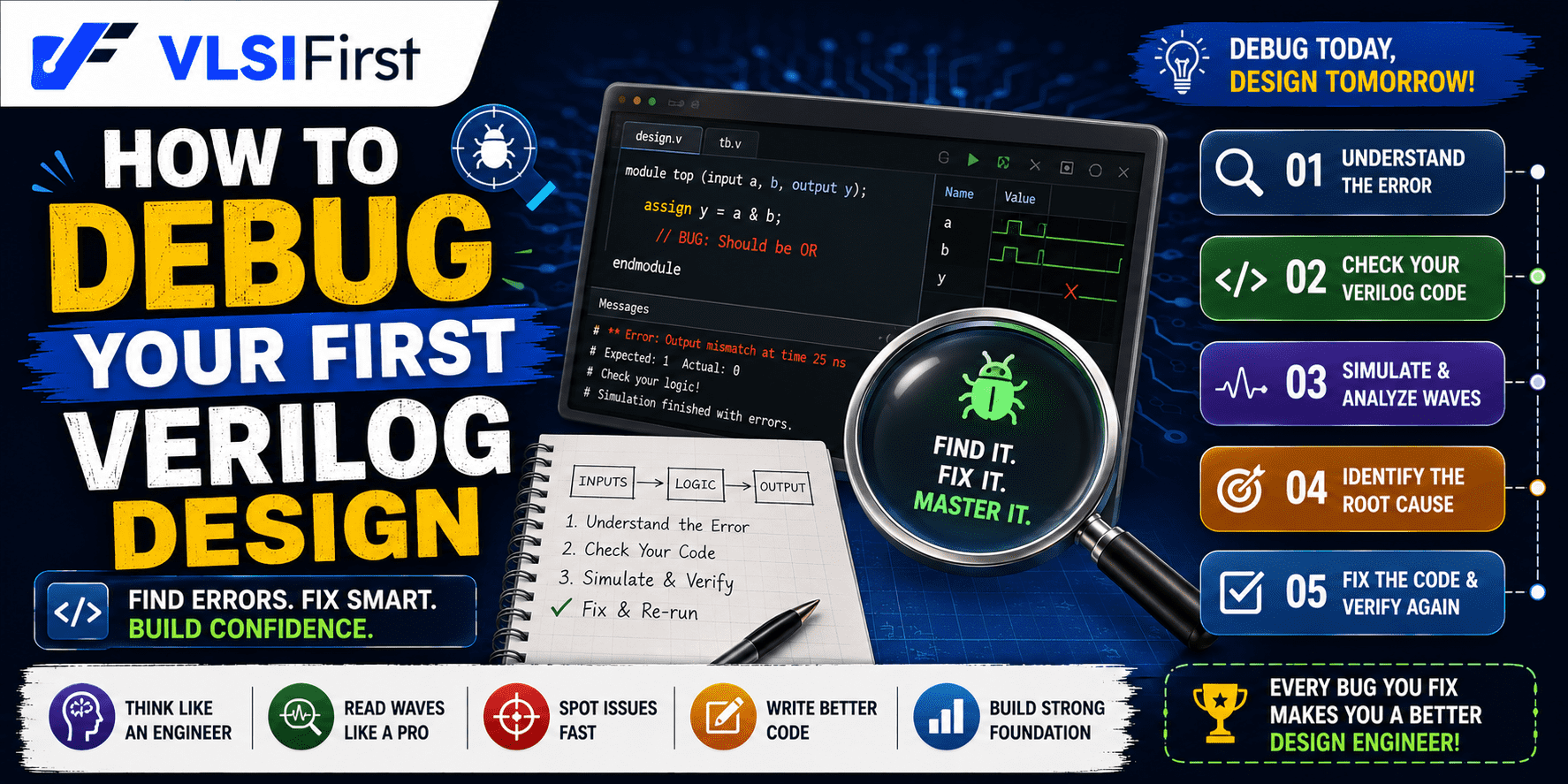
How to Debug Your First Verilog Design
Debugging your first Verilog design with practical RTL debug techniques, waveform analysis, testbench tips, FSM debugging, and common beginner mistakes. Read now!
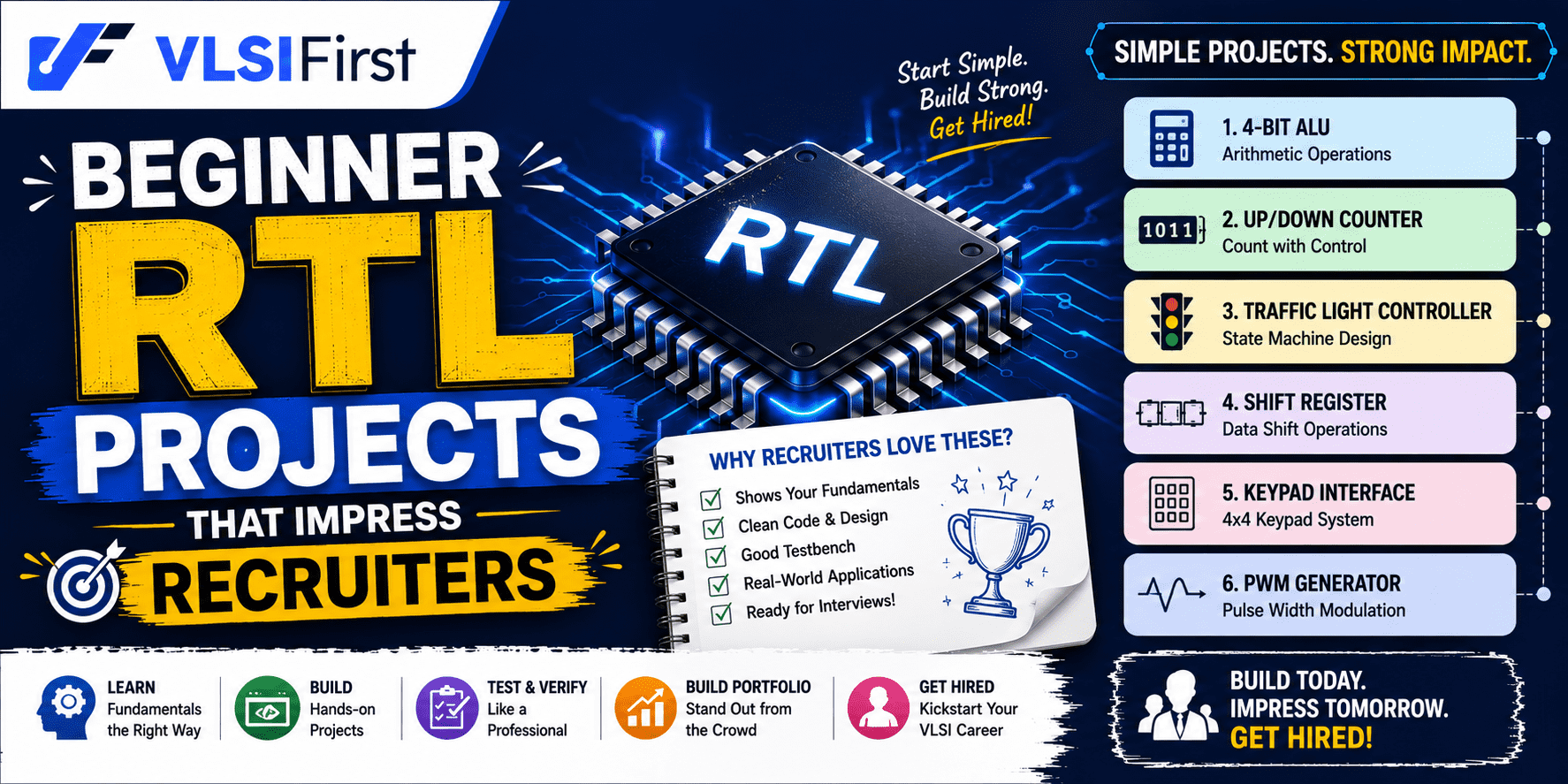
Beginner RTL Projects That Impress Recruiters
Discover beginner RTL projects that impress VLSI recruiters. Learn which Verilog projects build practical skills, strengthen your portfolio, and improve interview success.


Hours
2-98/1, Gurram Guda Road, Gurram Guda, Hyderabad, Rangareddy, Telangana, 501510
Copyright 2025 © VLSI Technologies Private Limited
Designed and developed by KandraDigitalCopyright 2025 © VLSI Technologies Private Limited
Designed, Developed & Marketing by KandraDigital