
One of the biggest challenges students face while entering the VLSI industry is not Verilog, SystemVerilog, Physical Design, STA, or Verification.
It is fear.
Fear of not understanding concepts.
Fear of failing interviews.
Fear of competing with students from top colleges.
Fear of investing time and money in VLSI training.
Fear of not getting placed.
Fear of making the wrong career decision.
If you have ever thought:
- "What if VLSI is too difficult for me?"
- "What if I don't get a job after training?"
- "What if others are smarter than me?"
- "What if I fail interviews repeatedly?"
- "What if I cannot understand RTL Design or Verification?"
You are not alone.
In fact, almost every successful VLSI engineer has experienced similar doubts at some stage.
The difference is that they learned how to move forward despite those fears.
The reality is that fear of failure is one of the most common reasons students delay learning, postpone career decisions, and miss valuable opportunities.
This article will help you understand why these fears occur, how they affect your progress, and practical ways to overcome them so that you can build confidence and move forward in your VLSI career.
Why Fear of Failure Is Common in VLSI
VLSI is often viewed as one of the most challenging engineering domains.
Students hear terms like:
- RTL Design
- Functional Verification
- UVM
- STA
- Physical Design
- DFT
- Timing Closure
- Low Power Design
For someone starting from scratch, these topics can feel overwhelming.
Additionally, students frequently see:
- Job descriptions with long skill lists
- Engineers discussing complex chip designs
- Placement success stories from experienced candidates
This creates the impression that everyone else is already ahead.
As a result, many students begin doubting themselves before they even start learning.
The Hidden Cost of Fear
Fear itself is not the problem.
The real problem is what fear makes people do.
Many students:
- Delay joining training programs
- Avoid applying for jobs
- Stop working on projects
- Give up after one failed interview
- Compare themselves constantly with others
Ironically, these actions often create the very outcome they fear.
The students who progress are not necessarily fearless.
They simply refuse to let fear control their decisions.
Understanding the Reality of Failure in VLSI
Many students assume that successful engineers never failed.
The reality is very different.
Most experienced professionals have:
- Failed interviews
- Struggled with debugging
- Made design mistakes
- Missed timing closure targets
- Faced project challenges
- Spent hours solving seemingly impossible issues
Failure is not an exception in semiconductor engineering.
It is part of the learning process.
The semiconductor industry itself is built around identifying and correcting failures before chips reach production.
Learning to handle setbacks is actually an essential engineering skill.
Fear #1: "I Am Not Good at Programming"
Many students worry because they are not strong programmers.
This fear is especially common among ECE and EEE graduates.
The good news is that not every VLSI role requires advanced software development skills.
For example:
- Physical Design focuses more on implementation concepts.
- STA emphasizes timing analysis.
- DFT focuses on testability and fault coverage.
- Verification requires coding but can be learned progressively.
Most successful VLSI professionals started with basic coding knowledge and improved over time.
Fear #2: "I Am From a Tier-3 College"
Many students believe that only graduates from prestigious institutions can succeed in VLSI.
This belief is increasingly outdated.
Today, companies evaluate candidates based on:
- Technical skills
- Project experience
- Problem-solving ability
- Learning mindset
- Interview performance
Students from lesser-known colleges regularly secure positions in semiconductor companies when they build the right skills.
Fear #3: "The Competition Is Too High"
Yes, competition exists.
But competition exists in every worthwhile career.
The important question is:
Are you competing with everyone?
Not really.
Most students never develop industry-ready skills.
Many stop learning midway.
Some rely only on theory.
Others avoid projects entirely.
Students who consistently improve their skills place themselves in a much smaller and more competitive group.
Fear #4: "What If I Fail Interviews?"
Interview failures are common.
One failed interview does not define your career.
In fact, interviews often provide valuable feedback.
Each interview helps you understand:
- Knowledge gaps
- Weak concepts
- Communication issues
- Technical expectations
Many engineers who eventually received excellent offers faced multiple rejections first.
The key is learning from each experience.
Fear #5: "VLSI Looks Too Difficult"
This may be the most common fear.
Students see advanced topics and assume they must master everything immediately.
But VLSI learning happens step by step.
Nobody starts by understanding complete SoC architectures.
Engineers gradually learn:
- Digital Electronics
- Verilog
- Timing Concepts
- Verification
- Design Flows
- Debugging Techniques
Every expert was once a beginner.
How to Build Confidence in VLSI
Fear decreases when competence increases.
The more you learn and practice, the more confident you become.
Here are practical ways to build confidence.
1. Focus on Small Wins
Do not aim to master VLSI in a month.
Instead:
- Complete one Verilog project.
- Learn one timing concept.
- Solve one debugging challenge.
- Finish one module.
Small achievements create momentum.
Over time, confidence grows naturally.
2. Stop Comparing Your Beginning to Someone Else's Middle
One of the fastest ways to destroy confidence is comparison.
Students often compare themselves with:
- Senior engineers
- Top performers
- Experienced professionals
Remember:
You are seeing years of their effort, not their starting point.
Focus on your own progress.
3. Build Projects
Projects transform theoretical knowledge into practical understanding.
They also provide evidence of your abilities.
Even simple projects can dramatically improve confidence because they demonstrate what you can actually build.
4. Learn Through Practical Exposure
Many fears disappear when students work with actual tools and design flows.
Practical learning helps students understand that complex concepts become manageable through structured practice.
5. Develop Problem-Solving Skills
Confidence does not come from knowing every answer.
It comes from knowing how to find solutions.
Strong problem-solving skills help engineers approach challenges with a constructive mindset.
6. Accept That Mistakes Are Part of Engineering
Debugging exists because mistakes happen.
Verification exists because bugs occur.
Timing analysis exists because designs have issues.
The entire semiconductor industry is built around identifying and correcting errors.
Making mistakes does not mean you are failing.
It means you are learning.
7. Build a Long-Term Perspective
Students often worry excessively about immediate outcomes.
Instead of asking:
"Will I get a job next month?"
Ask:
"Will the skills I learn today help me build a strong career over the next 10 years?"
This shift in perspective reduces pressure and improves decision-making.
Why Confidence Matters More Than Perfection
Many students believe they must become perfect before applying for jobs.
This is a mistake.
Employers do not expect freshers to know everything.
They expect:
- Strong fundamentals
- Willingness to learn
- Problem-solving ability
- Positive attitude
- Growth potential
Confidence helps students demonstrate these qualities effectively.
The Truth About Successful VLSI Engineers
Successful engineers are not people who never experience fear.
They are people who:
- Learn despite uncertainty
- Apply despite self-doubt
- Continue despite rejection
- Improve despite setbacks
Their confidence comes from action, not from waiting for fear to disappear.
Final Thoughts
Fear of failure is normal.
Almost every student entering VLSI experiences uncertainty at some point.
However, fear should not become a reason to delay learning, avoid opportunities, or underestimate your potential.
The semiconductor industry rewards:
- Consistency
- Curiosity
- Problem-solving
- Persistence
- Continuous learning
Not perfection.
If you focus on building skills one step at a time, your confidence will naturally increase.
Remember, the students who eventually succeed in VLSI are not always the smartest or the most experienced.
Very often, they are simply the ones who kept moving forward despite their fears.
And that is the mindset that transforms beginners into successful VLSI professionals.

How to Test Your RTL Before Simulation: A Practical Pre-Simulation Checklist for Beginners
Learn how to test your RTL before simulation with a practical pre-simulation checklist. Improve Verilog quality, reduce debugging time, and build industry-ready RTL skills.
From Logic Diagram to Verilog Code – Complete Workflow
Learn the complete workflow from logic diagram to Verilog code, including specifications, RTL architec ture, coding, simulation, debugging, verification, and documentation.
Common Mistakes While Writing Verilog Code
Learn the most common Verilog coding mistakes beginners make and how to avoid them. Improve RTL coding, simulation, debugging, verification, and interview readiness.
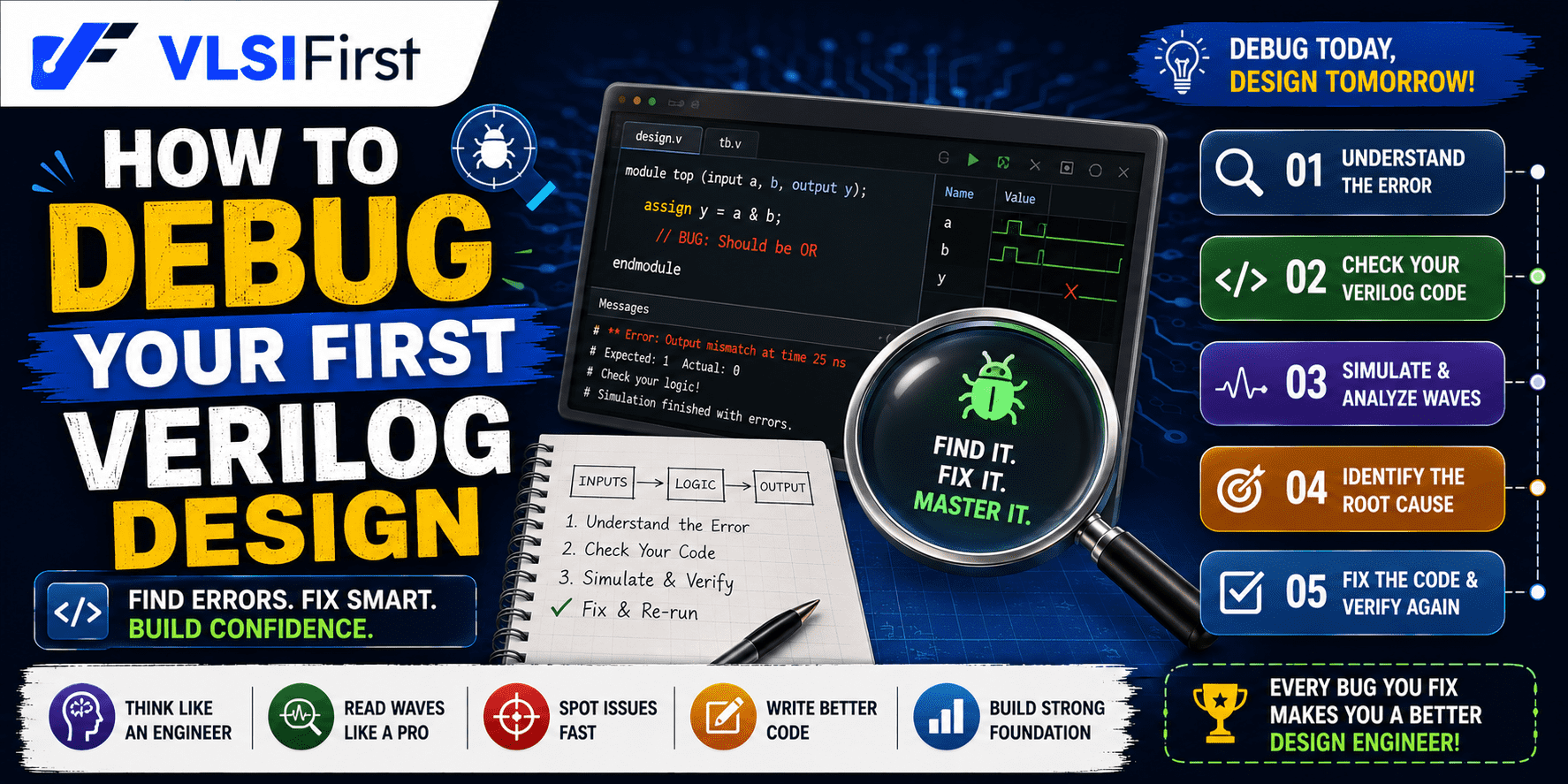
How to Debug Your First Verilog Design
Debugging your first Verilog design with practical RTL debug techniques, waveform analysis, testbench tips, FSM debugging, and common beginner mistakes. Read now!
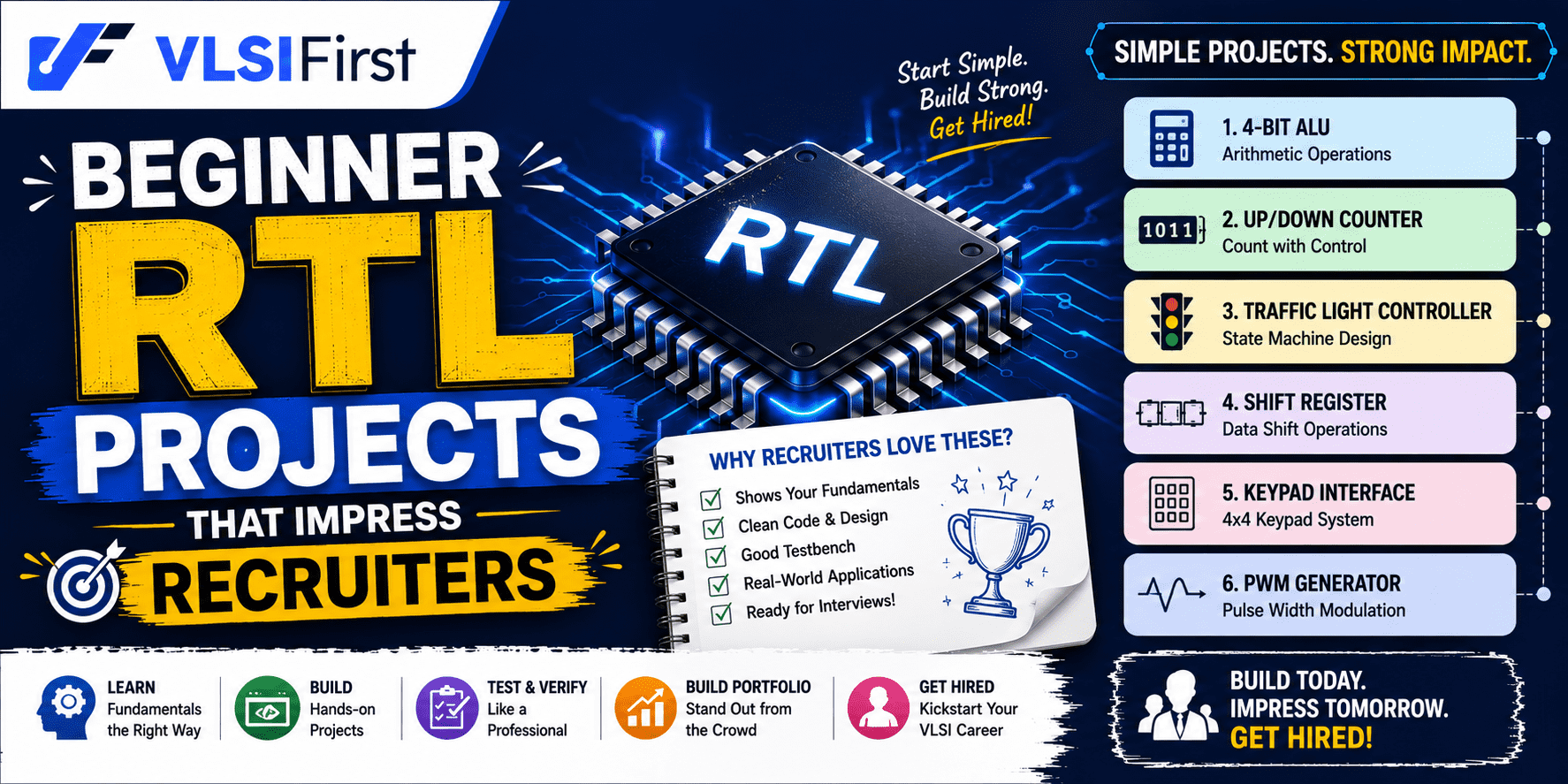
Beginner RTL Projects That Impress Recruiters
Discover beginner RTL projects that impress VLSI recruiters. Learn which Verilog projects build practical skills, strengthen your portfolio, and improve interview success.


Hours
2-98/1, Gurram Guda Road, Gurram Guda, Hyderabad, Rangareddy, Telangana, 501510
Copyright 2025 © VLSI Technologies Private Limited
Designed and developed by KandraDigitalCopyright 2025 © VLSI Technologies Private Limited
Designed, Developed & Marketing by KandraDigital