
VLSI is one of the most exciting engineering fields today, but it is also one of the most intellectually demanding.
At some point during learning, almost every student faces moments like these:
- “I don’t understand this timing analysis concept.”
- “Everyone else seems to be learning faster than me.”
- “Maybe I’m not smart enough for VLSI.”
- “RTL design feels too complicated.”
- “What if I never become job-ready?”
This feeling is called self-doubt.
And the truth is:
Self-doubt is extremely common in VLSI learning.
The problem is not that students experience doubt. The problem is when that doubt becomes so strong that it stops them from learning, practicing, and moving forward.
This article explains:
- why self-doubt happens while learning VLSI
- why it is normal
- how it affects progress
- practical ways to overcome it and build confidence
Why VLSI Learning Feels Intimidating
VLSI combines multiple difficult areas at once:
- Digital Electronics
- Verilog/SystemVerilog
- Timing Analysis
- Functional Verification
- Physical Design
- DFT
- Scripting
- Semiconductor Fundamentals
Unlike many college subjects, VLSI concepts are highly interconnected.
For example:
- RTL design affects timing.
- Timing affects physical design.
- Verification affects design quality.
- Clocking impacts almost everything.
This interconnected nature makes beginners feel overwhelmed.
Students often compare themselves with seniors or experienced engineers who already understand these topics deeply, forgetting that those professionals also started as beginners.
The Biggest Mistake Students Make
One major mistake is expecting instant understanding.
Many students believe:
“If I don’t understand a concept immediately, I’m not good at VLSI.”
That is simply not true.
Complex engineering concepts often require:
- repetition
- practical exposure
- debugging experience
- time for concepts to connect
Even experienced VLSI engineers revisit concepts multiple times throughout their careers.
Why Self-Doubt Can Become Dangerous
Self-doubt itself is not harmful.
It becomes harmful when it leads to:
- avoiding practice
- quitting projects midway
- comparing constantly with others
- fearing interviews
- delaying learning
- giving up after small failures
This creates a cycle:
- Complex topic → self-doubt
- Less practice → weaker understanding
- Weaker understanding → more self-doubt
Breaking this cycle is essential for growth.
1. Understand That Struggle Is Part of VLSI Learning
VLSI is not designed to be easy.
It involves real engineering problems such as:
- timing violations
- clock domain issues
- power optimization
- verification bugs
- routing congestion
- timing closure challenges
If you find these topics difficult, it does not mean you are failing.
It means you are learning engineering.
In fact, struggling with concepts is often a sign that your brain is actively building deeper understanding.
2. Stop Comparing Your Beginning to Someone Else’s Experience
This is one of the fastest ways to damage confidence.
You may compare yourself with:
- friends who already know coding
- seniors who completed internships
- experienced engineers on LinkedIn
- students who answer quickly in class
But you are comparing:
- Your beginning
- Their middle or advanced stage
You do not see the months or years they spent learning, struggling, and improving.
Focus on your own progress instead.
3. Break Complex Concepts into Smaller Pieces
A common reason students feel overwhelmed is that they try to understand everything at once.
For example, instead of trying to master “Static Timing Analysis” completely in one sitting, break it down into:
- What is setup time?
- What is hold time?
- What causes violations?
- How does clock skew affect timing?
- How is timing fixed?
Small, manageable steps reduce mental pressure and improve retention.
4. Learn Through Practical Application
Theory alone often increases self-doubt because concepts feel abstract.
Practical work changes that.
When students:
- write RTL code
- simulate waveforms
- debug timing issues
- use EDA tools
- build small projects
concepts become more concrete and understandable.
Hands-on learning is one of the best confidence builders in VLSI.
5. Accept That Debugging Is Supposed to Be Difficult
Many students feel discouraged when their code or design does not work immediately.
But debugging is not a sign of failure.
Debugging is a core part of semiconductor engineering.
Professional engineers spend significant time:
- analyzing waveforms
- finding root causes
- fixing bugs
- optimizing designs
The goal is not to avoid mistakes.
The goal is to become better at solving them.
6. Build Confidence Through Small Wins
Confidence does not appear suddenly.
It grows through repeated small achievements.
Examples include:
- successfully writing a Verilog module
- fixing a simulation error
- understanding a timing concept
- completing a mini project
- explaining a topic clearly to someone else
Celebrate these small wins.
They create momentum and gradually reduce self-doubt.
7. Develop a Consistent Learning Routine
Irregular learning often increases anxiety.
Students who study intensely for a few days and then stop for weeks usually feel disconnected and overwhelmed.
A consistent routine works better:
- daily or regular practice
- scheduled revision
- continuous project work
- steady skill improvement
Consistency builds familiarity, and familiarity builds confidence.
8. Ask Questions Without Fear
Many students stay silent because they think their questions are “basic.”
But asking questions is one of the fastest ways to learn.
Even experienced engineers ask questions regularly because semiconductor technology is constantly evolving.
Remember:
- clarity is more important than pretending to understand
- most students around you may have similar doubts
- trainers and mentors expect beginners to ask questions
9. Build a Supportive Learning Environment
Learning difficult concepts becomes easier when you surround yourself with:
- motivated peers
- helpful mentors
- structured training
- collaborative discussions
Avoid environments that increase negativity, constant comparison, or fear.
A supportive community can significantly improve confidence and persistence.
10. Remember That Job Readiness Takes Time
Many students panic because they expect to become industry-ready too quickly.
VLSI is a deep engineering field.
Becoming job-ready usually requires:
- months of structured learning
- practical exposure
- project work
- interview preparation
- continuous improvement
Progress is gradual, not instant.
11. Reframe Failure as Feedback
Interview rejection, project bugs, or difficult assignments do not mean you are incapable.
They provide information about:
- what needs improvement
- which concepts need revision
- what skills require more practice
Engineers grow by iterating and improving.
This mindset transforms setbacks into learning opportunities.
12. Focus on Long-Term Growth, Not Immediate Perfection
Perfectionism often creates unnecessary stress.
Instead of asking:
“Do I understand everything perfectly?”
Ask:
“Am I understanding more than I did last month?”
Long-term growth matters far more than temporary confusion.
Final Thoughts
Self-doubt while learning complex VLSI concepts is completely normal.
It does not mean you are not capable.
It does not mean you chose the wrong field.
It simply means you are learning something challenging and valuable.
The students who succeed in VLSI are not the ones who never feel doubt.
They are the ones who:
- keep practicing despite confusion
- ask questions
- build projects
- learn from mistakes
- stay consistent over time
VLSI is a field that rewards persistence, curiosity, and continuous learning.
Confidence does not come before action.
It comes from repeated effort, small wins, and the realization that every expert engineer once struggled with the same concepts you are learning today.

How to Test Your RTL Before Simulation: A Practical Pre-Simulation Checklist for Beginners
Learn how to test your RTL before simulation with a practical pre-simulation checklist. Improve Verilog quality, reduce debugging time, and build industry-ready RTL skills.
From Logic Diagram to Verilog Code – Complete Workflow
Learn the complete workflow from logic diagram to Verilog code, including specifications, RTL architec ture, coding, simulation, debugging, verification, and documentation.
Common Mistakes While Writing Verilog Code
Learn the most common Verilog coding mistakes beginners make and how to avoid them. Improve RTL coding, simulation, debugging, verification, and interview readiness.
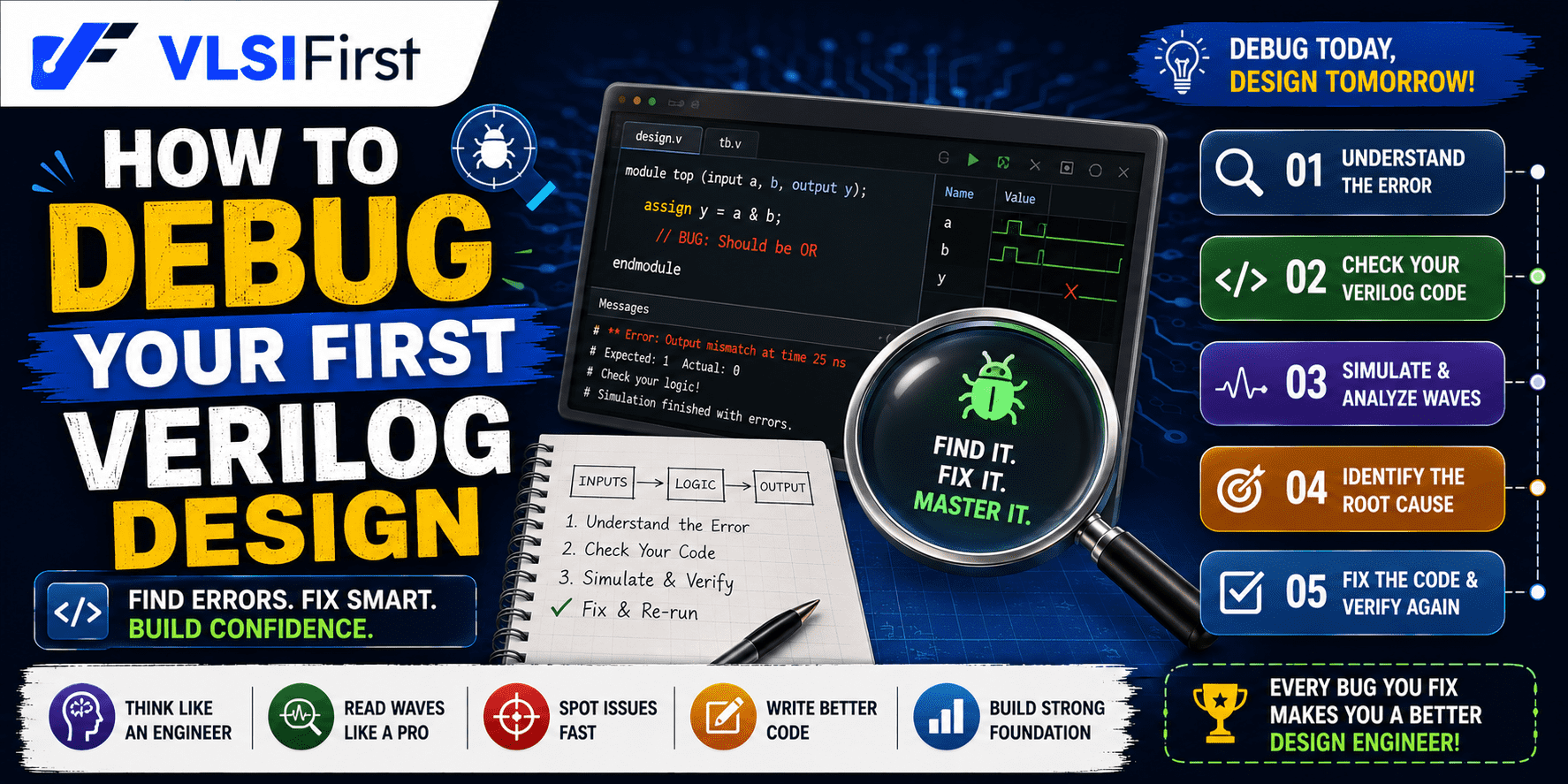
How to Debug Your First Verilog Design
Debugging your first Verilog design with practical RTL debug techniques, waveform analysis, testbench tips, FSM debugging, and common beginner mistakes. Read now!
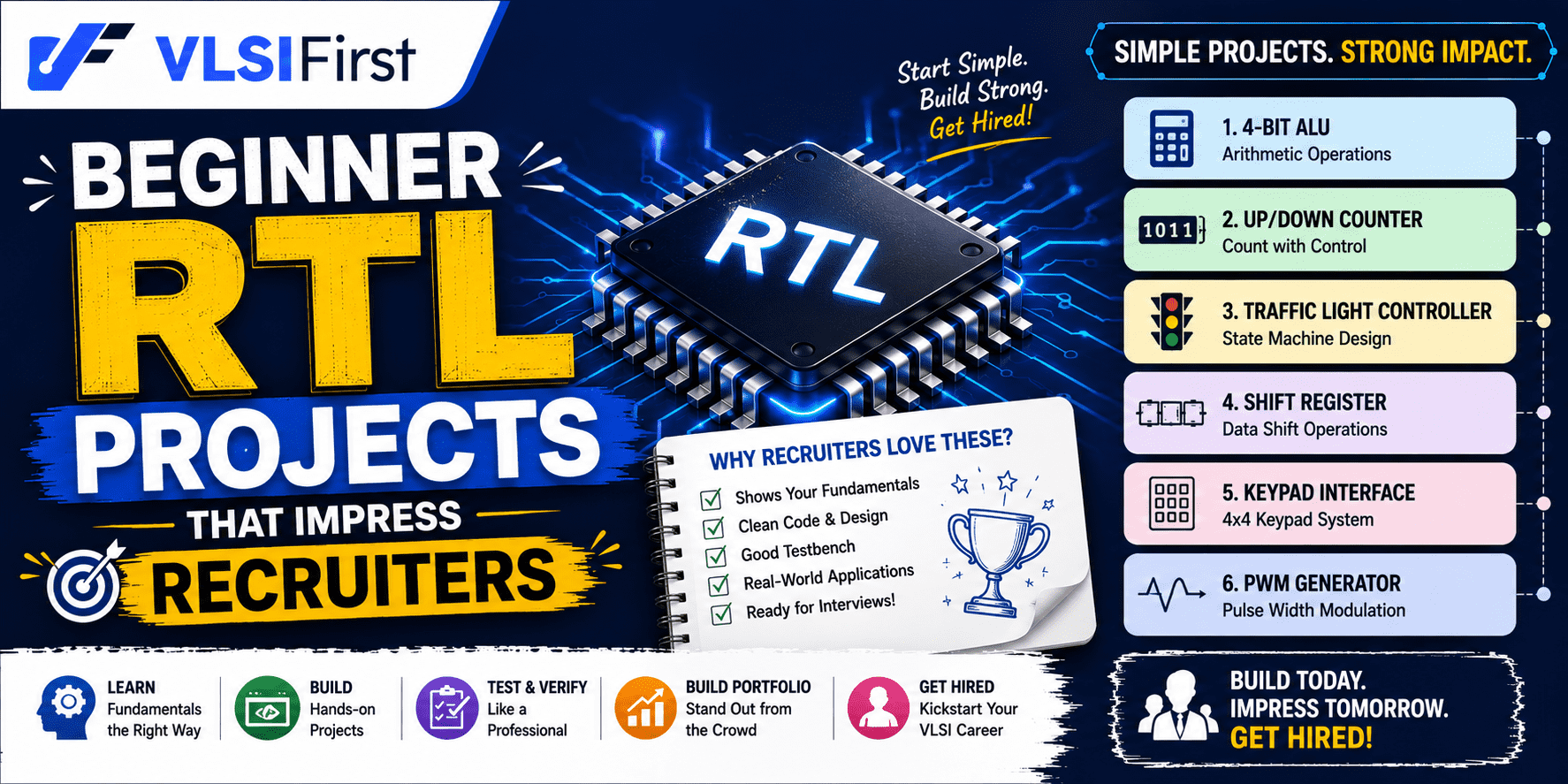
Beginner RTL Projects That Impress Recruiters
Discover beginner RTL projects that impress VLSI recruiters. Learn which Verilog projects build practical skills, strengthen your portfolio, and improve interview success.


Hours
2-98/1, Gurram Guda Road, Gurram Guda, Hyderabad, Rangareddy, Telangana, 501510
Copyright 2025 © VLSI Technologies Private Limited
Designed and developed by KandraDigitalCopyright 2025 © VLSI Technologies Private Limited
Designed, Developed & Marketing by KandraDigital