
The VLSI industry offers exciting career opportunities, attractive salary growth, and the chance to work on technologies that power everything from smartphones and AI systems to automotive electronics and data centers. However, one reality that many students discover after entering the field is that becoming job-ready in VLSI is not a short-term process.
Unlike learning a single software tool or completing a quick certification, VLSI requires mastering multiple interconnected concepts such as Digital Electronics, Verilog, SystemVerilog, Static Timing Analysis, Physical Design, Verification, DFT, scripting, and semiconductor fundamentals. This journey can take several months and sometimes more than a year, depending on a student's background and learning pace.
As a result, the biggest challenge for many aspiring VLSI professionals is not intelligence or capability; it's consistency.
Many students start with enthusiasm but gradually lose momentum due to difficult concepts, interview rejections, distractions, academic commitments, or uncertainty about career outcomes.
The good news is that consistency is a skill that can be developed. In fact, most successful VLSI engineers are not necessarily the smartest learners; they are often the ones who stayed committed long enough to build expertise.
In this article, we'll explore practical strategies to remain consistent throughout your VLSI learning journey and increase your chances of achieving long-term success.
Why Consistency Matters More Than Speed in VLSI
Many beginners assume that learning quickly is the key to success.
In reality, semiconductor engineering rewards depth of understanding rather than speed.
A student who studies VLSI concepts for one hour every day over six months often develops stronger skills than someone who studies intensely for a few weekends and then stops practicing.
This happens because VLSI concepts build upon each other.
For example:
- Digital logic supports RTL design.
- RTL design supports verification.
- Timing analysis depends on design understanding.
- Physical Design relies on timing and implementation knowledge.
When learning is inconsistent, gaps begin to form, making advanced topics harder to understand.
Understand That VLSI Is a Marathon, Not a Sprint
One of the biggest reasons students lose motivation is unrealistic expectations.
Some learners expect:
- Immediate mastery of Verilog
- Quick understanding of STA
- Instant placement opportunities
- Fast interview success
When these expectations are not met, frustration sets in.
The reality is that VLSI careers are built gradually.
Even experienced engineers continuously learn new methodologies, tools, and technologies throughout their careers.
Accepting that VLSI is a long-term journey reduces pressure and helps maintain focus.
Set Learning Goals Instead of Outcome Goals
Many students focus exclusively on outcomes such as:
- Getting a job
- Receiving interview calls
- Achieving a specific salary package
While these goals are important, they are often outside your direct control.
Instead, focus on process-based goals such as:
- Completing one Verilog module every week
- Practicing timing analysis problems regularly
- Revising digital electronics concepts daily
- Completing a project milestone each month
Process goals create a sense of progress and help maintain motivation even when external results take time.
Build a Realistic Study Schedule
One common mistake is creating an overly ambitious plan.
Students often decide:
- 6 hours daily after college
- 8 hours every weekend
- Completing an entire module in a few days
These schedules rarely remain sustainable.
A better approach is consistency over intensity.
For example:
- 1–2 focused hours daily
- Dedicated weekend project sessions
- Weekly revision plans
A realistic schedule is easier to maintain for months.
Divide Large Topics into Smaller Milestones
Topics like Physical Design or Functional Verification can appear overwhelming when viewed as a whole.
Instead of focusing on the entire subject, break it into manageable sections.
For example, Physical Design can be divided into:
- Floorplanning
- Placement
- Clock Tree Synthesis
- Routing
- Timing Closure
- Signoff
Completing small milestones regularly creates momentum and reduces feelings of being overwhelmed.
Track Progress Visually
Many students underestimate how much they have already learned.
Keeping track of progress can significantly improve motivation.
You can maintain:
- Learning journals
- Concept checklists
- Project completion trackers
- Weekly progress reports
When motivation drops, reviewing previous achievements reminds you how far you've come.
Focus on Practical Learning
Theory alone can become monotonous over time.
Practical implementation makes learning more engaging.
Examples include:
- Writing RTL code
- Simulating designs
- Building mini projects
- Running timing analysis exercises
- Debugging verification environments
Hands-on practice transforms abstract concepts into real engineering skills.
Accept That Difficult Concepts Are Normal
Every VLSI learner eventually encounters topics that feel difficult.
Examples include:
- Setup and hold timing
- Clock domain crossing
- UVM methodology
- Timing closure
- DFT architecture
Struggling with these topics does not mean you are incapable.
It simply means you are learning complex engineering concepts.
Students who stay consistent despite confusion often outperform those who quit after encountering challenges.
Build a Project Alongside Learning
Projects provide direction and purpose.
Instead of learning concepts in isolation, apply them to a practical implementation.
Examples include:
- Traffic light controller
- UART design
- FIFO implementation
- Memory controller design
- Verification testbench development
Projects help connect theory with real-world applications and keep learning interesting.
Find a Learning Community
Learning alone for extended periods can reduce motivation.
Joining a learning community offers:
- Accountability
- Peer support
- Doubt clarification
- Interview preparation assistance
- Knowledge sharing
Interacting with others facing similar challenges often helps maintain consistency.
Avoid Constant Comparison
Comparison is one of the fastest ways to lose motivation.
You may see peers who:
- Learn faster
- Complete projects sooner
- Receive interviews earlier
- Understand concepts more quickly
However, everyone has a different starting point and learning style.
Your focus should remain on personal growth rather than competing with others.
Prepare for Motivation Fluctuations
Motivation naturally rises and falls.
Students often assume that successful learners remain motivated all the time.
This is rarely true.
Successful learners continue working even when motivation decreases.
This is where discipline becomes more important than inspiration.
Create routines that keep you moving forward regardless of how motivated you feel on a particular day.
Develop Problem-Solving Habits
VLSI engineers spend much of their careers solving problems.
Building this habit early improves both learning and employability.
Practice:
- Debugging RTL errors
- Solving timing violations
- Analyzing waveforms
- Understanding design trade-offs
These activities develop engineering thinking and make learning more rewarding.
Celebrate Small Wins
Many students wait for major achievements before feeling satisfied.
Instead, recognize smaller accomplishments such as:
- Understanding a difficult topic
- Completing a project milestone
- Solving a debugging issue
- Finishing a training module
- Successfully answering interview questions
Small wins reinforce positive learning behavior.
Keep the Long-Term Vision in Mind
During difficult phases, remember why you started.
The semiconductor industry offers opportunities in areas such as:
- Chip Design
- Verification
- Physical Design
- DFT
- FPGA Development
- AI Hardware
- Automotive Electronics
The effort invested today can lead to a highly rewarding career in one of the world's most strategic industries.
Learn from Industry-Oriented Training Programs
Structured learning environments help students maintain consistency because they provide:
- Defined learning paths
- Mentor guidance
- Practical assignments
- Industry-relevant projects
- Interview preparation support
Final Thoughts
Consistency is one of the most underrated skills in VLSI learning.
The students who succeed are rarely those who learn everything quickly. More often, they are the ones who continue learning when concepts become difficult, interviews don't go as planned, or progress feels slow.
If you can:
- Study regularly
- Build practical skills
- Complete projects
- Revise fundamentals
- Stay patient through challenges
you will gradually develop the expertise needed for a successful semiconductor career.
Remember, VLSI is not about who learns the fastest.
It is about who keeps learning long enough to become truly capable.
Every hour of focused effort compounds over time. Stay consistent, trust the process, and keep moving forward. The results often arrive later than expected, but they are worth the wait.

How to Test Your RTL Before Simulation: A Practical Pre-Simulation Checklist for Beginners
Learn how to test your RTL before simulation with a practical pre-simulation checklist. Improve Verilog quality, reduce debugging time, and build industry-ready RTL skills.
From Logic Diagram to Verilog Code – Complete Workflow
Learn the complete workflow from logic diagram to Verilog code, including specifications, RTL architec ture, coding, simulation, debugging, verification, and documentation.
Common Mistakes While Writing Verilog Code
Learn the most common Verilog coding mistakes beginners make and how to avoid them. Improve RTL coding, simulation, debugging, verification, and interview readiness.
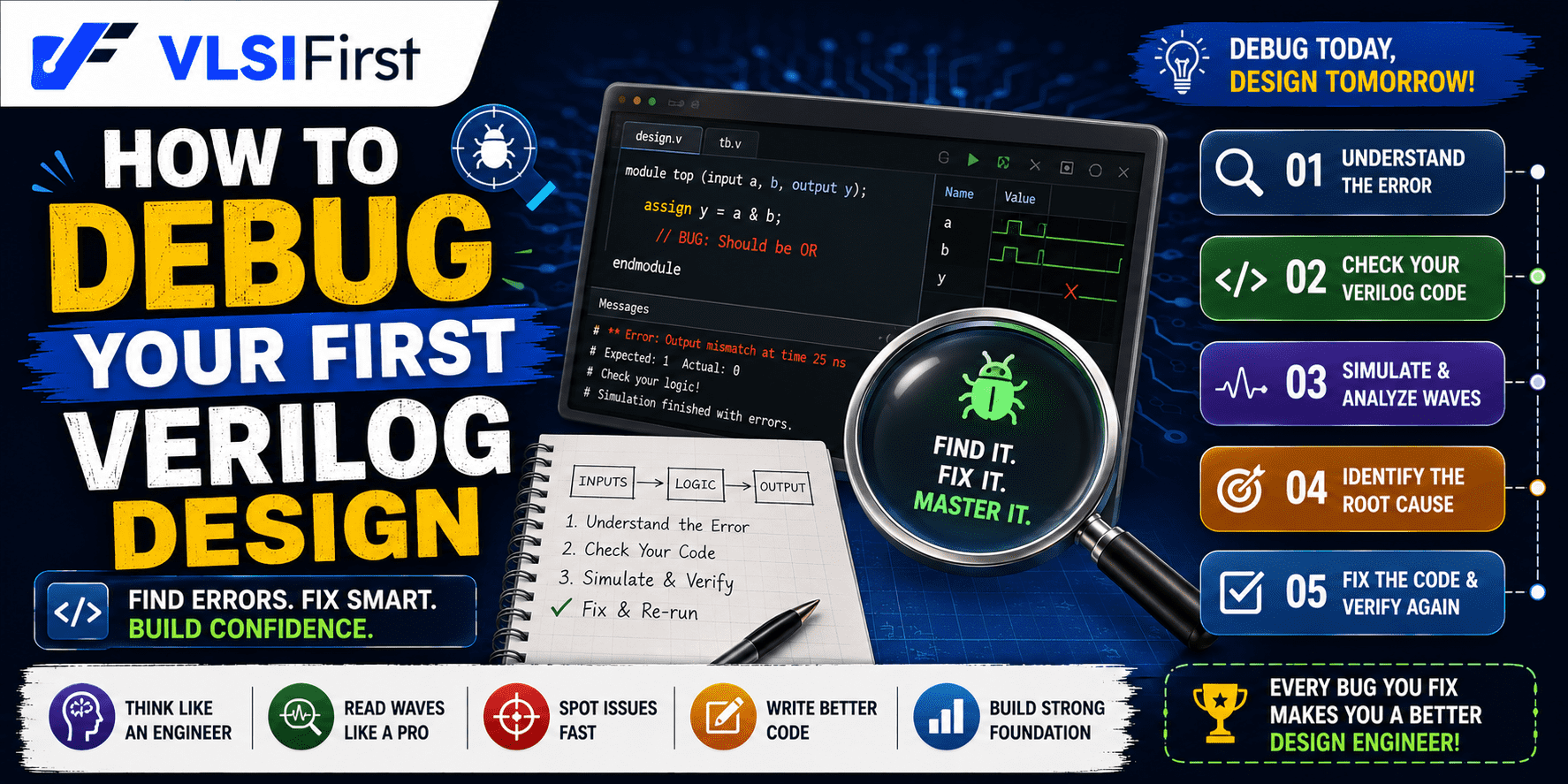
How to Debug Your First Verilog Design
Debugging your first Verilog design with practical RTL debug techniques, waveform analysis, testbench tips, FSM debugging, and common beginner mistakes. Read now!
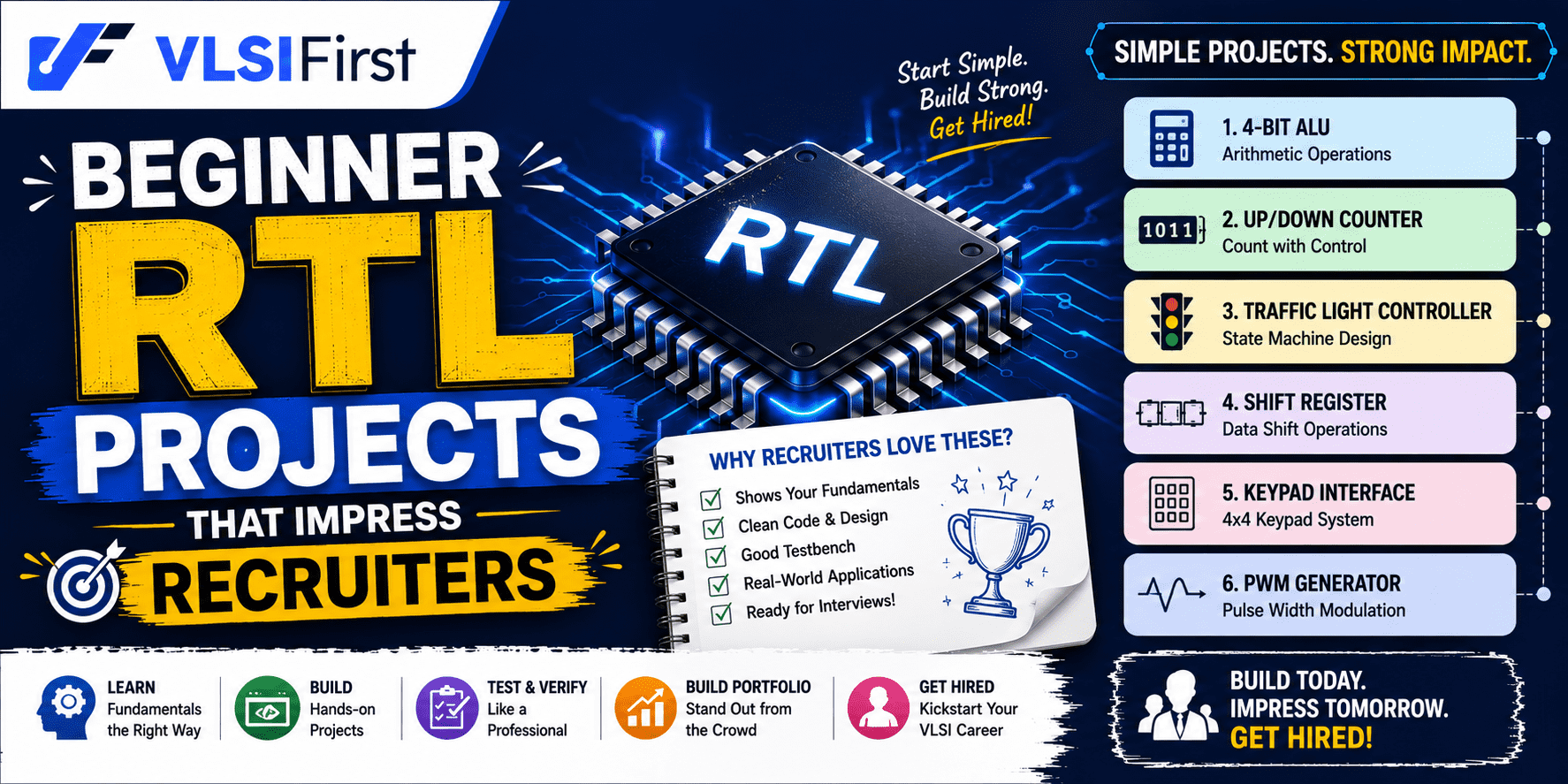
Beginner RTL Projects That Impress Recruiters
Discover beginner RTL projects that impress VLSI recruiters. Learn which Verilog projects build practical skills, strengthen your portfolio, and improve interview success.


Hours
2-98/1, Gurram Guda Road, Gurram Guda, Hyderabad, Rangareddy, Telangana, 501510
Copyright 2025 © VLSI Technologies Private Limited
Designed and developed by KandraDigitalCopyright 2025 © VLSI Technologies Private Limited
Designed, Developed & Marketing by KandraDigital