
The semiconductor industry is entering one of the biggest transitions in its history.
Artificial Intelligence is no longer limited to chatbots, software automation, or data analysis. AI is now becoming deeply integrated into semiconductor design workflows themselves.
Today, major semiconductor companies are using AI-assisted tools for:
- placement optimization
- timing prediction
- verification acceleration
- power analysis
- routing assistance
- bug detection
As these technologies become more advanced, many students and freshers are asking important questions:
- “Will AI reduce VLSI jobs?”
- “Are semiconductor roles changing?”
- “What skills will matter in the future?”
- “Should I still choose VLSI as a career?”
The answer is not as simple as “AI will replace engineers.”
In reality:
AI is transforming how VLSI engineers work, not eliminating the need for engineers altogether.
This blog explains:
- how AI-assisted chip design is changing semiconductor workflows
- how different VLSI roles are evolving
- what skills will become more valuable
- how students can prepare for the future semiconductor industry
Why AI Is Entering Chip Design
Modern chips are becoming incredibly complex.
Today’s semiconductor designs include:
- billions of transistors
- advanced-node constraints
- multi-core architectures
- AI accelerators
- massive verification requirements
Traditional engineering workflows are struggling to handle this growing complexity efficiently.
That is why semiconductor companies are increasingly adopting AI-assisted EDA solutions to improve:
- productivity
- optimization
- power efficiency
- design turnaround time
The rapid growth of AI workloads is also driving demand for more advanced semiconductor innovation globally.
What AI-Assisted Chip Design Actually Means
Many students misunderstand this concept.
AI-assisted chip design does NOT mean: “AI designs chips completely by itself.”
Instead, AI is being used to:
- assist engineering workflows
- automate repetitive tasks
- optimize design decisions
- improve analysis efficiency
Human engineers still remain central to:
- architecture decisions
- debugging
- validation
- design strategy
- trade-off analysis
EDA companies increasingly describe AI as a productivity enhancer for semiconductor teams rather than a full replacement for engineers.
The Biggest Change: Engineers Are Moving Toward Higher-Level Problem Solving
This is the most important shift happening today.
Previously, engineers spent significant time on:
- repetitive manual optimization
- trial-and-error tuning
- low-level workflow tasks
AI tools are gradually automating parts of these activities.
As a result, engineers are now expected to focus more on:
- Debugging
- architectural reasoning
- system-level optimization
- complex trade-offs
- validation strategies
This means the future VLSI engineer must think more like: a system problem solver rather than only a tool operator.
How Different VLSI Roles Are Changing
1. RTL Design Roles
RTL design is evolving rapidly with AI-assisted coding and optimization tools.
AI can now help:
- generate RTL suggestions
- identify syntax issues
- optimize portions of logic
- recommend coding improvements
But engineers are still required to:
- define architecture
- manage scalability
- handle corner cases
- optimize functionality
- validate correctness
Modern RTL design increasingly demands stronger architectural understanding instead of only syntax familiarity.
2. Verification Roles
Verification is one of the most heavily impacted areas by AI-assisted automation.
AI tools are now helping with:
- automated test generation
- coverage analysis
- bug prediction
- regression optimization
However, verification engineers still remain essential because:
- complex corner cases require human reasoning
- debugging requires engineering judgment
- protocol understanding remains critical
Verification complexity continues to grow as chips become more advanced.
This means verification engineers with strong debugging skills will remain highly valuable.
3. Physical Design Roles
AI-assisted placement and routing tools are becoming increasingly sophisticated.
AI can help optimize:
- congestion
- routing efficiency
- timing closure
- power distribution
But physical design engineers are still required for:
- floorplanning decisions
- constraint handling
- optimization trade-offs
- signoff analysis
- advanced-node debugging
At smaller technology nodes, physical implementation challenges remain extremely complex.
4. STA and Timing Analysis Roles
AI tools are improving timing prediction and analysis efficiency.
But timing engineers still need to:
- analyze critical paths
- debug violations
- optimize constraints
- understand timing behavior deeply
Timing closure remains one of the most difficult engineering challenges in advanced chip design.
5. DFT Roles
DFT is also evolving with AI-assisted automation.
However, engineers still handle:
- test architecture
- scan strategy
- fault analysis
- manufacturing yield optimization
As chips grow more complex, testing challenges are increasing rather than decreasing.
What Skills Will Become More Important?
AI is not reducing the need for skills.
It is changing WHICH skills matter most.
1. Problem-Solving Ability
Students who only memorize commands may struggle in the future.
Engineers who can:
- analyze issues
- debug failures
- optimize systems
will remain highly valuable.
2. Strong Fundamentals
AI tools still depend on engineering inputs.
Students must deeply understand:
- digital electronics
- timing
- RTL behavior
- semiconductor fundamentals
Strong fundamentals are becoming even more important in AI-assisted workflows.
3. System-Level Thinking
Future semiconductor engineers must understand:
- hardware-software interaction
- architecture-level decisions
- integration challenges
This broader understanding is becoming increasingly valuable.
4. Debugging Skills
Debugging remains extremely difficult to automate fully.
Engineers who can:
- isolate root causes
- analyze failures logically
- debug efficiently
will continue to stand out.
Recent industry discussions consistently highlight debugging as one of the most important VLSI skills today.
5. Adaptability
Semiconductor technology evolves rapidly.
Engineers who continuously learn:
- new flows
- new tools
- new methodologies
will remain future-ready.
What Skills May Become Less Valuable?
Students should also understand which skills may lose importance over time.
Purely repetitive tasks such as:
- basic manual scripting
- repetitive low-level optimizations
- routine workflow execution
may become increasingly automated.
This is why students should avoid depending only on:
- tool commands
- memorized interview answers
- superficial workflow familiarity
Will AI Reduce Fresher Opportunities?
This is one of the biggest fears among students.
The reality is, fresher expectations are changing.
Companies may expect freshers to:
- learn faster
- understand systems better
- debug independently earlier
But semiconductor demand itself is still growing strongly.
Global investment in AI hardware, automotive electronics, cloud computing, and edge devices continues to create demand for semiconductor talent.
How Students Should Prepare for Future VLSI Careers
1. Focus on Fundamentals First
Do not skip:
- digital electronics
- timing analysis
- RTL concepts
- architecture basics
2. Build Real Projects
Projects improve:
- debugging ability
- implementation understanding
- practical thinking
3. Learn Debugging Seriously
Debugging is becoming more important—not less.
4. Understand Entire Flows
Students who understand:
RTL → Synthesis → STA → PD → Verification
will adapt faster to future workflows.
5. Learn Alongside AI, Not Against It
The best engineers will use AI effectively.
Students should learn:
- how automation works
- where AI helps
- where human reasoning still matters
Why VLSI Still Remains a Strong Career Option
Despite automation fears, semiconductor engineering continues to offer:
- strong long-term demand
- advanced technical work
- high-growth industries
- global opportunities
AI itself is increasing the need for:
- AI accelerators
- advanced processors
- memory technologies
- semiconductor innovation
This creates long-term opportunities for skilled engineers.
Final Verdict
AI-assisted chip design is definitely changing the semiconductor industry.
But the future is not: “AI replacing all VLSI engineers.”
Instead, the future is: engineers working with increasingly intelligent tools.
The roles are evolving toward:
- deeper problem-solving
- stronger debugging
- system-level thinking
- architectural understanding
- smarter optimization
Students who adapt to this shift will remain highly valuable.
Do not fear AI.
Instead: become the type of engineer AI cannot easily replace.
Focus on:
- engineering thinking
- debugging ability
- strong fundamentals
- adaptability
- practical understanding
Because in the future semiconductor industry:
The most successful VLSI engineers will not be those who simply operate tools, they will be the engineers who can think beyond the tools.
For more semiconductor career guidance, VLSI learning strategies, and industry-focused preparation resources, explore detailed content on VLSIFirst.com.

How to Test Your RTL Before Simulation: A Practical Pre-Simulation Checklist for Beginners
Learn how to test your RTL before simulation with a practical pre-simulation checklist. Improve Verilog quality, reduce debugging time, and build industry-ready RTL skills.
From Logic Diagram to Verilog Code – Complete Workflow
Learn the complete workflow from logic diagram to Verilog code, including specifications, RTL architec ture, coding, simulation, debugging, verification, and documentation.
Common Mistakes While Writing Verilog Code
Learn the most common Verilog coding mistakes beginners make and how to avoid them. Improve RTL coding, simulation, debugging, verification, and interview readiness.
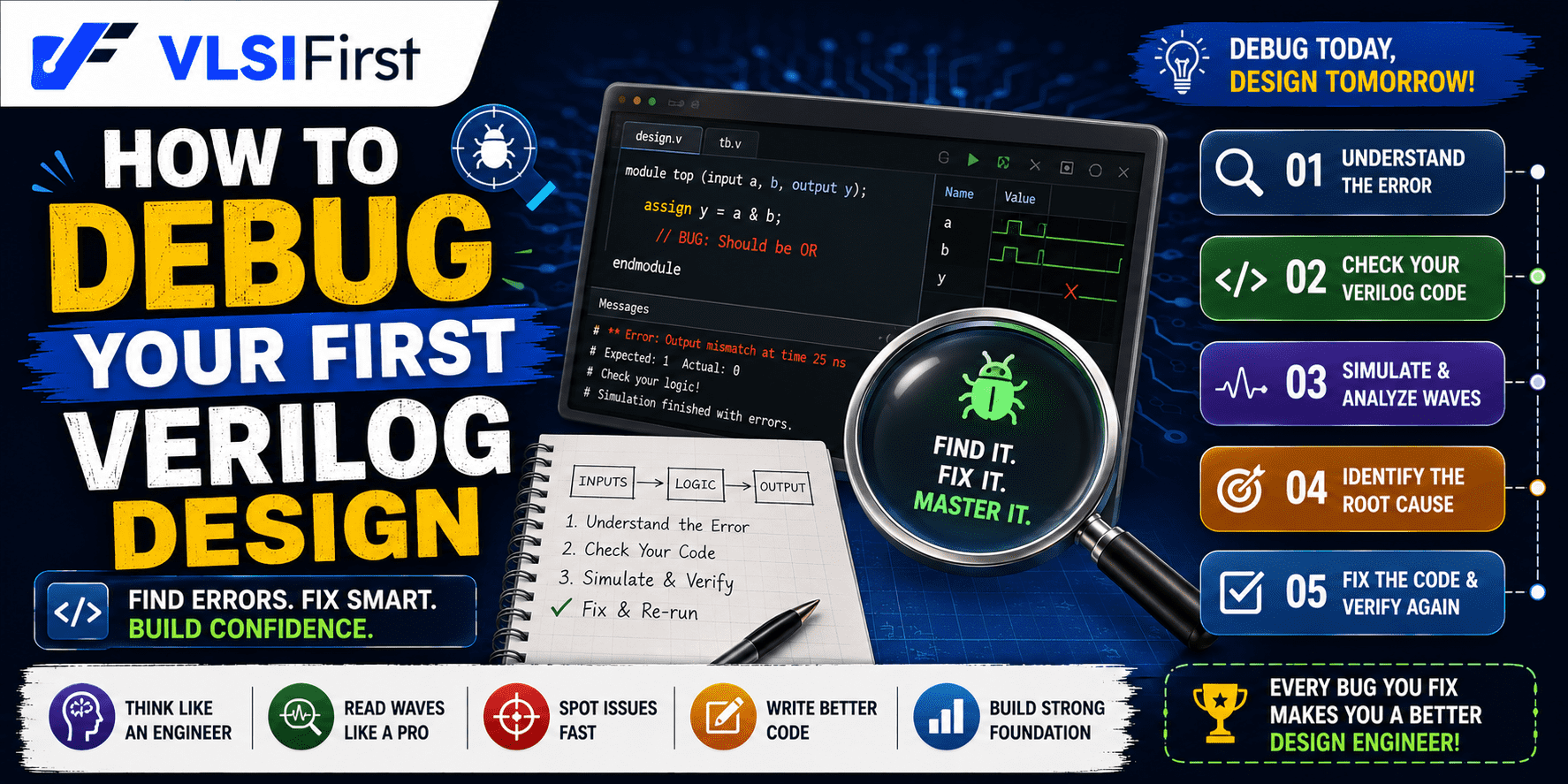
How to Debug Your First Verilog Design
Debugging your first Verilog design with practical RTL debug techniques, waveform analysis, testbench tips, FSM debugging, and common beginner mistakes. Read now!
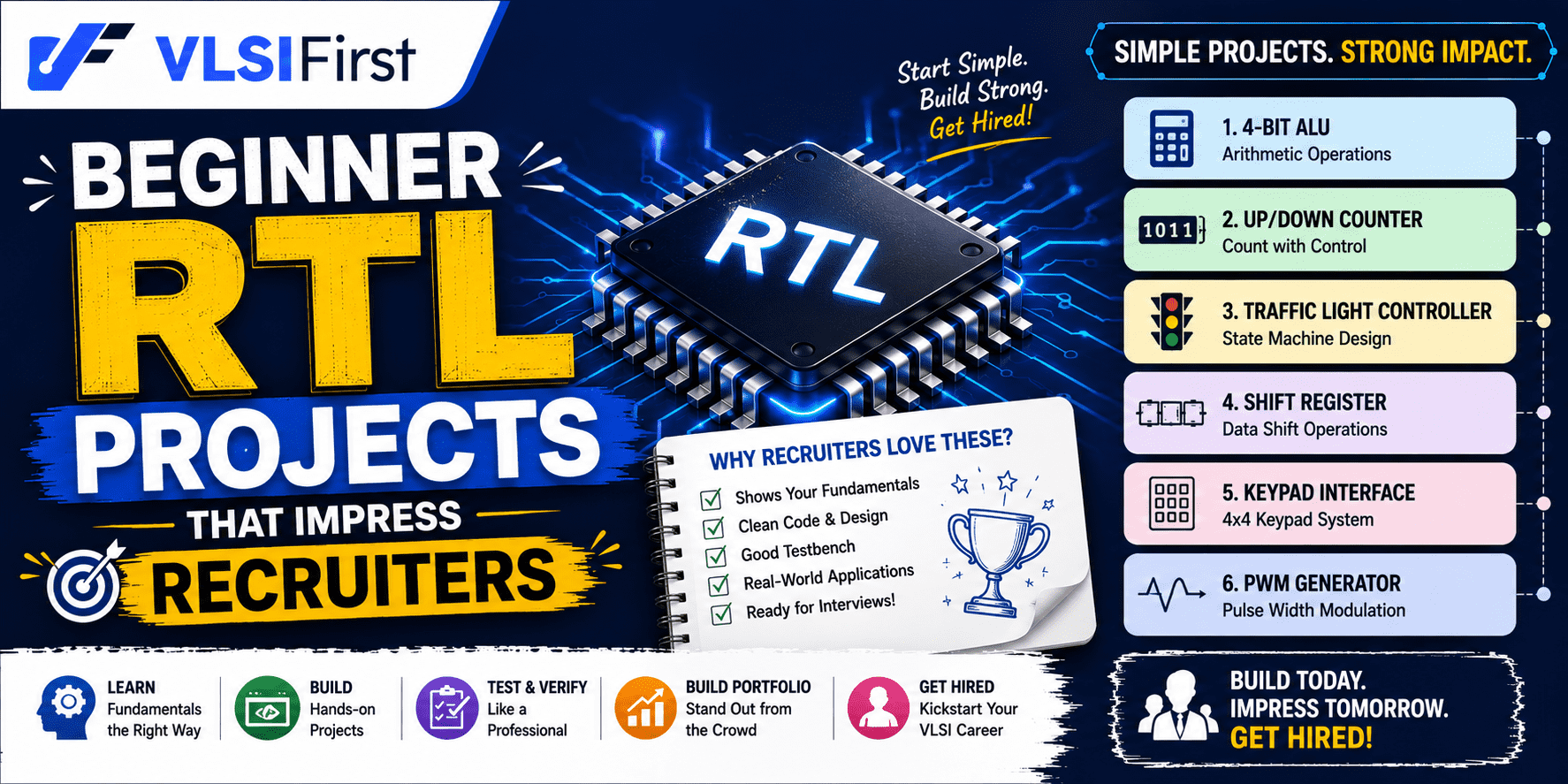
Beginner RTL Projects That Impress Recruiters
Discover beginner RTL projects that impress VLSI recruiters. Learn which Verilog projects build practical skills, strengthen your portfolio, and improve interview success.


Hours
2-98/1, Gurram Guda Road, Gurram Guda, Hyderabad, Rangareddy, Telangana, 501510
Copyright 2025 © VLSI Technologies Private Limited
Designed and developed by KandraDigitalCopyright 2025 © VLSI Technologies Private Limited
Designed, Developed & Marketing by KandraDigital