
One of the most common questions aspiring VLSI professionals ask is:
"I'm already 24, 26, or even 28 years old. Is it too late to start a career in VLSI?"
The concern is understandable.
Many people see LinkedIn posts about students getting placed during college, hear stories about fresh graduates joining semiconductor companies at 21 or 22, and begin comparing their own journey.
Some may have:
- Taken a career break
- Prepared for government exams
- Worked in a non-core job
- Pursued higher education
- Switched domains
- Spent time figuring out their career direction
As a result, they worry they have missed the opportunity to enter the semiconductor industry.
The reality is far more encouraging.
The VLSI industry values skills, problem-solving ability, practical knowledge, and technical competence far more than whether you started at 22 or 28.
In fact, many successful semiconductor engineers began their VLSI journey later than they originally planned.
This article explores whether age matters in VLSI, what companies actually look for, and how candidates in their mid-to-late twenties can successfully enter the semiconductor industry.
Why Many Students Feel They Are "Late"
The feeling of being late often comes from comparison.
Students compare themselves with:
- Campus placements
- College toppers
- LinkedIn success stories
- Friends who started earlier
- Seniors already working in the industry
What they often forget is that career journeys are rarely identical.
Some people discover VLSI during their second year of engineering.
Others learn about it only after graduation.
Some discover it after working in unrelated fields for several years.
A different timeline does not automatically mean a worse outcome.
The Semiconductor Industry Is Growing Faster Than Ever
The semiconductor ecosystem today is significantly larger than it was a decade ago.
Growth areas include:
- AI accelerators
- Automotive electronics
- Data center processors
- 5G infrastructure
- IoT devices
- Consumer electronics
- Edge computing
- Advanced chip packaging
As demand for chips increases globally, companies continue seeking skilled engineers across various VLSI domains.
This means opportunities are expanding beyond traditional campus recruitment channels.
The industry's need for talent is often greater than the supply of job-ready candidates.
What Recruiters Actually Care About
Many candidates assume recruiters focus primarily on age.
In reality, most hiring managers are more interested in questions such as:
- Can this candidate understand digital design concepts?
- Do they have practical exposure?
- Can they solve engineering problems?
- Do they understand verification methodologies?
- Have they worked on projects?
- Can they contribute to a team?
Notice that age is not on that list.
Companies hire engineers to solve problems.
If you can demonstrate capability, your age becomes much less important.
Starting at 24 Is Not Late
Let's address this directly.
A 24-year-old candidate is often only a few years beyond traditional campus recruitment age.
At 24, you still have decades of potential career growth ahead.
Many candidates at this age are:
- Fresh graduates
- MTech students
- Career switchers
- Individuals preparing for their first core job
With structured training and practical learning, entering VLSI at 24 is entirely realistic.
Starting at 26 Is Still a Strong Option
Candidates at 26 often worry because they have already spent a few years elsewhere.
Perhaps they:
- Worked in IT support
- Pursued competitive exams
- Joined a different engineering field
- Took a personal break
However, 26 is still early in a professional career.
Most engineers spend 30–40 years working.
Viewed from that perspective, starting at 26 still leaves enormous room for growth and specialization.
What matters is how quickly you can build industry-relevant skills.
What About Starting at 28?
This is where anxiety tends to increase.
Many candidates believe 28 is "too late."
But let's examine the reality.
If you start learning VLSI seriously at 28 and work until 60, you still have over three decades of professional growth ahead.
The real question is not:
"Am I too old?"
The better question is:
"Am I willing to invest the effort needed to become job-ready?"
Companies value competence.
A motivated and skilled 28-year-old candidate can absolutely compete for opportunities.
Advantages Older Learners Often Have
Interestingly, candidates who start later frequently bring valuable strengths.
Better Discipline
Many older learners are more focused than college students.
They understand the importance of consistent effort and career planning.
Clearer Career Goals
Unlike students who are still exploring options, career switchers often know exactly why they want to enter VLSI.
This motivation can improve learning outcomes.
Professional Experience
Even non-core work experience can help develop:
- Communication skills
- Teamwork
- Problem-solving
- Professional discipline
These qualities are valuable in engineering environments.
Greater Appreciation for Learning
Students who return to education after a gap often approach training with more seriousness and commitment.
Challenges Older Candidates May Face
While success is possible, it's important to acknowledge the challenges.
Knowledge Gaps
Candidates who have been away from electronics for several years may need to revisit:
- Digital Electronics
- CMOS concepts
- Logic design
- Number systems
Confidence Issues
Many candidates worry they are competing against younger graduates.
This can create unnecessary stress.
Remember that interviews evaluate skills, not birth certificates.
Family and Financial Responsibilities
Older learners may need to balance:
- Work
- Family commitments
- Financial obligations
- Training schedules
This requires strong time management.
How to Make a Successful Transition
If you're starting VLSI at 24, 26, or 28, focus on becoming job-ready efficiently.
Build Strong Fundamentals
Master:
- Digital Electronics
- Verilog
- Semiconductor Basics
- Timing Concepts
Strong fundamentals accelerate learning later.
Gain Practical Tool Exposure
Companies value practical skills.
Hands-on experience helps bridge the gap between theory and industry requirements.
Complete Meaningful Projects
Projects demonstrate your ability to apply concepts.
They also provide valuable discussion points during interviews.
Develop Problem-Solving Skills
Technical interviews frequently evaluate analytical thinking.
Learning how to approach engineering problems systematically can significantly improve employability.
Don't Let Age Become an Excuse
Sometimes age becomes a psychological barrier rather than a practical one.
Candidates spend months wondering:
- "Am I too late?"
- "What if companies reject me?"
- "What if younger candidates are preferred?"
Meanwhile, others spend those same months learning, practicing, and building projects.
Progress usually comes from action, not overthinking.
The Better Question to Ask
Instead of asking:
"Am I too old for VLSI?"
Ask:
- Am I willing to learn consistently?
- Can I dedicate time to practical training?
- Am I ready to work on projects?
- Can I strengthen my fundamentals?
- Am I prepared to keep improving?
These questions have a much greater impact on your future than your age.
Final Thoughts
Starting VLSI at 24, 26, or 28 is not too late.
The semiconductor industry is not looking for the youngest candidate.
It is looking for capable engineers who can contribute effectively.
Your success in VLSI will depend far more on:
- Technical skills
- Practical exposure
- Project experience
- Problem-solving ability
- Consistency
- Learning mindset
than on the age at which you began.
The truth is simple:
Five years from now, you will still be five years older.
The real difference is whether you spent those years building skills and moving toward your goals.
If VLSI genuinely interests you, the best time to start may not have been years ago.
The best time may be today.

How to Test Your RTL Before Simulation: A Practical Pre-Simulation Checklist for Beginners
Learn how to test your RTL before simulation with a practical pre-simulation checklist. Improve Verilog quality, reduce debugging time, and build industry-ready RTL skills.
From Logic Diagram to Verilog Code – Complete Workflow
Learn the complete workflow from logic diagram to Verilog code, including specifications, RTL architec ture, coding, simulation, debugging, verification, and documentation.
Common Mistakes While Writing Verilog Code
Learn the most common Verilog coding mistakes beginners make and how to avoid them. Improve RTL coding, simulation, debugging, verification, and interview readiness.
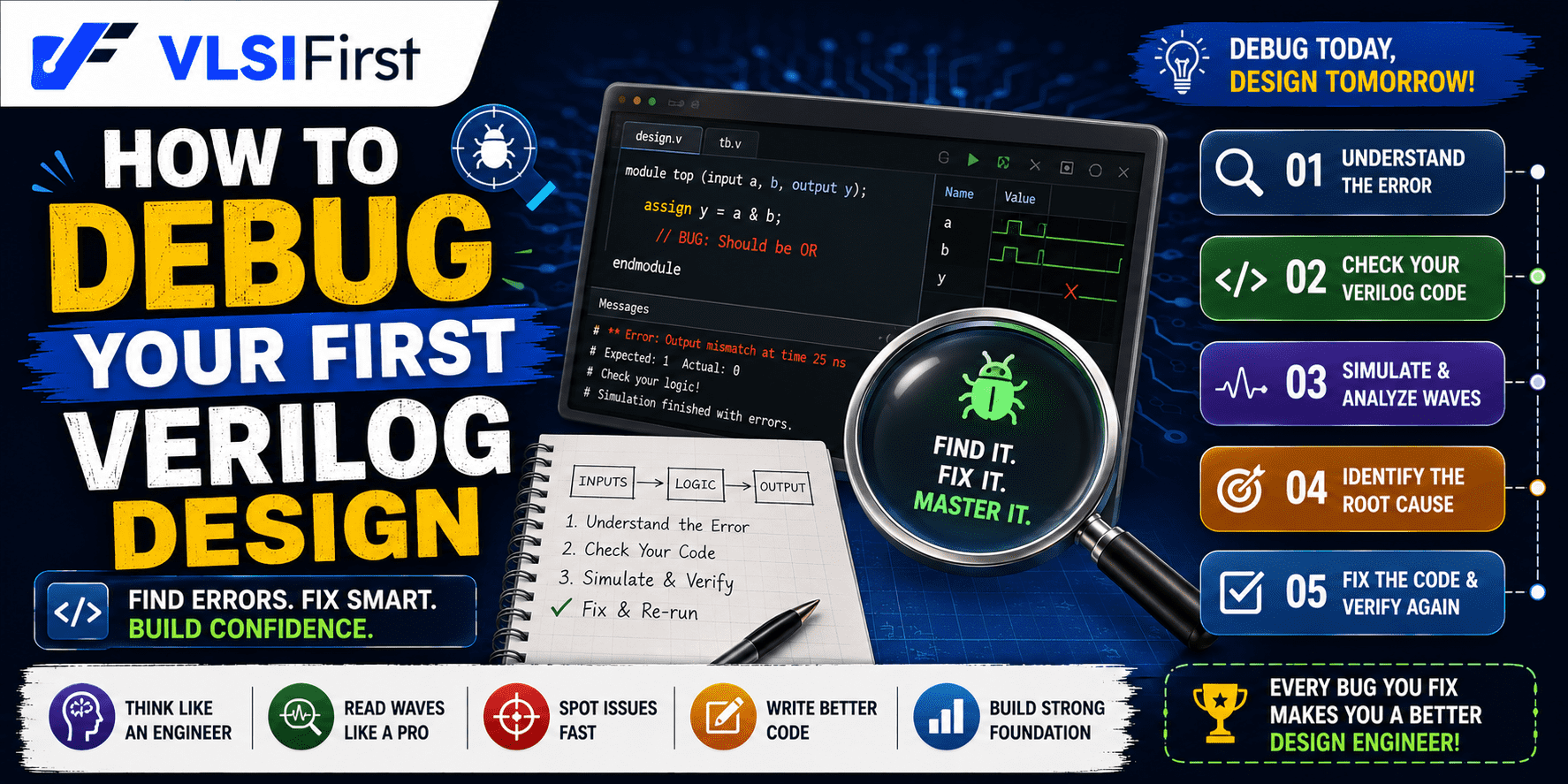
How to Debug Your First Verilog Design
Debugging your first Verilog design with practical RTL debug techniques, waveform analysis, testbench tips, FSM debugging, and common beginner mistakes. Read now!
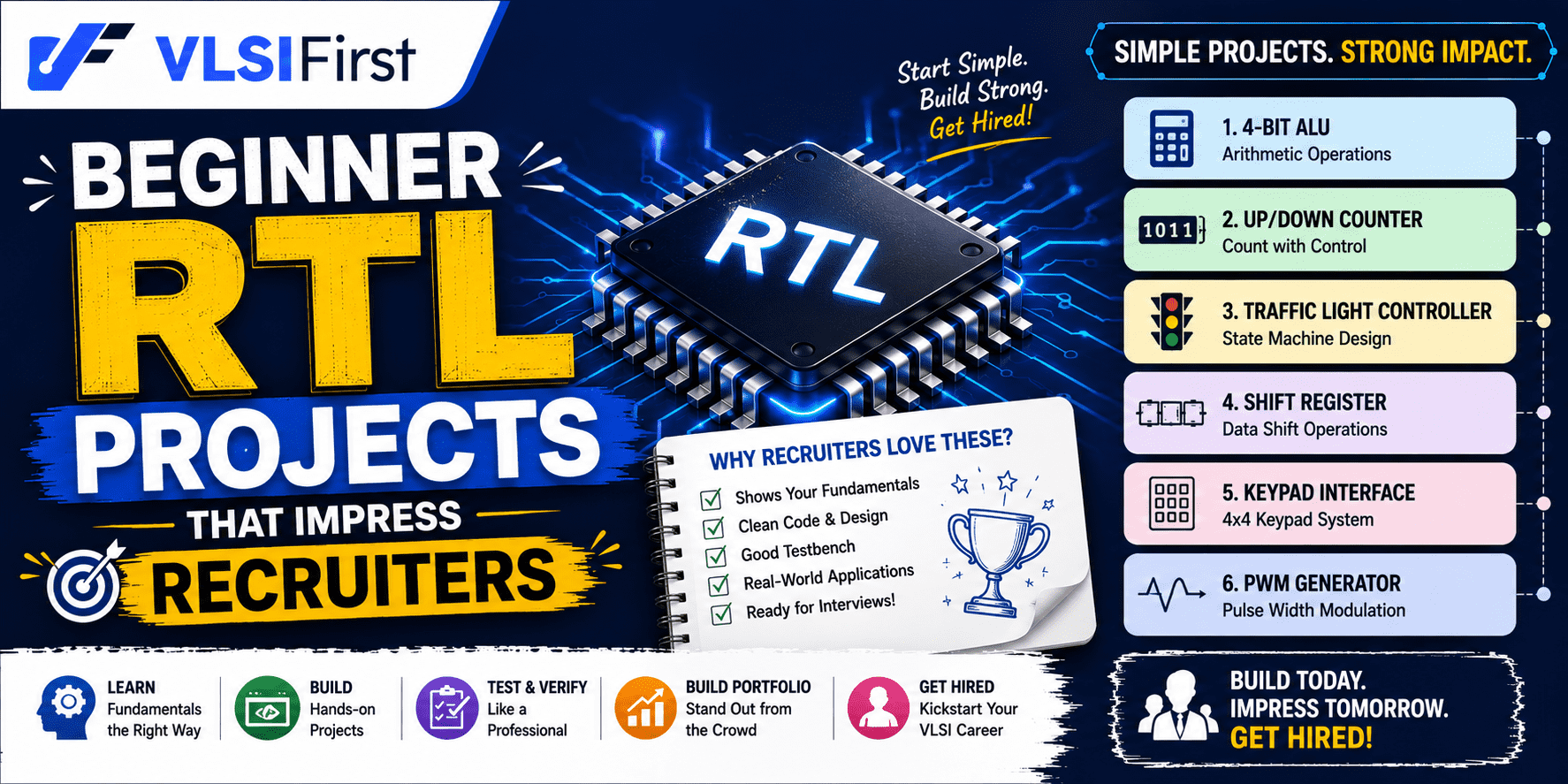
Beginner RTL Projects That Impress Recruiters
Discover beginner RTL projects that impress VLSI recruiters. Learn which Verilog projects build practical skills, strengthen your portfolio, and improve interview success.


Hours
2-98/1, Gurram Guda Road, Gurram Guda, Hyderabad, Rangareddy, Telangana, 501510
Copyright 2025 © VLSI Technologies Private Limited
Designed and developed by KandraDigitalCopyright 2025 © VLSI Technologies Private Limited
Designed, Developed & Marketing by KandraDigital