
One of the most common career concerns among engineers is the fear of choosing the wrong specialization.
A fresher entering the VLSI industry often wonders:
- What if I start in Verification and later want to move into Design?
- Can a Physical Design engineer become an STA specialist?
- Is it possible to move from DFT to RTL Design?
- Will I get stuck in one domain forever?
At the same time, software professionals face similar questions:
- Can a Java developer become a Data Scientist?
- Is it easy to move from Testing to DevOps?
- Can a Front-End Developer switch to Cybersecurity?
These questions highlight an important aspect of long-term career planning: domain mobility.
A career is rarely a straight line. As industries evolve, technologies change, and personal interests develop, professionals often seek new opportunities within their field.
This raises an interesting comparison:
Is switching domains within VLSI easier than switching domains in the IT industry?
The answer is not a simple yes or no. Both industries allow domain transitions, but the nature of those transitions is significantly different.
In this article, we will explore how domain switching works in VLSI, how it compares with IT career transitions, and what engineers should know before planning a move.
Understanding What "Domain Switching" Means
Before comparing VLSI and IT, let's define domain switching.
Domain switching refers to moving from one specialization to another while remaining within the same broader industry.
Examples in VLSI
- Verification → RTL Design
- Physical Design → STA
- RTL Design → SoC Integration
- DFT → Verification
- Design → Architecture
Examples in IT
- Software Testing → Development
- Web Development → Data Science
- Backend Development → DevOps
- Cybersecurity → Cloud Engineering
- Mobile Development → AI Engineering
The ease of switching depends largely on how much overlap exists between the two domains.
Why Domain Switching Happens
Engineers usually consider switching domains for several reasons:
- Greater career growth
- Better salary opportunities
- Increased interest in another specialization
- Exposure to new technologies
- Long-term career goals
- Better alignment with strengths
Switching domains is not necessarily a sign of dissatisfaction. In many cases, it is part of professional growth.
Domain Relationships in VLSI
One reason VLSI domain transitions can be relatively manageable is that many semiconductor specializations are closely connected.
A chip development cycle involves:
RTL Design → Verification → Synthesis → STA → Physical Design → DFT → Signoff
Since these teams collaborate closely, engineers often gain visibility into adjacent domains.
For example:
A Verification Engineer regularly interacts with RTL Designers.
An STA Engineer works closely with Physical Design teams.
A DFT Engineer understands design structures and verification flows.
This interconnected workflow creates opportunities for learning beyond one's immediate role.
Domain Relationships in IT
The IT industry is much broader.
Consider the knowledge required for:
- Cloud Computing
- Artificial Intelligence
- Cybersecurity
- Full Stack Development
- Data Engineering
- Mobile Development
Each area may require completely different:
- Programming languages
- Frameworks
- Architectures
- Methodologies
- Certifications
As a result, switching domains in IT sometimes requires learning an entirely new ecosystem.
Why Switching Within VLSI Is Often Easier
There are several reasons.
Shared Engineering Fundamentals
Most VLSI domains rely on the same core concepts:
- Digital Electronics
- Logic Design
- Timing Analysis
- Semiconductor Fundamentals
- Hardware Architecture
An engineer moving from Verification to RTL Design already understands much of the underlying design behavior.
Similarly, an STA engineer already understands timing concepts that are important in Physical Design.
Because the foundational knowledge overlaps significantly, transitions can be smoother.
Common Tools and Workflows
Although different teams use different EDA tools, many concepts remain connected.
Engineers often encounter:
- Verilog/SystemVerilog
- TCL scripting
- Linux environments
- Debugging workflows
- Design databases
This common ecosystem reduces the learning curve.
Continuous Cross-Team Interaction
Unlike some IT domains that operate independently, VLSI teams frequently collaborate throughout the chip development cycle.
This exposure naturally builds awareness of adjacent roles.
For example:
A Physical Design engineer frequently interacts with:
- STA engineers
- Floorplanning teams
- Power analysis teams
A Verification engineer regularly collaborates with:
- RTL designers
- SoC teams
- Architecture groups
Over time, this interaction creates opportunities for internal transitions.
When Switching Within VLSI Becomes Difficult
While domain transitions are possible, they are not always easy.
Example: Physical Design to RTL Design
A Physical Design engineer may have strong implementation knowledge but limited RTL coding experience.
Transitioning may require:
- Learning Verilog deeply
- Understanding architecture decisions
- Improving coding skills
- Building design projects
The switch is possible but requires effort.
Example: Verification to Architecture
Moving into architecture requires:
- System-level understanding
- Product knowledge
- Performance optimization skills
- Multi-domain expertise
This transition usually happens after years of industry experience.
How IT Domain Switching Differs
In IT, some transitions involve a complete skill reset.
For example:
Web Development → Data Science
Requires learning:
- Statistics
- Machine Learning
- Data Analysis
- Python Ecosystem
- Model Development
Software Testing → AI Engineering
Requires:
- Programming depth
- Mathematics
- Neural Networks
- AI Frameworks
The overlap may be much smaller than typical VLSI transitions.
Which VLSI Domain Switches Are Most Common?
Certain transitions are frequently seen in the semiconductor industry.
Verification → RTL Design
Common because engineers gain deep design understanding through debugging.
Physical Design → STA
Natural overlap exists due to timing analysis involvement.
RTL Design → Verification
Many design engineers move into advanced verification leadership roles.
STA → Signoff
A very common progression path.
Design → Architecture
A long-term career growth route for experienced engineers.
Skills That Make Domain Switching Easier
Regardless of the destination domain, certain skills accelerate transitions.
Strong Fundamentals
Engineers with solid understanding of:
- Digital Logic
- Timing
- Architecture
- CMOS Concepts
can adapt much faster.
Debugging Ability
Debugging skills transfer across almost every VLSI specialization.
Companies highly value engineers who can identify root causes and solve complex problems.
Scripting Knowledge
Python, TCL, and Shell scripting are useful across:
- Verification
- Physical Design
- STA
- DFT
System-Level Thinking
Engineers who understand complete chip development flows find transitions much easier.
Should Freshers Worry About Choosing the Perfect Domain?
Not really.
Many students believe that their first specialization determines their entire career.
This is rarely true.
The semiconductor industry values:
- Learning ability
- Technical depth
- Problem-solving skills
- Adaptability
A strong engineer can often transition successfully over time.
What matters most is building a solid foundation in the first few years.
How to Prepare for Future Domain Flexibility
If you want long-term flexibility:
Learn Beyond Your Current Role
Understand how neighboring teams operate.
Study Complete Design Flows
Know how your work impacts downstream teams.
Build Cross-Domain Projects
Projects expose you to multiple aspects of chip development.
Develop Strong Fundamentals
Fundamentals make future transitions easier.
Stay Curious
Many successful architects started as specialists in a completely different area.
Final Verdict
So, is switching domains within VLSI easier than switching IT domains?
In many cases, yes.
This is because VLSI domains share:
- Common engineering foundations
- Similar workflows
- Connected development processes
- Significant technical overlap
While transitions still require effort and learning, the knowledge gained in one VLSI specialization often remains useful in another.
By comparison, many IT domain transitions involve entirely different technology stacks, frameworks, and methodologies.
The key takeaway for students is simple:
Do not become overly worried about selecting the "perfect" VLSI domain on day one.
Instead, focus on:
- Strong fundamentals
- Practical project experience
- Problem-solving skills
- Continuous learning
These qualities will not only help you secure your first VLSI job but will also give you the flexibility to grow, specialize, and transition into new domains throughout your semiconductor career.
How to Test Your RTL Before Simulation: A Practical Pre-Simulation Checklist for Beginners
Learn how to test your RTL before simulation with a practical pre-simulation checklist. Improve Verilog quality, reduce debugging time, and build industry-ready RTL skills.
From Logic Diagram to Verilog Code – Complete Workflow
Learn the complete workflow from logic diagram to Verilog code, including specifications, RTL architec ture, coding, simulation, debugging, verification, and documentation.
Common Mistakes While Writing Verilog Code
Learn the most common Verilog coding mistakes beginners make and how to avoid them. Improve RTL coding, simulation, debugging, verification, and interview readiness.
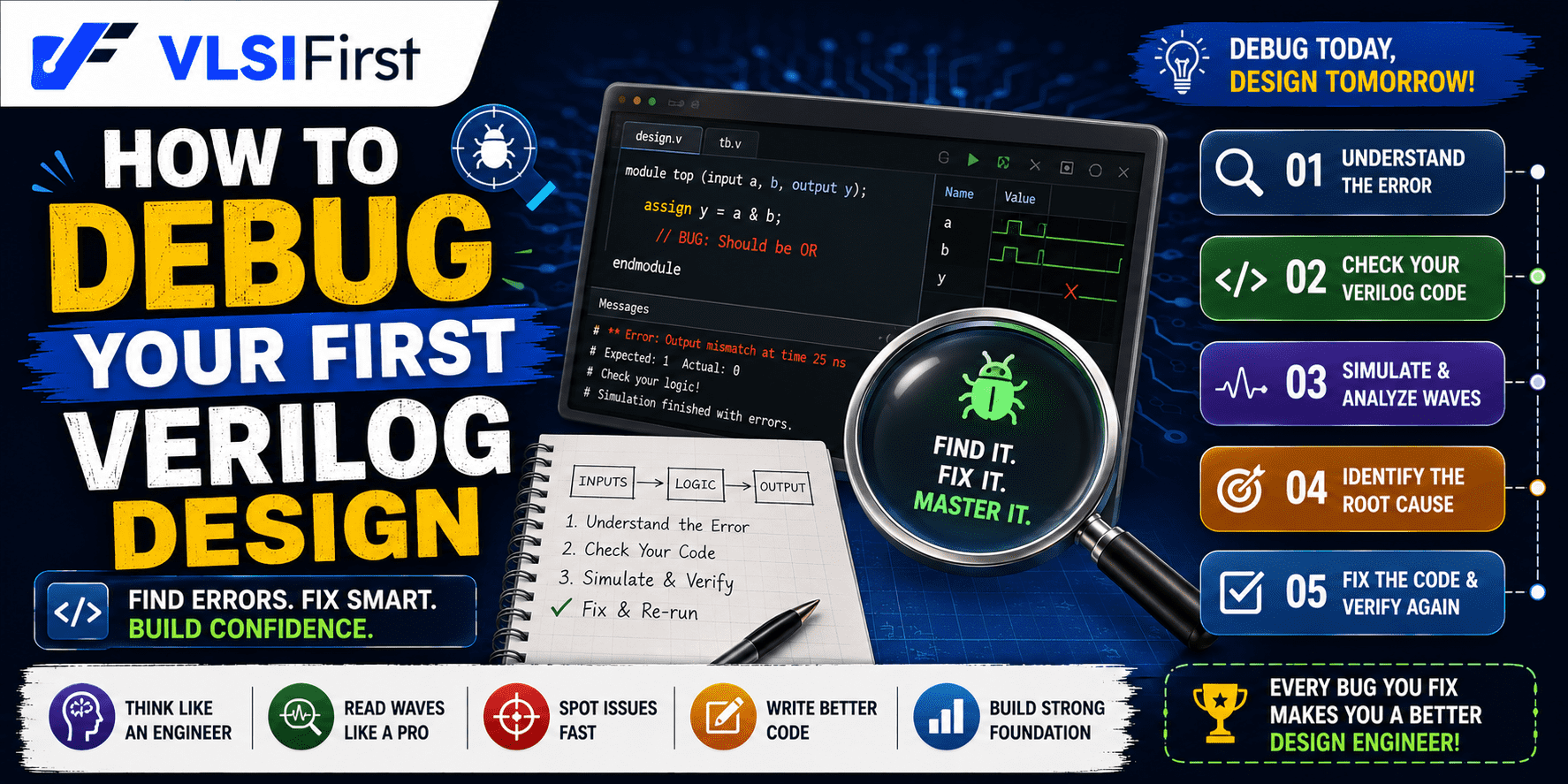
How to Debug Your First Verilog Design
Debugging your first Verilog design with practical RTL debug techniques, waveform analysis, testbench tips, FSM debugging, and common beginner mistakes. Read now!
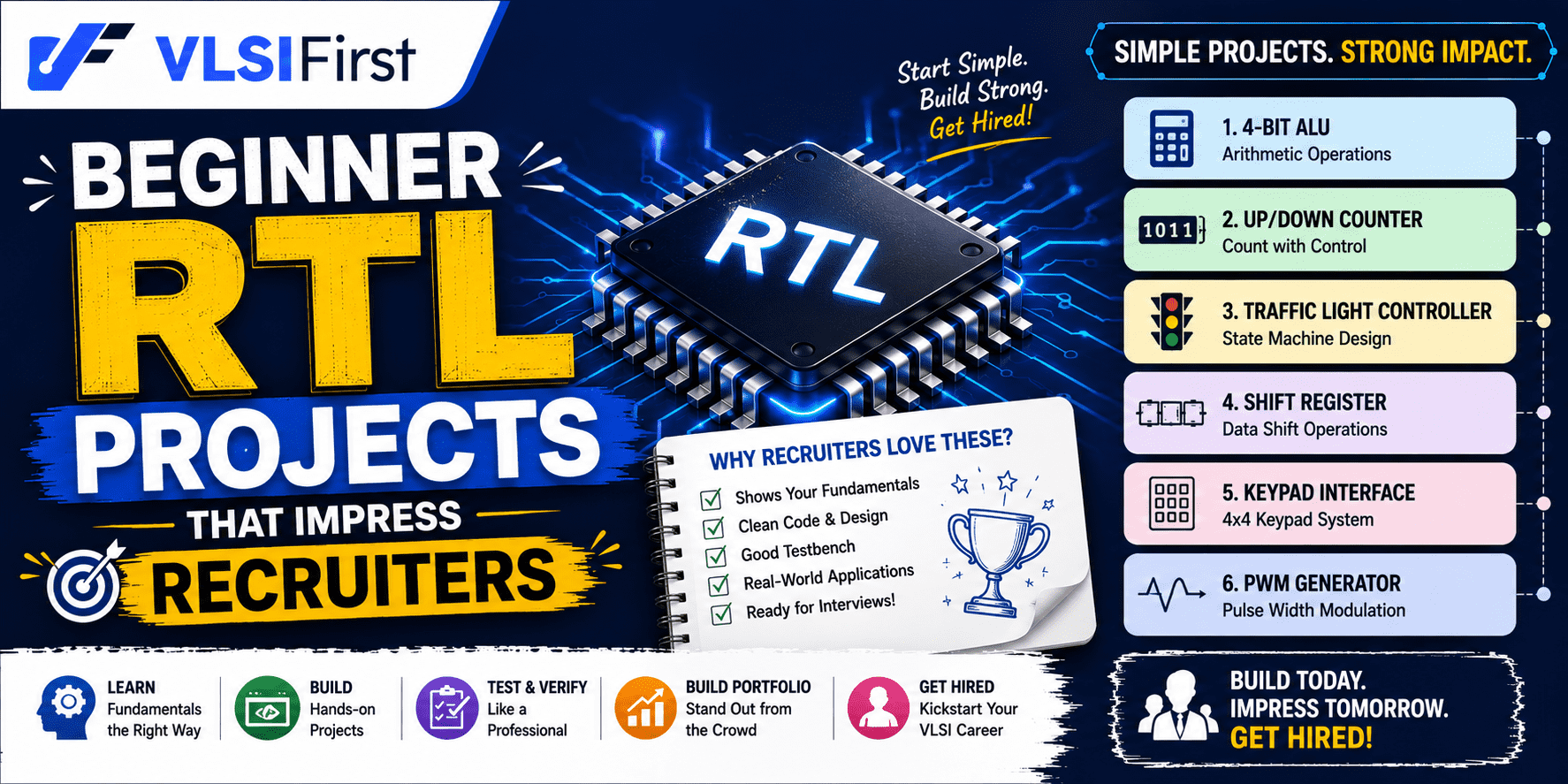
Beginner RTL Projects That Impress Recruiters
Discover beginner RTL projects that impress VLSI recruiters. Learn which Verilog projects build practical skills, strengthen your portfolio, and improve interview success.


Hours
2-98/1, Gurram Guda Road, Gurram Guda, Hyderabad, Rangareddy, Telangana, 501510
Copyright 2025 © VLSI Technologies Private Limited
Designed and developed by KandraDigitalCopyright 2025 © VLSI Technologies Private Limited
Designed, Developed & Marketing by KandraDigital