
Artificial Intelligence is transforming industries across the world.
From software development and testing to customer support and data analysis, automation is changing how companies work. Naturally, many engineering students now wonder:
- “Will AI replace VLSI jobs too?”
- “Is semiconductor engineering still a stable career?”
- “Should I enter VLSI if automation is growing rapidly?”
These concerns are understandable.
Every few months, students see headlines about:
- AI-generated code
- automated design tools
- intelligent verification systems
- machine learning-based chip optimization
As a result, many freshers fear that semiconductor jobs may become unstable in the future.
But the reality is far more nuanced.
In fact, AI and automation are not reducing the importance of VLSI.
They are actually increasing the demand for advanced semiconductor engineering in many areas.
This blog explains:
- how AI is impacting the VLSI industry
- which skills remain valuable
- whether semiconductor careers are still stable
- what students should focus on
Why AI Is Increasing Semiconductor Demand
This is the first thing students must understand.
AI itself depends heavily on semiconductor technology.
Modern AI systems require:
- GPUs
- AI accelerators
- high-speed processors
- memory chips
- advanced packaging
- data center hardware
Without semiconductor innovation, modern AI cannot exist.
The rapid growth of AI workloads is directly increasing global demand for advanced chips and semiconductor talent.
This means: “AI is creating MORE semiconductor opportunities, not eliminating them completely.”
Why Semiconductor Companies Still Need Engineers
Some students assume: “If tools become automated, engineers won’t be needed.”
But semiconductor engineering is much more complex than running tools.
Real VLSI work involves:
- architecture decisions
- debugging
- timing optimization
- power analysis
- verification strategy
- physical implementation trade-offs
EDA tools can automate workflows, but they still depend heavily on engineering judgment.
Even AI-assisted EDA platforms still require skilled engineers to:
- define constraints
- analyze failures
- optimize designs
- validate functionality
Industry experts consistently point out that automation supports engineers rather than fully replacing them.
The Biggest Misunderstanding About Automation
Automation usually replaces:
- repetitive tasks
- predictable workflows
- low-level manual effort
But VLSI engineering increasingly involves:
- problem-solving
- system-level reasoning
- debugging complex interactions
- architectural optimization
These areas still require human thinking.
Modern semiconductor development has become too complex for fully automated decision-making in many critical stages.
What AI Is Actually Changing in VLSI
AI is definitely changing semiconductor workflows.
For example, AI is helping in:
- placement optimization
- routing assistance
- verification acceleration
- power optimization
- bug prediction
- test generation
But this does NOT mean: engineers become unnecessary.
Instead, engineers now need to:
- work alongside AI tools
- understand automated flows
- validate AI-generated results
- solve higher-level problems
This is similar to how software developers still exist despite advanced IDEs and automation tools.
Why VLSI Remains a Long-Term Career
Several major industry trends continue to support semiconductor career stability.
1. AI Needs More Advanced Chips
AI workloads demand:
- faster processing
- lower power consumption
- higher bandwidth
- specialized AI accelerators
This increases demand for:
- chip design engineers
- verification engineers
- physical design engineers
- architecture specialists
AI hardware development is now one of the fastest-growing semiconductor sectors globally.
2. Semiconductor Demand Is Expanding Everywhere
Today, chips are used in:
- smartphones
- EVs
- medical devices
- robotics
- cloud infrastructure
- aerospace systems
- IoT devices
This broad industry dependence creates long-term semiconductor demand.
The semiconductor industry is projected to continue strong growth through the next decade.
3. Chip Complexity Is Increasing
Modern chips contain:
- billions of transistors
- multiple IP integrations
- advanced node constraints
- complex timing challenges
As complexity increases, companies need more skilled engineers who can:
- debug efficiently
- optimize designs
- manage verification complexity
This makes experienced semiconductor talent even more valuable.
Which VLSI Roles Are Most Stable?
Some roles are more automation-resistant because they depend heavily on engineering judgment.
Verification Engineering
Verification involves:
- debugging
- protocol analysis
- coverage closure
- corner-case validation
AI may assist verification, but human engineers still drive verification strategy.
Physical Design
Advanced-node physical design requires:
- timing closure
- congestion optimization
- power analysis
- floorplanning trade-offs
Automation helps, but expert engineers remain essential.
RTL Design and Architecture
Architecture-level decisions still depend heavily on human creativity and system understanding.
AI tools can assist implementation, but architectural thinking remains highly valuable.
DFT and System-Level Engineering
As chips become more complex, testing and system integration become even more critical.
These roles continue to offer strong long-term opportunities.
What Skills Will Become More Important in the AI Era?
This is the most important question students should ask.
Instead of fearing automation, students should focus on becoming engineers who work effectively with automation.
The following skills will become even more valuable:
1. Problem-Solving Skills
AI tools generate outputs.
Engineers still solve real-world engineering problems.
2. Debugging Ability
As chips become more complex, debugging becomes harder, not easier.
Companies increasingly value engineers who can:
- analyze failures
- isolate issues
- debug efficiently
Recent industry discussions repeatedly emphasize debugging as one of the most critical VLSI skills today.
3. Strong Fundamentals
AI tools may automate workflows, but engineers still need:
- digital logic understanding
- timing analysis knowledge
- architecture awareness
Fundamentals remain essential.
4. Adaptability
The semiconductor industry evolves constantly.
Engineers who continuously learn:
- new tools
- new flows
- new architectures
will remain highly employable.
5. System-Level Thinking
Modern semiconductor companies increasingly value engineers who understand:
- hardware-software interaction
- system architecture
- integration challenges
System-level understanding is becoming more important in AI-era chip development.
Will Entry-Level Jobs Reduce?
Some repetitive entry-level tasks may become partially automated.
But companies will still need freshers who can:
- learn quickly
- debug logically
- contribute to projects
- understand workflows
The industry may shift expectations upward, but it is unlikely to eliminate freshers completely.
In fact, many semiconductor companies are actively investing in talent development because of global chip demand growth.
Common Mistakes Students Make
1. Thinking Tool Knowledge Alone Is Enough
Automation reduces the value of shallow tool operation skills.
Students must build:
- engineering thinking
- debugging ability
- analytical skills
2. Ignoring Fundamentals
Students who neglect:
- timing
- digital logic
- RTL quality
may struggle long-term.
3. Avoiding Practical Projects
Projects build:
- problem-solving
- debugging experience
- engineering maturity
These become even more important in an AI-assisted future.
4. Fearing AI Instead of Learning Alongside It
The best engineers will not compete against AI.
They will use AI effectively.
Students who adapt early will gain major advantages.
Is VLSI Safer Than Some Software Roles?
While no industry is completely immune to automation, many VLSI roles involve:
- hardware constraints
- physical implementation challenges
- deep system integration
which are often harder to automate fully compared to repetitive software workflows.
This is one reason semiconductor engineering continues to be viewed as a strong long-term technical career path.
Conclusion
So, is VLSI a stable career in the age of AI and automation?
Yes, but with an important condition.
Students who rely only on:
- tool familiarity
- memorization
- repetitive workflows
may struggle as automation grows.
But engineers who develop:
- strong fundamentals
- debugging skills
- problem-solving ability
- system-level thinking
- adaptability
will continue to remain highly valuable.
AI is not killing semiconductor careers.
In many ways, AI is accelerating semiconductor innovation.
The industry still needs engineers who can:
- think critically
- solve difficult problems
- optimize complex systems
- validate intelligent automation
So instead of asking: “Will AI replace VLSI engineers?”
Ask: “How can I become the kind of engineer AI cannot easily replace?”
Because in the future semiconductor industry:
The safest careers will belong to engineers who combine technical depth with adaptability and practical problem-solving skills.
How to Test Your RTL Before Simulation: A Practical Pre-Simulation Checklist for Beginners
Learn how to test your RTL before simulation with a practical pre-simulation checklist. Improve Verilog quality, reduce debugging time, and build industry-ready RTL skills.
From Logic Diagram to Verilog Code – Complete Workflow
Learn the complete workflow from logic diagram to Verilog code, including specifications, RTL architec ture, coding, simulation, debugging, verification, and documentation.
Common Mistakes While Writing Verilog Code
Learn the most common Verilog coding mistakes beginners make and how to avoid them. Improve RTL coding, simulation, debugging, verification, and interview readiness.
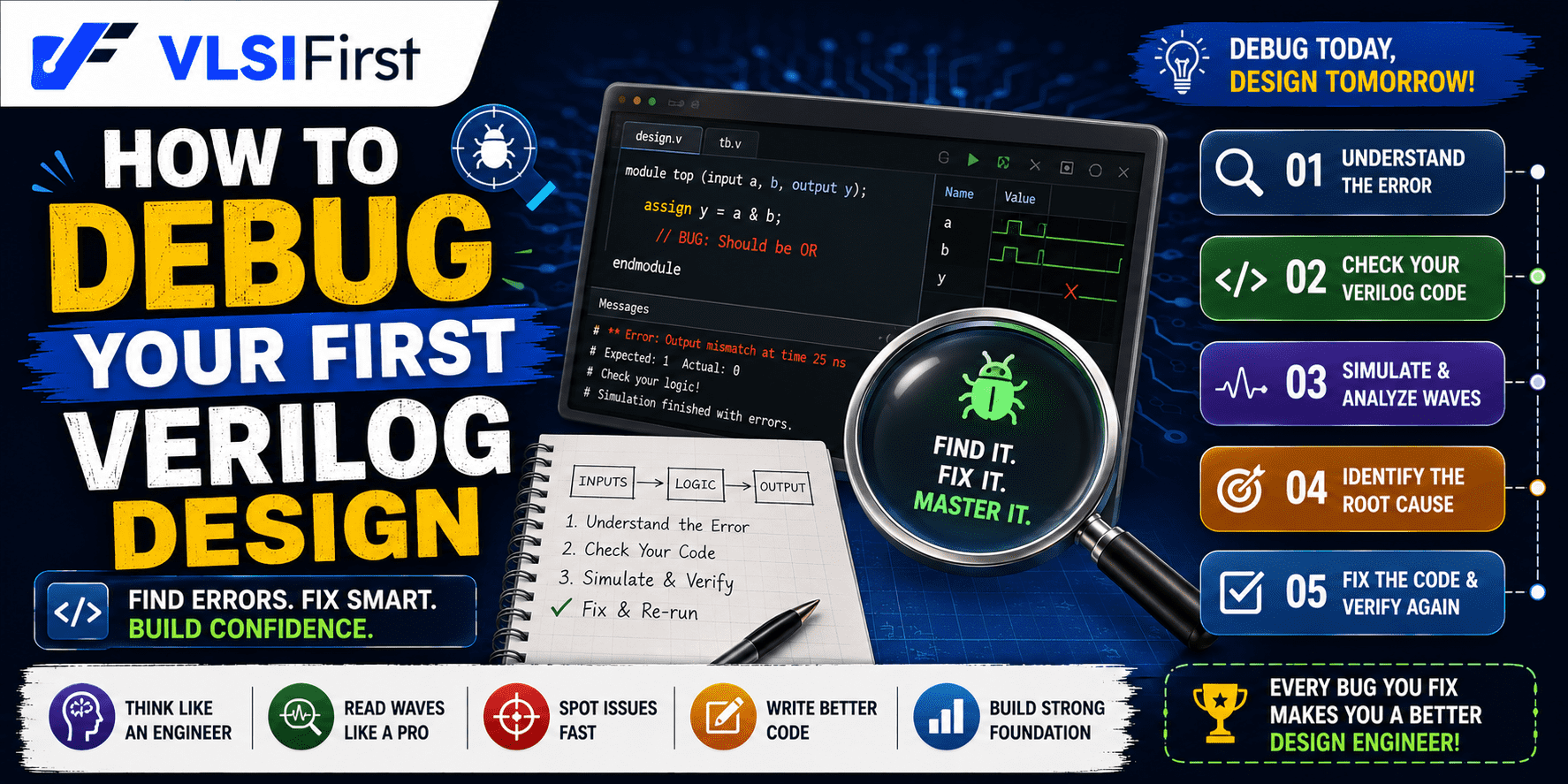
How to Debug Your First Verilog Design
Debugging your first Verilog design with practical RTL debug techniques, waveform analysis, testbench tips, FSM debugging, and common beginner mistakes. Read now!
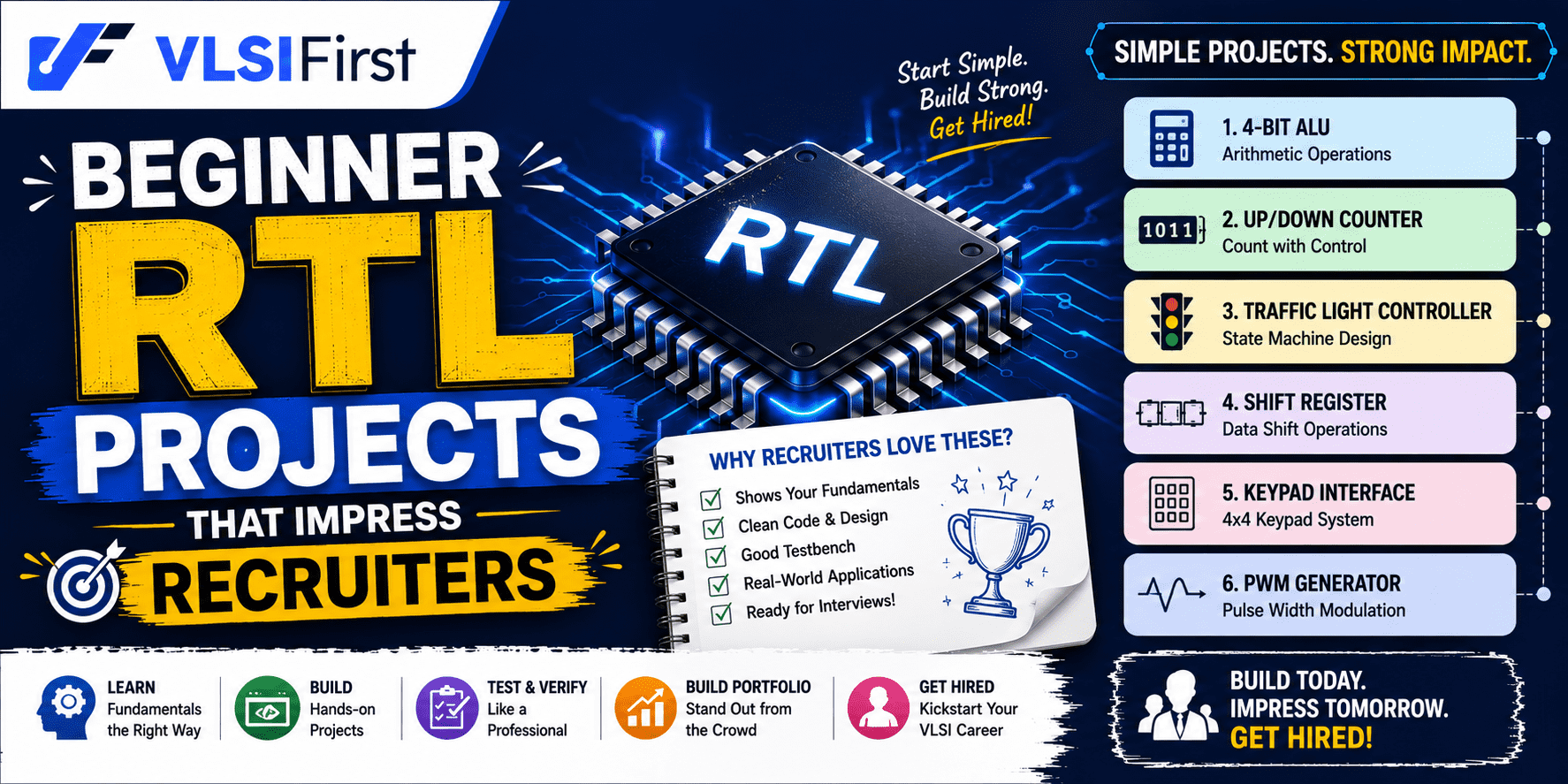
Beginner RTL Projects That Impress Recruiters
Discover beginner RTL projects that impress VLSI recruiters. Learn which Verilog projects build practical skills, strengthen your portfolio, and improve interview success.


Hours
2-98/1, Gurram Guda Road, Gurram Guda, Hyderabad, Rangareddy, Telangana, 501510
Copyright 2025 © VLSI Technologies Private Limited
Designed and developed by KandraDigitalCopyright 2025 © VLSI Technologies Private Limited
Designed, Developed & Marketing by KandraDigital