
Application-Specific Integrated Circuits (ASICs) are the backbone of modern electronics, powering smartphones, data centers, automotive systems, and AI accelerators. For freshers aspiring to build a career in VLSI, ASIC design projects are one of the strongest ways to demonstrate practical knowledge and industry readiness.
Why ASIC Design Projects Are Important for Freshers
The semiconductor industry values hands-on experience more than theoretical knowledge alone. ASIC projects help freshers:
- Apply digital design fundamentals in real scenarios
- Gain confidence in Verilog/SystemVerilog
- Understand RTL-to-GDS flow
- Improve debugging and problem-solving skills
- Stand out in VLSI job interviews
Recruiters often evaluate candidates based on project depth and clarity of explanation.
Tools and Skills Required for ASIC Projects
Before starting ASIC projects, freshers should be familiar with:
- Verilog HDL / SystemVerilog
- Digital electronics and FSMs
- Simulation tools (basic level)
- Logic synthesis concepts
- Static timing analysis basics
Open-source tools and FPGA platforms can be used for early validation.
1. Simple RISC Processor Design
Project Overview
Design a basic RISC processor supporting a limited instruction set such as add, subtract, load, store, and branch.
Key Concepts Learned
- Instruction decoding
- Datapath and control logic
- FSM-based control unit
- RTL modular design
Why It’s Ideal for Freshers
This project demonstrates core computer architecture and RTL skills.
2. UART Controller (Transmitter and Receiver)
Project Overview
Implement a UART controller to enable serial communication between two digital systems.
Key Concepts Learned
- Baud rate generation
- Shift registers
- FSM design
- Timing accuracy
Industry Relevance
Communication IPs are widely used in SoCs and embedded systems.
3. FIFO Memory Controller
Project Overview
Design a FIFO buffer with configurable depth and data width.
Key Concepts Learned
- Read/write pointer logic
- Overflow and underflow handling
- Memory interfacing
- Synchronization concepts
Why It Matters
FIFO structures are essential in data flow control and clock domain crossing.
4. Traffic Light Controller (ASIC Version)
Project Overview
Implement a traffic light controller using FSMs, optimized for ASIC design.
Key Concepts Learned
- State transition optimization
- Low-power FSM design
- Timing-aware coding
Beginner Advantage
Simple logic with strong conceptual clarity.
5. ALU (Arithmetic Logic Unit) Design
Project Overview
Design an ALU supporting arithmetic and logical operations controlled by opcode inputs.
Key Concepts Learned
- Combinational logic optimization
- Control signal decoding
- Modular RTL coding
Industry Value
ALUs are core components of processors and DSPs.
6. Digital Timer and Stopwatch
Project Overview
Design a digital timer with start, stop, reset, and lap functionality.
Key Concepts Learned
- Clock division
- Counters
- Reset and enable logic
Practical Use
Demonstrates real-time digital design and clock handling.
7. SPI Controller Design
Project Overview
Implement a Serial Peripheral Interface (SPI) controller with master mode functionality.
Key Concepts Learned
- Serial data transfer
- Clock polarity and phase
- FSM-based protocol control
Industry Demand
SPI is commonly used in SoCs and peripheral IPs.
8. Low-Power FSM Design
Project Overview
Design an FSM optimized for low power using techniques like clock gating.
Key Concepts Learned
- Power-aware RTL coding
- Activity reduction
- Power vs performance trade-offs
Why It Stands Out
Low-power awareness is highly valued in modern chip design.
9. Memory Controller (SRAM Interface)
Project Overview
Design a simple SRAM controller supporting read and write operations.
Key Concepts Learned
- Address decoding
- Read/write timing
- Interface control
ASIC Relevance
Memory controllers are fundamental in SoC architecture.
10. Mini SoC Integration Project
Project Overview
Integrate multiple IP blocks such as ALU, FIFO, UART, and controller into a mini SoC.
Key Concepts Learned
- IP integration
- Top-level design
- Bus interfacing
- Verification strategy
Fresher Advantage
Demonstrates system-level understanding and design maturity.
How to Present ASIC Projects in Interviews
Freshers should be able to explain:
- Design architecture
- Key challenges and solutions
- Timing considerations
- Verification approach
- Improvements and scalability
Clear explanation matters as much as the project itself.
Common Mistakes Freshers Make in ASIC Projects
- Copying code without understanding
- Ignoring reset and timing
- Poor documentation
- Over-complex designs too early
Start simple and build depth gradually.
How These ASIC Projects Help in Career Growth
These projects prepare freshers for roles such as:
- RTL Design Engineer
- Verification Engineer
- FPGA Engineer
- ASIC Design Trainee
Strong projects increase confidence and job readiness.
Tips to Succeed in ASIC Design Projects
- Follow RTL coding best practices
- Simulate thoroughly before synthesis
- Maintain clean hierarchy
- Document assumptions and limitations
Consistency is key.
Conclusion
ASIC design projects are a critical stepping stone for freshers entering the semiconductor industry. By working on well-structured, industry-relevant projects, freshers can develop strong RTL design, debugging, and system-level thinking skills.
Choosing the right projects and executing them with clarity can significantly improve interview performance and long-term career growth in VLSI.

How to Test Your RTL Before Simulation: A Practical Pre-Simulation Checklist for Beginners
Learn how to test your RTL before simulation with a practical pre-simulation checklist. Improve Verilog quality, reduce debugging time, and build industry-ready RTL skills.
From Logic Diagram to Verilog Code – Complete Workflow
Learn the complete workflow from logic diagram to Verilog code, including specifications, RTL architec ture, coding, simulation, debugging, verification, and documentation.
Common Mistakes While Writing Verilog Code
Learn the most common Verilog coding mistakes beginners make and how to avoid them. Improve RTL coding, simulation, debugging, verification, and interview readiness.
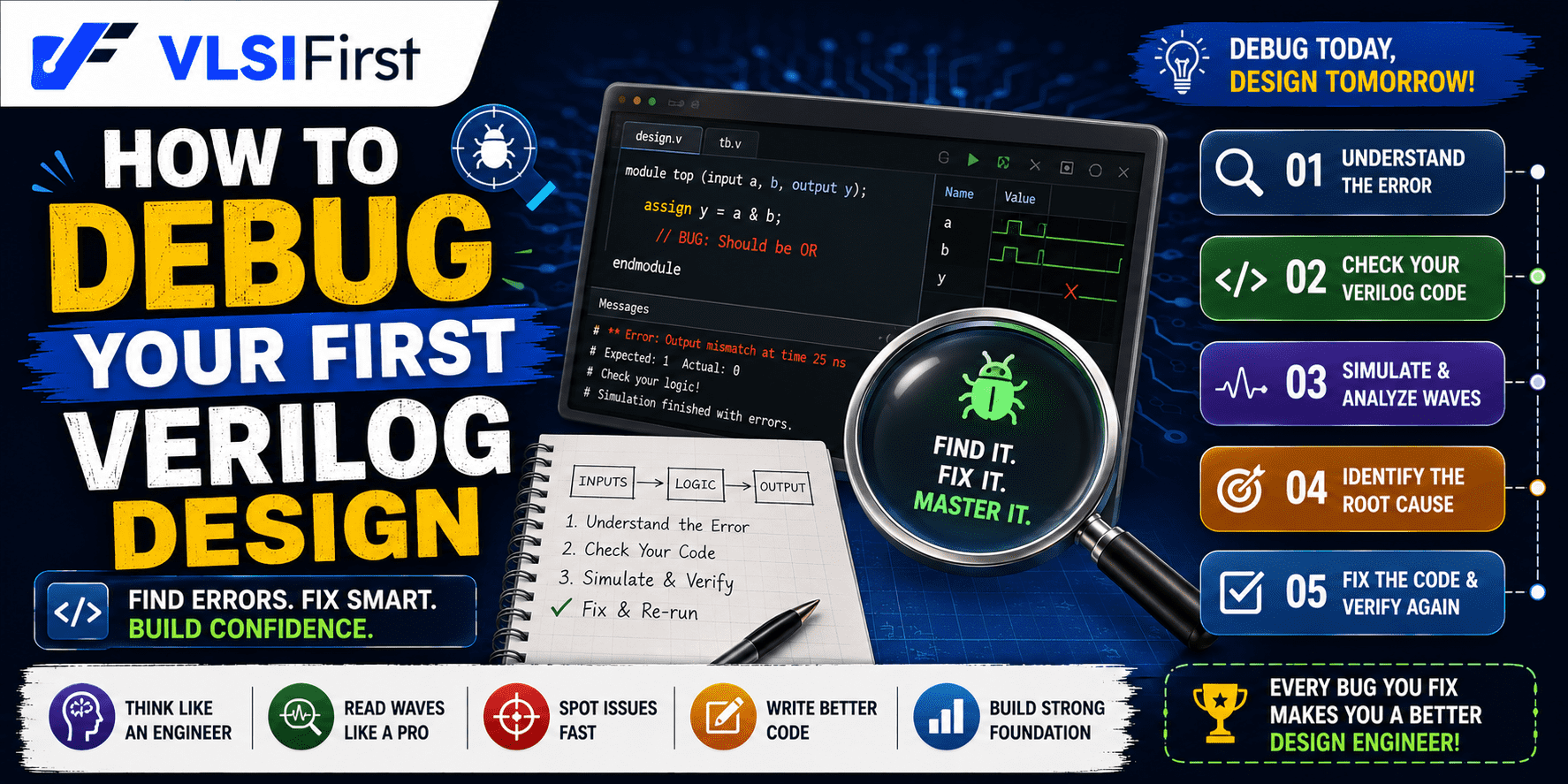
How to Debug Your First Verilog Design
Debugging your first Verilog design with practical RTL debug techniques, waveform analysis, testbench tips, FSM debugging, and common beginner mistakes. Read now!
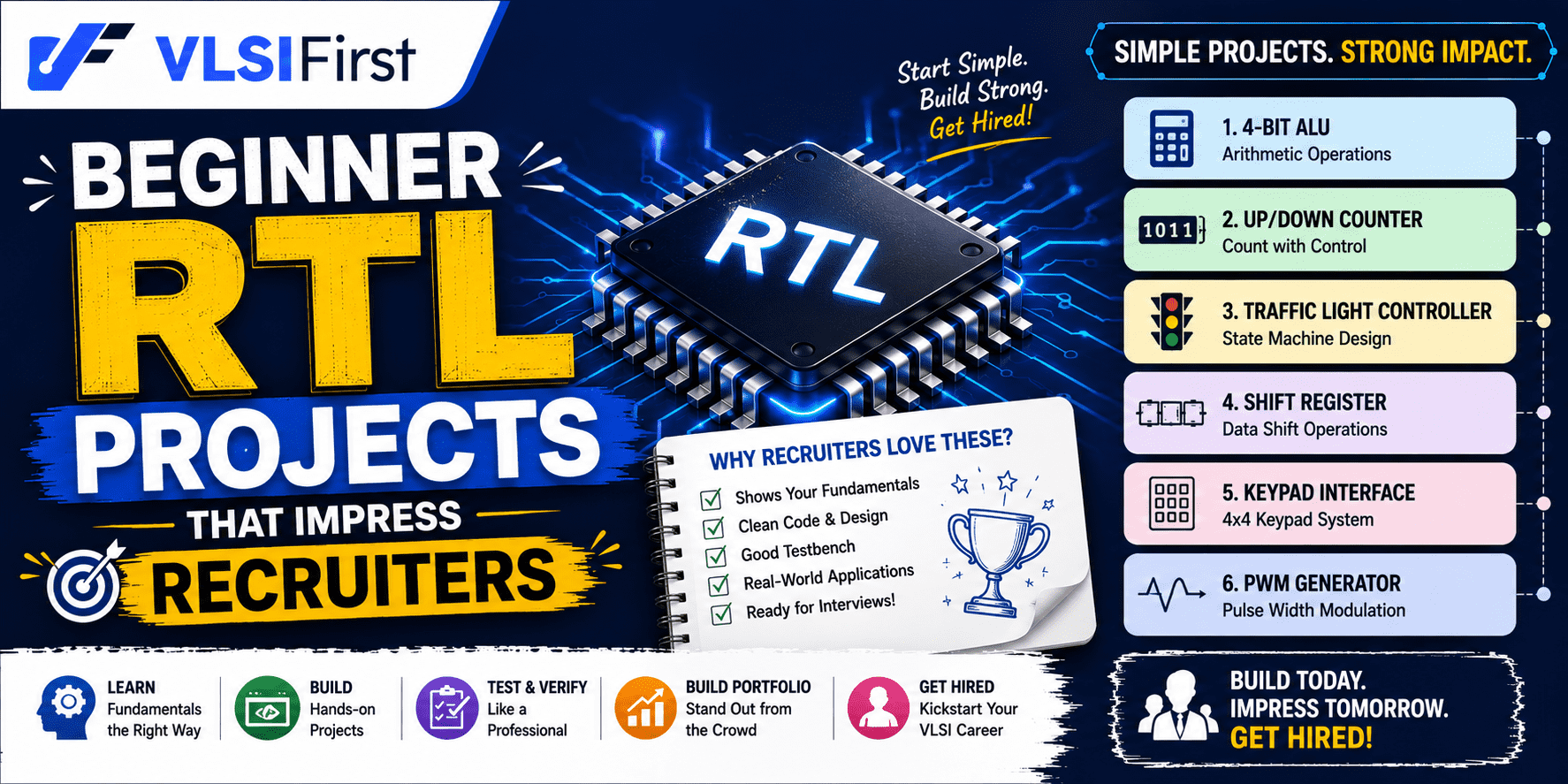
Beginner RTL Projects That Impress Recruiters
Discover beginner RTL projects that impress VLSI recruiters. Learn which Verilog projects build practical skills, strengthen your portfolio, and improve interview success.
.


Hours
2-98/1, Gurram Guda Road, Gurram Guda, Hyderabad, Rangareddy, Telangana, 501510
Copyright 2025 © VLSI Technologies Private Limited
Designed and developed by KandraDigitalCopyright 2025 © VLSI Technologies Private Limited
Designed, Developed & Marketing by KandraDigital