
The semiconductor industry is entering a transformative phase driven by AI acceleration, automotive electronics, 5G/6G communication, advanced process nodes, and chiplet-based architectures. The role of a VLSI engineer is evolving rapidly. Employers are no longer looking for only textbook knowledge; they expect multi-skilled engineers who can design, verify, optimize, and collaborate across domains.
1. Strong Fundamentals of Digital VLSI Design
No matter how advanced technology becomes, digital design fundamentals remain the backbone of VLSI engineering.
Key Areas to Master
- Combinational and sequential logic
- Finite State Machines (FSMs)
- Timing concepts (setup, hold, skew)
- Clocking and reset strategies
Engineers with weak fundamentals struggle at advanced nodes, where timing margins are tight.
2. Proficiency in Verilog and SystemVerilog
Hardware Description Languages continue to be core skills.
Why This Skill Matters
- Verilog is widely used for RTL design
- SystemVerilog is essential for modern verification
- Clean RTL improves synthesis and timing closure
Must-Know Topics
- RTL coding guidelines
- Assertions (SVA)
- Parameterized and modular design
3. Verification and Debugging Expertise
With increasing chip complexity, verification consumes over half of the total project effort.
Critical Verification Skills
- Functional verification concepts
- UVM methodology
- Coverage-driven verification
- Debugging simulation failures
Even design engineers are expected to understand verification deeply.
4. Understanding of ASIC Design Flow
By 2030, companies expect engineers to see the big picture of chip development.
Key ASIC Flow Knowledge
- RTL to GDSII flow
- Logic synthesis
- Static timing analysis (STA)
- Design for testability (DFT)
This knowledge helps engineers make better design decisions early.
5. Physical Design and Timing Awareness
Advanced nodes make physical design awareness mandatory—even for front-end engineers.
Essential Physical Design Concepts
- Floorplanning and placement
- Clock Tree Synthesis (CTS)
- Routing congestion
- Timing closure techniques
Understanding physical effects reduces iterations and design failures.
6. Low-Power Design Techniques
Power efficiency is a top priority, especially for AI and mobile chips.
Low-Power Skills to Learn
- Clock gating
- Power gating
- Multi-voltage domains
- UPF/CPF basics
Low-power optimization is now a core expectation, not a niche skill.
7. Knowledge of Semiconductor Technology and Process Nodes
VLSI engineers must understand how silicon technology affects design.
Important Topics
- FinFET and GAAFET technologies
- Process node scaling challenges
- Variability and reliability
- Yield and manufacturability
This knowledge helps engineers design robust and manufacturable chips.
8. Exposure to FPGA Prototyping
FPGA skills continue to complement ASIC development.
Why FPGA Matters
- Rapid prototyping
- Early validation of RTL
- Hardware-software co-design
Engineers who can move designs from FPGA to ASIC are highly valued.
9. Programming and Scripting Skills
Automation is becoming a necessity rather than an advantage.
Recommended Languages
- Python for automation
- Tcl for EDA tool scripting
- Shell scripting for workflows
Engineers who automate tasks deliver results faster.
10. Familiarity with AI and ML in Chip Design
AI is reshaping how chips are designed and optimized.
Emerging Applications
- AI-assisted verification
- Predictive timing and power analysis
- Intelligent EDA tools
Understanding AI’s role gives engineers a competitive edge.
11. Knowledge of Industry-Standard EDA Tools
While tools differ across companies, familiarity with industry workflows is essential.
Tool Categories
- RTL simulation
- Synthesis
- Physical design
- Debug and analysis
Conceptual understanding is more important than memorizing tool commands.
12. Design for Testability (DFT) Awareness
Testability is critical for manufacturing success.
Core DFT Skills
- Scan chains
- ATPG concepts
- Fault models
Engineers with DFT awareness reduce silicon test costs.
13. Problem-Solving and Analytical Thinking
Beyond technical skills, problem-solving defines great VLSI engineers.
Why It Matters
- Debugging complex issues
- Root-cause analysis
- Handling design trade-offs
Employers value thinking ability over rote knowledge.
14. Documentation and Communication Skills
In global teams, communication is critical.
Required Soft Skills
- Clear technical documentation
- Design reviews
- Cross-team collaboration
Engineers who communicate well advance faster.
15. Continuous Learning Mindset
Technology evolves rapidly, and there is no exception.
Areas for Continuous Learning
- New process nodes
- Advanced packaging and chiplets
- Updated verification methodologies
Adaptability is one of the most valuable skills.
Common Skill Gaps VLSI Engineers Must Address
- Weak fundamentals
- Overdependence on tools
- Poor debugging habits
- Lack of system-level thinking
Identifying gaps early ensures long-term success.
How Freshers Can Build These Skills
- Follow a structured VLSI learning roadmap
- Work on hands-on RTL and FPGA projects
- Learn scripting alongside design
- Participate in internships and design challenges
Conclusion
A successful VLSI engineer is not defined by a single specialization but by a balanced combination of fundamentals, practical skills, automation, and adaptability. Whether you choose design, verification, or physical design, mastering these top VLSI skills will make you future-ready in a highly competitive semiconductor industry.

How to Test Your RTL Before Simulation: A Practical Pre-Simulation Checklist for Beginners
Learn how to test your RTL before simulation with a practical pre-simulation checklist. Improve Verilog quality, reduce debugging time, and build industry-ready RTL skills.
From Logic Diagram to Verilog Code – Complete Workflow
Learn the complete workflow from logic diagram to Verilog code, including specifications, RTL architec ture, coding, simulation, debugging, verification, and documentation.
Common Mistakes While Writing Verilog Code
Learn the most common Verilog coding mistakes beginners make and how to avoid them. Improve RTL coding, simulation, debugging, verification, and interview readiness.
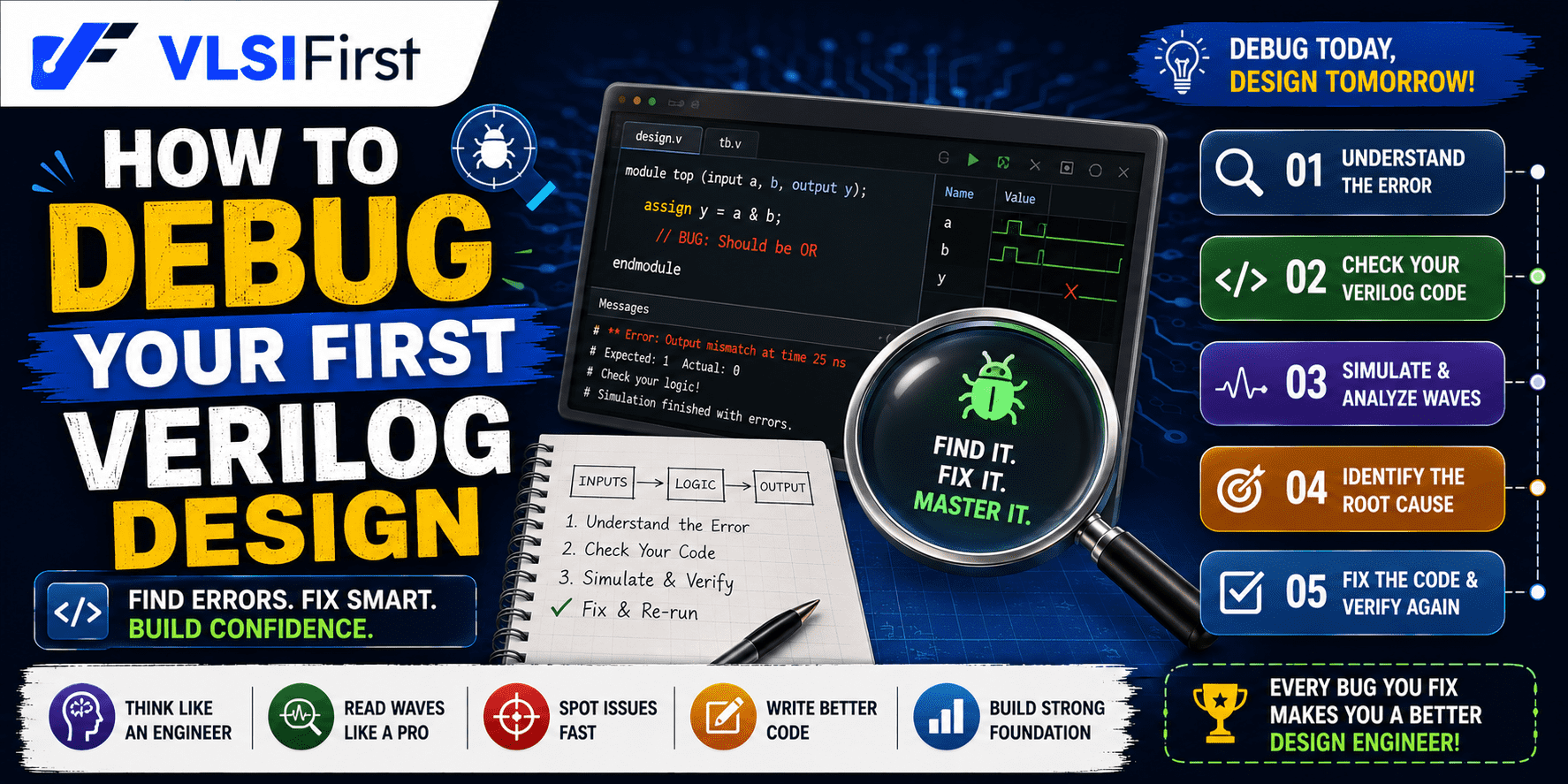
How to Debug Your First Verilog Design
Debugging your first Verilog design with practical RTL debug techniques, waveform analysis, testbench tips, FSM debugging, and common beginner mistakes. Read now!
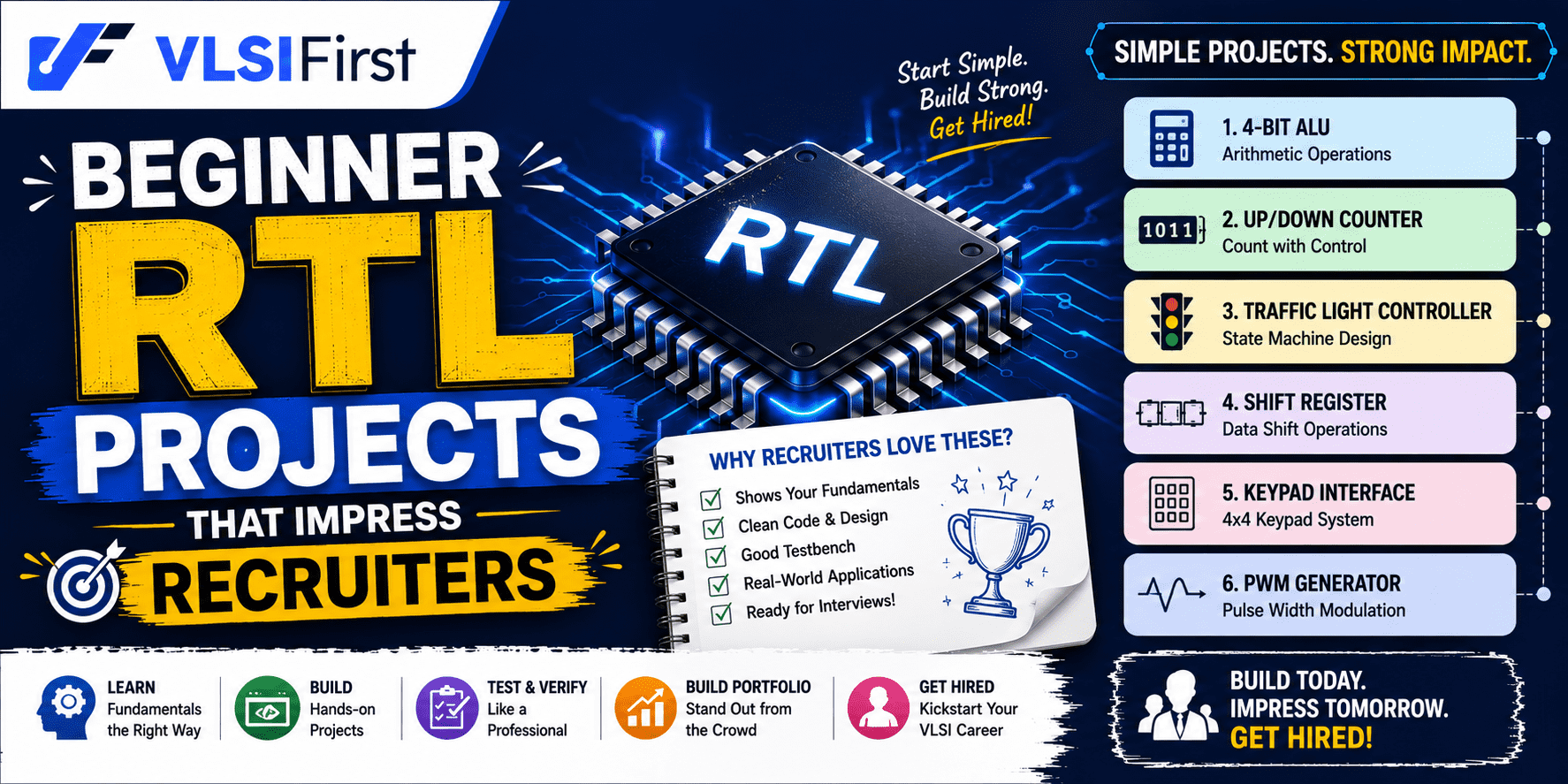
Beginner RTL Projects That Impress Recruiters
Discover beginner RTL projects that impress VLSI recruiters. Learn which Verilog projects build practical skills, strengthen your portfolio, and improve interview success.
.


Hours
2-98/1, Gurram Guda Road, Gurram Guda, Hyderabad, Rangareddy, Telangana, 501510
Copyright 2025 © VLSI Technologies Private Limited
Designed and developed by KandraDigitalCopyright 2025 © VLSI Technologies Private Limited
Designed, Developed & Marketing by KandraDigital