
The debate between VLSI and Software careers has existed for decades, but it has become more relevant than ever.
Students graduating from ECE, EEE, and even Computer Science backgrounds often face a difficult question:
Should I build a career in semiconductor engineering or choose software development?
For many freshers, the comparison starts with salary packages, placement opportunities, and job availability. However, experienced professionals often look at a different factor:
Career longevity.
A career is not just about securing a first job. It is about staying relevant, growing professionally, adapting to industry changes, and maintaining demand over the next 20 to 30 years.
Both VLSI and Software industries offer tremendous opportunities. Both have produced highly successful professionals. However, the way careers evolve in these domains is significantly different.
This article explores how VLSI and Software careers compare from a long-term perspective and what students should understand before choosing their path.
Understanding Career Longevity
Career longevity refers to how long a professional can remain valuable, employable, and competitive within an industry.
A career with strong longevity usually offers:
- Long-term demand
- Continuous growth opportunities
- Skill relevance over decades
- Resistance to automation
- Strong value for experienced professionals
- Sustainable salary progression
When evaluating VLSI versus Software careers, this perspective is often more important than short-term salary comparisons.
Why Software Careers Became Popular
Software engineering has become one of the largest employment sectors in the world.
Students are attracted by:
- Massive hiring volumes
- Diverse technology stacks
- Startup opportunities
- Remote work options
- Relatively lower entry barriers
- Strong initial salary packages
A software developer can specialize in:
- Web Development
- Mobile Development
- Cloud Computing
- DevOps
- Data Engineering
- Artificial Intelligence
- Cybersecurity
- Full Stack Development
This diversity creates tremendous opportunities for newcomers.
However, the rapid pace of change creates unique challenges.
Why VLSI Careers Are Different
The semiconductor industry operates differently.
VLSI engineers work on technologies that power:
- Smartphones
- AI accelerators
- Automotive electronics
- Data centers
- Consumer electronics
- Medical devices
- Aerospace systems
- Industrial automation
Unlike software products that can be updated frequently, semiconductor products require extensive engineering validation before manufacturing.
As a result, semiconductor companies place significant value on:
- Deep technical expertise
- Engineering judgment
- Design experience
- Debugging capability
- System-level understanding
These characteristics influence long-term career growth.
How Skills Age in Software Careers
One challenge software professionals often face is rapid technology turnover.
Consider how frequently technologies change:
- Programming frameworks evolve.
- New development methodologies emerge.
- Cloud platforms introduce new services.
- Development tools become obsolete.
A developer who stops learning for a few years may discover that industry demand has shifted significantly.
For example, technologies that were highly popular five years ago may not receive the same attention today.
This does not mean software careers are unstable.
It simply means continuous adaptation is mandatory.
How Skills Age in VLSI Careers
VLSI also evolves, but core engineering concepts remain relevant for much longer.
Fundamental concepts such as:
- Digital logic
- Timing analysis
- RTL design
- Clock domain crossing
- Verification methodologies
- Physical design principles
continue to remain valuable across multiple technology generations.
An engineer who mastered timing analysis ten years ago still benefits from that knowledge today.
Similarly, debugging expertise becomes more valuable as chip complexity increases.
Experience Has Different Value in Both Industries
One of the biggest differences between software and VLSI careers is how experience is perceived.
In Software
Experience is important, but technology transitions can sometimes reduce the value of older expertise.
Professionals must continuously upgrade their technology stack.
The industry often rewards:
- Speed of adaptation
- Knowledge of current technologies
- Framework expertise
In VLSI
Experience usually compounds.
A senior VLSI engineer has likely encountered:
- Silicon failures
- Timing closure challenges
- Complex debugging scenarios
- Large-scale integration issues
- Multiple tape-outs
These experiences are difficult to replace.
As a result, senior semiconductor engineers often become increasingly valuable over time.
Impact of AI on Both Careers
Artificial Intelligence is transforming both industries.
However, the impact differs.
Software Industry
AI can now:
- Generate code
- Create applications
- Assist debugging
- Automate testing
- Produce documentation
This has raised concerns about the future of some software roles.
VLSI Industry
AI is being used to:
- Optimize placement
- Improve routing
- Accelerate verification
- Enhance timing prediction
However, AI still relies heavily on engineers to:
- Define architectures
- Analyze trade-offs
- Validate results
- Solve complex design issues
This means AI is currently acting more as an assistant than a replacement in semiconductor engineering.
Learning Curve: Software vs VLSI
Software generally offers a faster entry path.
Students can often:
- Learn programming online
- Build applications independently
- Create portfolios quickly
VLSI requires stronger engineering foundations.
Students typically need knowledge of:
- Digital electronics
- CMOS concepts
- RTL design
- Timing analysis
- Verification methodologies
This higher entry barrier can initially appear challenging, but it often contributes to stronger specialization and long-term value.
Career Progression Comparison
Typical Software Career Path
- Junior Developer
- Software Engineer
- Senior Developer
- Tech Lead
- Engineering Manager
- Solution Architect
Typical VLSI Career Path
- Trainee Engineer
- Design/Verification Engineer
- Senior Engineer
- Lead Engineer
- Staff Engineer
- Principal Engineer
- Technical Architect
Salary Growth Over Time
Students frequently compare starting salaries.
However, career longevity is influenced more by long-term earning potential.
In both industries:
- Skilled professionals earn well.
- Specialists command premium salaries.
- Technical leaders are highly compensated.
The major difference is that VLSI often rewards deep specialization, while software frequently rewards adaptability and technology transitions.
Which Industry Offers Better Stability?
No industry guarantees permanent stability.
However, semiconductor demand is driven by long-term trends including:
- AI hardware
- Electric vehicles
- Automotive electronics
- Edge computing
- Data centers
- Industrial automation
Every major technological advancement requires semiconductor innovation.
This creates strong long-term demand for experienced VLSI engineers.
When Software May Be a Better Choice
Software may be ideal if you:
- Enjoy coding extensively
- Prefer rapid innovation cycles
- Like building applications
- Want startup opportunities
- Prefer broad technology options
When VLSI May Be a Better Choice
VLSI may be ideal if you:
- Enjoy hardware engineering
- Like debugging complex systems
- Prefer deep technical expertise
- Have strong analytical thinking
- Enjoy understanding how technology works at the chip level
The Real Secret to Career Longevity
Many students ask:
"Which field guarantees a longer career?"
The truth is:
No field guarantees success.
Career longevity ultimately depends on:
- Continuous learning
- Problem-solving ability
- Adaptability
- Technical depth
- Professional growth mindset
An average engineer may struggle in either domain.
A highly skilled engineer can thrive in both.
Final Verdict
If the question is:
"Which field offers stronger long-term technical career value?"
VLSI has several advantages:
- Skills remain relevant longer
- Experience compounds significantly
- Deep expertise is highly rewarded
- Semiconductor demand continues to grow
- Technical architects remain valuable for decades
If the question is:
"Which field offers broader opportunities and faster entry?"
Software often provides:
- Larger hiring volumes
- More technology options
- Faster entry pathways
- Greater role diversity
Ultimately, the best choice depends on your interests, strengths, and career goals.
Students who genuinely enjoy hardware, digital design, problem-solving, and semiconductor technology often find VLSI to be an exceptionally rewarding long-term career.
Because while technologies change, the world will continue to need smarter chips, faster processors, efficient hardware, and the engineers who design them.
And that is why many experienced professionals believe VLSI remains one of the strongest long-term engineering careers in the technology industry.
How to Test Your RTL Before Simulation: A Practical Pre-Simulation Checklist for Beginners
Learn how to test your RTL before simulation with a practical pre-simulation checklist. Improve Verilog quality, reduce debugging time, and build industry-ready RTL skills.
From Logic Diagram to Verilog Code – Complete Workflow
Learn the complete workflow from logic diagram to Verilog code, including specifications, RTL architec ture, coding, simulation, debugging, verification, and documentation.
Common Mistakes While Writing Verilog Code
Learn the most common Verilog coding mistakes beginners make and how to avoid them. Improve RTL coding, simulation, debugging, verification, and interview readiness.
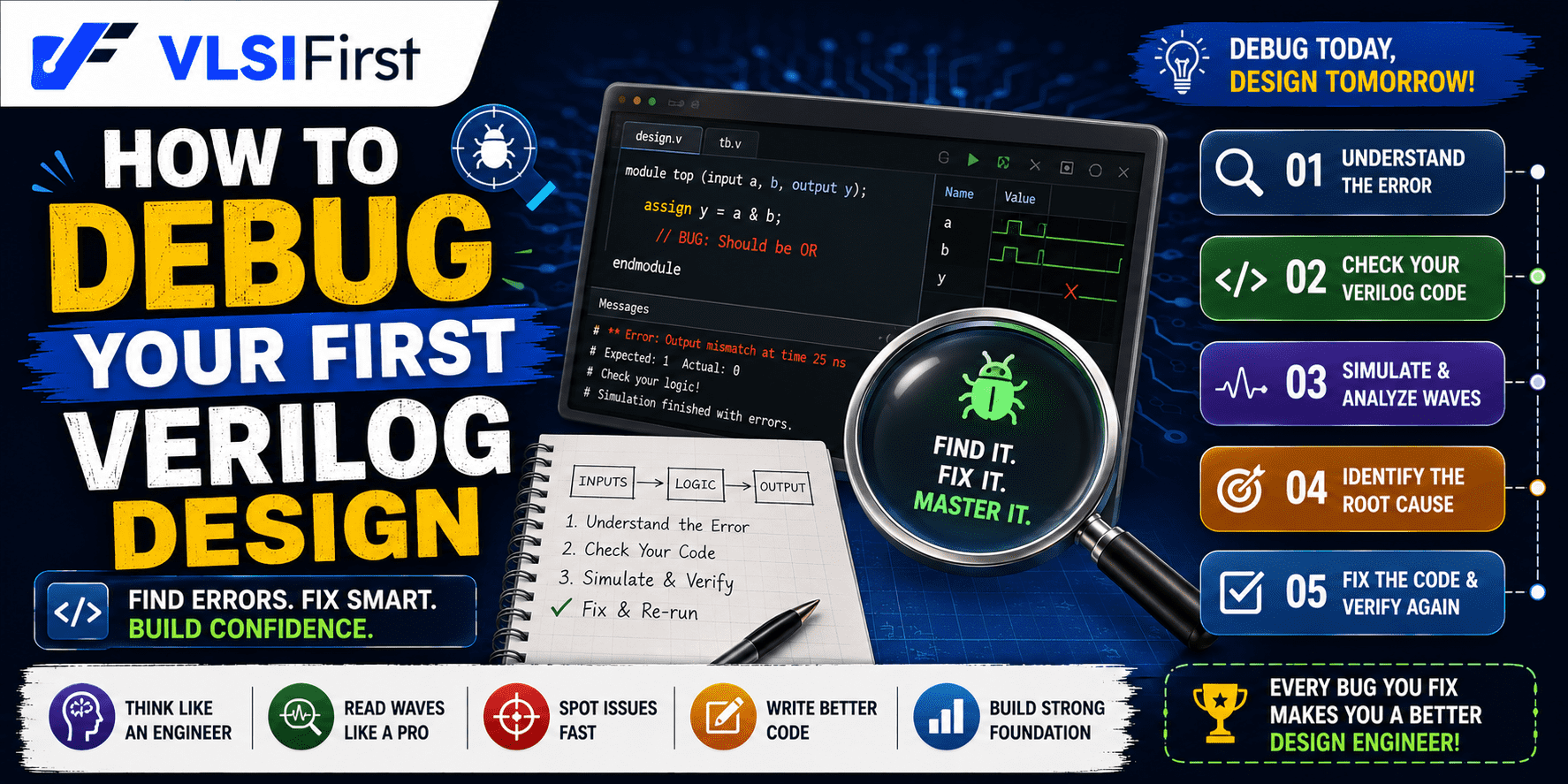
How to Debug Your First Verilog Design
Debugging your first Verilog design with practical RTL debug techniques, waveform analysis, testbench tips, FSM debugging, and common beginner mistakes. Read now!
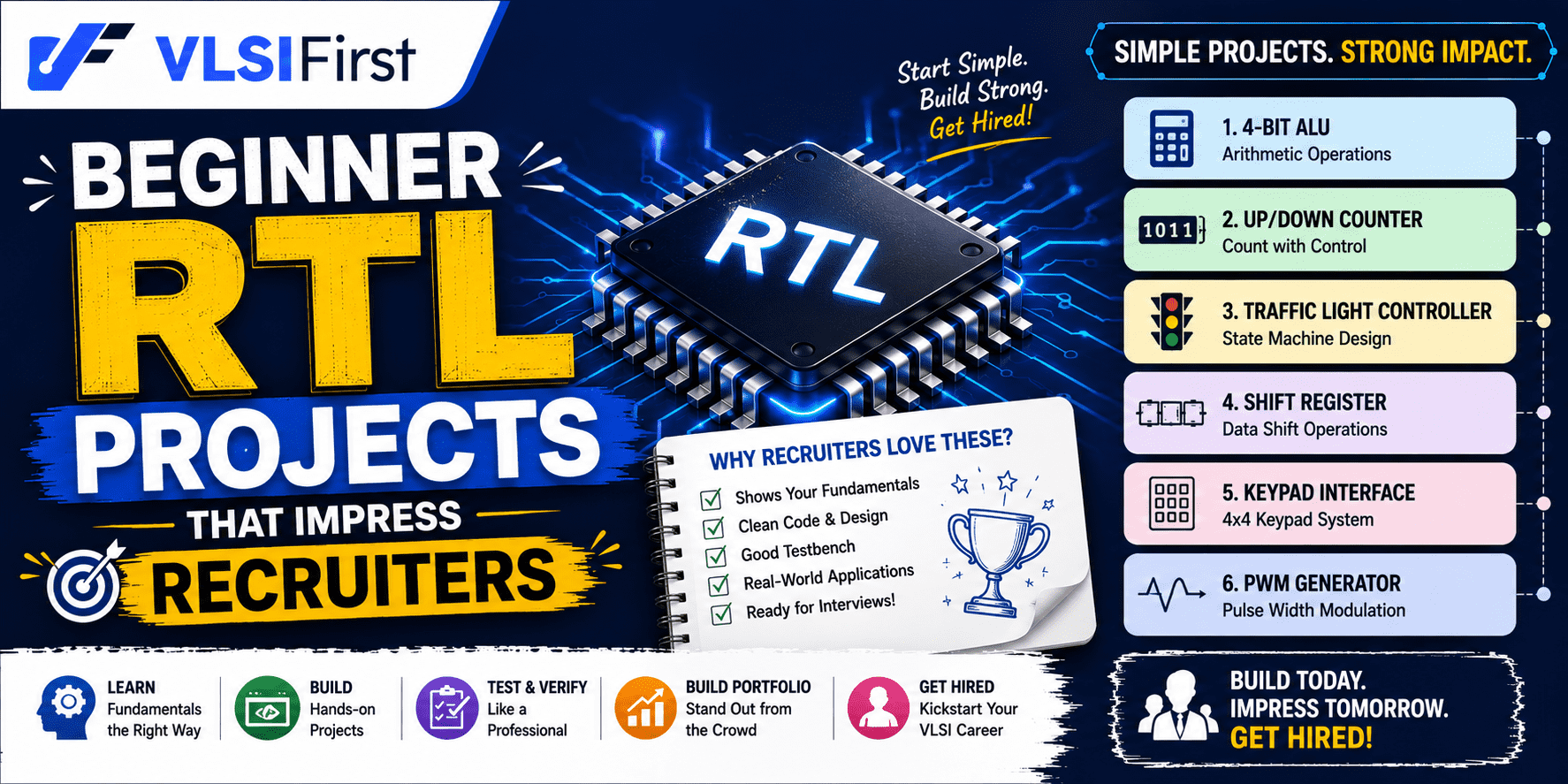
Beginner RTL Projects That Impress Recruiters
Discover beginner RTL projects that impress VLSI recruiters. Learn which Verilog projects build practical skills, strengthen your portfolio, and improve interview success.


Hours
2-98/1, Gurram Guda Road, Gurram Guda, Hyderabad, Rangareddy, Telangana, 501510
Copyright 2025 © VLSI Technologies Private Limited
Designed and developed by KandraDigitalCopyright 2025 © VLSI Technologies Private Limited
Designed, Developed & Marketing by KandraDigital