
One of the most common questions students ask before joining a VLSI training program is:
"What if I spend money on a VLSI course and still don't get a job?"
It's a fair question.
Whether you are a final-year ECE student, an EEE graduate, a fresher looking for your first opportunity, or someone planning a career transition, investing in professional training involves time, effort, and money.
Naturally, students want assurance that the investment will lead to employment.
Unfortunately, many training institutes market VLSI courses as if getting a job is automatic after course completion.
The reality is different.
A VLSI course can significantly improve your chances of getting hired, but no course can guarantee success without effort from the student.
The good news is that understanding the real factors behind VLSI placements can help you make smarter decisions and maximize your return on investment.
In this article, we'll discuss what happens if you don't get a job immediately after completing a VLSI course, why it happens, and how to ensure your investment continues creating value for your career.
The First Thing to Understand: A Course Is an Opportunity, Not a Guarantee
Many students unknowingly approach training with the wrong expectation.
They think:
Course + Certificate = Job
However, companies don't hire candidates simply because they completed a course.
Employers evaluate:
- Technical knowledge
- Practical skills
- Problem-solving ability
- Project experience
- Communication skills
- Learning attitude
A VLSI course provides the environment to develop these capabilities.
Whether you actually build them depends largely on how seriously you engage with the learning process.
Why Some Students Don't Get Jobs Immediately
Not getting placed immediately after course completion does not necessarily mean the course failed.
Several factors can influence placement timelines.
1. Lack of Practical Skills
Some students focus only on attending classes.
They avoid:
- Hands-on labs
- Tool practice
- Assignments
- Mini projects
As a result, they struggle during interviews despite completing the syllabus.
2. Weak Fundamentals
Companies often test:
- Digital Electronics
- Verilog concepts
- Timing analysis
- Semiconductor fundamentals
Students who rely only on tool knowledge may struggle to answer fundamental questions.
3. Poor Interview Preparation
Some candidates know the concepts but cannot explain them effectively.
Interview performance depends on:
- Communication
- Confidence
- Technical clarity
- Problem-solving approach
4. Unrealistic Expectations
Some students expect placement within a few weeks of course completion.
In reality, hiring cycles vary based on:
- Industry demand
- Company requirements
- Market conditions
- Candidate readiness
Placement is often a process rather than a single event.
Does Not Getting a Job Immediately Mean the Investment Is Lost?
Absolutely not.
This is where many students make a critical mistake.
They evaluate a VLSI course only by asking:
"Did I get a job immediately?"
A better question is:
"Did I acquire skills that increase my future employability?"
Skills continue creating value long after the course ends.
For example:
A student who learns:
- RTL Design
- Verification
- Physical Design
- STA
- DFT concepts
has developed capabilities that remain useful for years.
The Real Risk Is Not Learning
Students often worry about investing in training.
But many ignore the opposite risk:
What happens if I don't learn industry-relevant skills at all?
Without practical VLSI exposure, many graduates struggle because college education alone rarely provides:
- Industry tools
- Real-world workflows
- Advanced verification concepts
- Timing closure understanding
- Signoff methodologies
The cost of delaying skill development can often be much higher than the cost of training itself.
What Successful Students Do Differently
Students who secure VLSI jobs usually approach training differently.
They treat the course as a starting point rather than a finish line.
They:
- Practice regularly
- Ask questions
- Complete projects
- Build portfolios
- Attend mock interviews
- Strengthen fundamentals
The difference is rarely intelligence.
It is usually consistency.
How to Evaluate Whether a VLSI Course Is Worth the Investment
Before enrolling, ask the following questions.
Does the Course Include Practical Tool Exposure?
Theory alone is rarely enough.
Students should gain experience with industry-relevant workflows.
Does It Include Projects?
Projects demonstrate practical understanding.
They also improve resume quality and interview confidence.
Are Trainers Industry Experienced?
Learning from professionals who have worked on actual semiconductor projects provides valuable insights.
Is Placement Support Available?
While no institute can guarantee a job, good institutes often provide:
- Resume guidance
- Interview preparation
- Mock interviews
- Job referrals
- Career mentoring
These services can significantly improve outcomes.
What If You Face Multiple Interview Rejections?
Many students assume rejection means they are not suitable for VLSI.
This is rarely true.
Interview rejections usually indicate:
- Knowledge gaps
- Communication issues
- Lack of preparation
- Insufficient project exposure
Each interview provides valuable feedback.
Successful engineers often experience multiple rejections before receiving offers.
How Long Should You Give Yourself?
One common mistake is expecting immediate results.
Building industry-level competency takes time.
Depending on your starting point, becoming job-ready may require:
- Several months of learning
- Project work
- Interview practice
- Skill refinement
Patience and persistence are essential.
Can a VLSI Course Help Even If You Don't Get a Core Job Immediately?
Yes.
Many students leverage their VLSI skills in related areas such as:
- FPGA Development
- Embedded Systems
- Hardware Validation
- Semiconductor Testing
- EDA Support
- Product Engineering
The knowledge gained often opens multiple career pathways.
The Importance of Continuous Learning
The semiconductor industry rewards engineers who continue improving after training.
Learning should not stop after course completion.
Students should continue:
- Practicing coding
- Working on projects
- Exploring advanced topics
- Following industry trends
- Improving debugging skills
This mindset dramatically increases long-term success.
What VLSIFirst Encourages Students to Focus On
At VLSIFirst, the goal is not merely to help students complete a course.
The focus is on helping students build:
- Strong fundamentals
- Practical skills
- Industry exposure
- Project experience
- Interview readiness
- Long-term career growth
Students who focus on these areas are far more likely to succeed in semiconductor careers.
Final Thoughts
The question should not be:
"What if I invest in a VLSI course and don't get a job?"
A better question is:
"Will this course help me develop valuable skills that improve my career opportunities?"
The answer depends on:
- The quality of the course
- Your commitment to learning
- Practical project experience
- Interview preparation
- Consistency and persistence
A VLSI course is not a magic solution.
It is a platform.
What you build on that platform determines the outcome.
Students who actively learn, practice, improve, and stay committed typically find that their investment continues paying dividends long after the course is completed.
And in a growing semiconductor industry, strong skills remain one of the most valuable investments you can make in your future.

How to Test Your RTL Before Simulation: A Practical Pre-Simulation Checklist for Beginners
Learn how to test your RTL before simulation with a practical pre-simulation checklist. Improve Verilog quality, reduce debugging time, and build industry-ready RTL skills.
From Logic Diagram to Verilog Code – Complete Workflow
Learn the complete workflow from logic diagram to Verilog code, including specifications, RTL architec ture, coding, simulation, debugging, verification, and documentation.
Common Mistakes While Writing Verilog Code
Learn the most common Verilog coding mistakes beginners make and how to avoid them. Improve RTL coding, simulation, debugging, verification, and interview readiness.
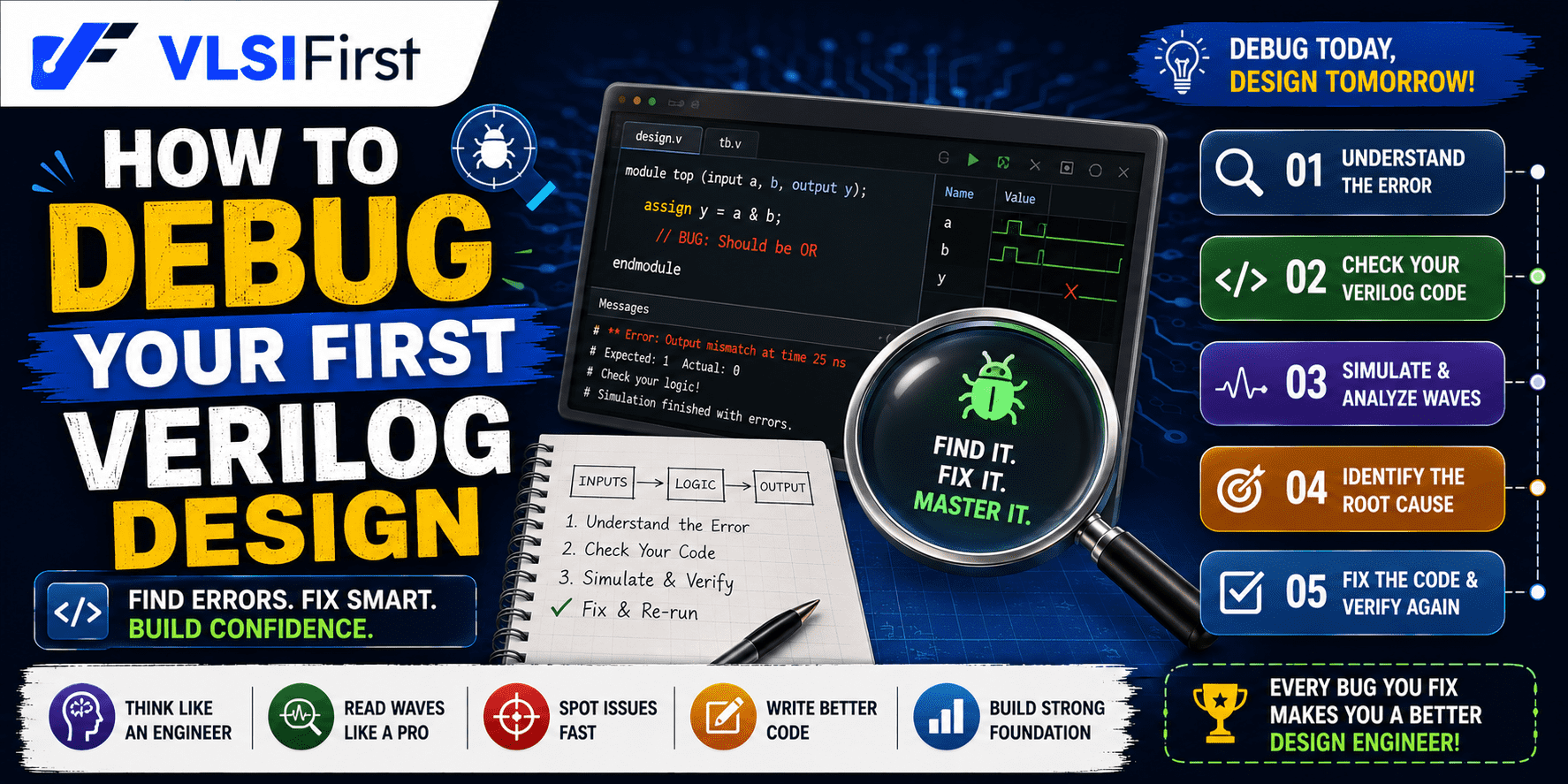
How to Debug Your First Verilog Design
Debugging your first Verilog design with practical RTL debug techniques, waveform analysis, testbench tips, FSM debugging, and common beginner mistakes. Read now!
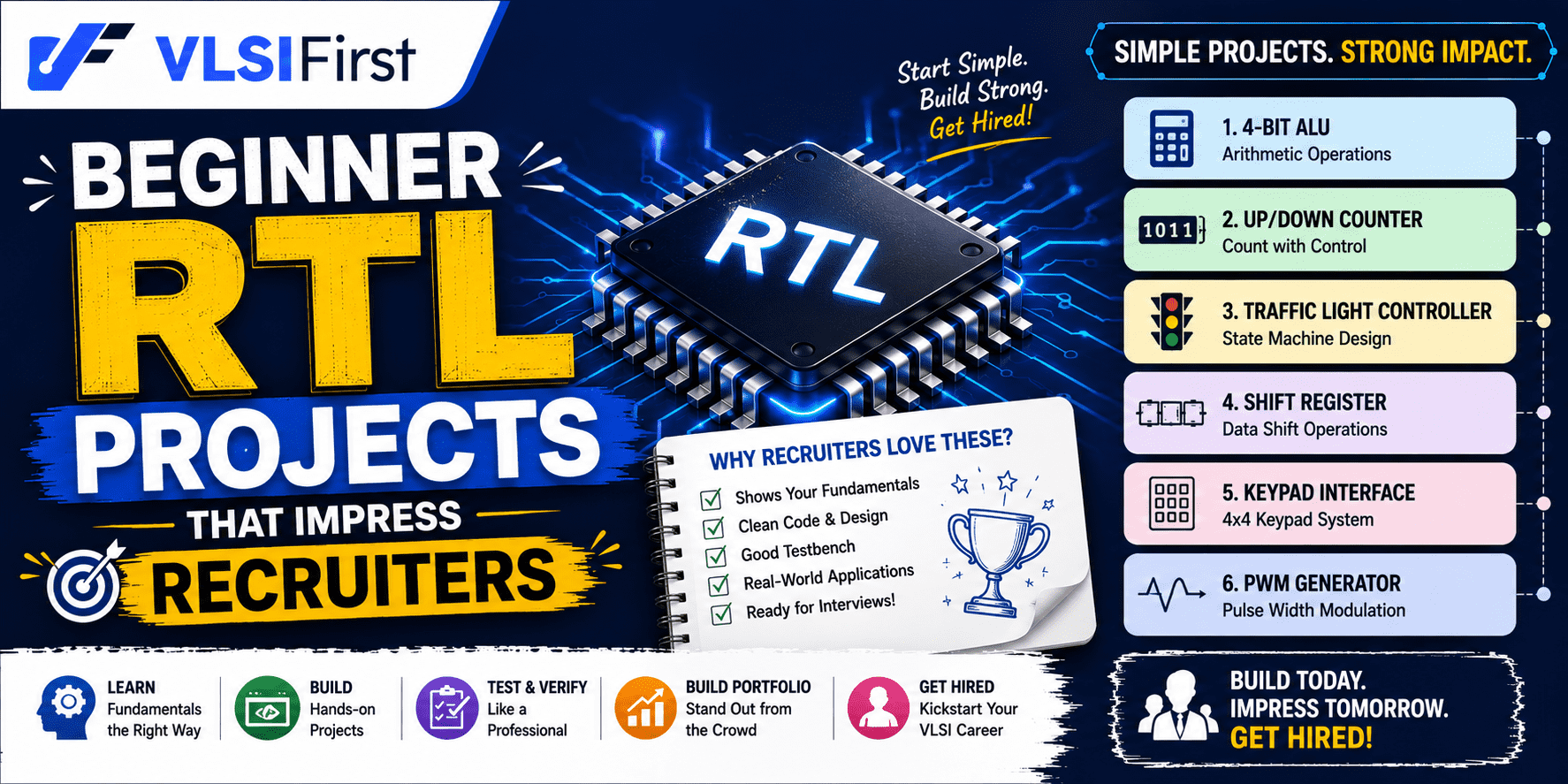
Beginner RTL Projects That Impress Recruiters
Discover beginner RTL projects that impress VLSI recruiters. Learn which Verilog projects build practical skills, strengthen your portfolio, and improve interview success.


Hours
2-98/1, Gurram Guda Road, Gurram Guda, Hyderabad, Rangareddy, Telangana, 501510
Copyright 2025 © VLSI Technologies Private Limited
Designed and developed by KandraDigitalCopyright 2025 © VLSI Technologies Private Limited
Designed, Developed & Marketing by KandraDigital