
The semiconductor industry is evolving faster than ever.
Artificial Intelligence, automation, advanced-node chip design, chiplets, high-performance computing, automotive electronics, and AI accelerators are transforming how modern semiconductor products are built.
Naturally, many students and freshers now ask an important question:
- “Which VLSI skills will still matter in the future?”
- “Will today’s skills become outdated?”
- “How can I build a future-proof VLSI career?”
These are smart questions because technology changes rapidly.
Tools evolve.
Workflows improve.
Automation increases.
But despite all these changes, some engineering skills continue to remain valuable decade after decade.
The students who build those long-term skills become:
- adaptable engineers
- strong problem solvers
- technically stable professionals
This blog explains:
- which VLSI skills are likely to remain relevant over the next 10 years
- why these skills matter
- which skills may become less valuable
- how students can prepare for long-term semiconductor careers
Why Some Skills Become Obsolete Faster Than Others
Before discussing future-proof skills, students must understand something important:
Tools change faster than engineering fundamentals.
For example:
- EDA interfaces evolve
- workflows improve
- automation increases
- scripting styles change
But core semiconductor principles like:
- timing
- digital logic
- architecture
- debugging
- verification reasoning
remain essential.
This is why engineers with strong fundamentals adapt better across technology changes.
Industry hiring trends consistently show that companies value adaptable engineers with strong engineering depth over candidates who only know tool operations.
1. Digital Design Fundamentals
This skill will NEVER become irrelevant.
No matter how advanced semiconductor technology becomes, engineers still need to understand:
- combinational logic
- sequential logic
- FSMs
- synchronization
- clocking
- timing behavior
Even AI-assisted design tools depend on correct digital engineering principles.
Students with weak digital fundamentals often struggle long-term because advanced tools cannot compensate for conceptual confusion.
2. Debugging Skills
Debugging will remain one of the most valuable VLSI skills for the foreseeable future.
Why?
Because as chips become more complex:
- failures become harder to identify
- corner cases increase
- integration issues grow
- timing interactions become more complicated
AI tools may help identify patterns, but human engineers still perform:
- root-cause analysis
- waveform debugging
- design reasoning
- failure isolation
Modern semiconductor companies increasingly prioritize debugging capability during hiring.
3. Problem-Solving Ability
This may become the single most important future-proof skill.
Automation can handle repetitive tasks.
But engineers still need to:
- analyze problems
- optimize systems
- make trade-off decisions
- solve unexpected issues
Semiconductor engineering is fundamentally a problem-solving field.
Students who depend only on:
- memorization
- tutorials
- copied code
may struggle as automation grows.
4. RTL Design Skills
RTL design will continue to remain highly relevant because hardware description remains central to digital chip development.
Even if AI tools assist coding:
- architecture decisions
- modularity
- optimization
- functionality
still require human engineering judgment.
Strong RTL engineers understand:
- scalability
- synthesizable coding
- timing-aware design
- maintainability
These skills remain critical in real semiconductor workflows.
5. Timing Analysis Knowledge
Timing will remain one of the core challenges in semiconductor engineering.
As chips move toward:
- smaller nodes
- higher frequencies
- lower voltages
- denser integration
timing complexity continues to increase.
Engineers who understand:
- setup violations
- hold violations
- clock uncertainty
- critical paths
- timing optimization
will remain valuable for many years.
Advanced-node timing closure is already one of the toughest engineering problems today.
6. Verification Expertise
Verification demand is growing rapidly because chip complexity is exploding.
Verification engineers are increasingly needed for:
- protocol validation
- coverage closure
- system-level testing
- corner-case analysis
- regression management
Even with AI-assisted verification tools, human engineers still define:
- test strategy
- verification architecture
- debugging flow
Verification continues to be one of the largest engineering segments in semiconductor development.
7. System-Level Thinking
Future semiconductor engineers will increasingly need to understand:
- hardware-software interaction
- architecture integration
- SoC-level behavior
- power-performance trade-offs
The industry is moving toward:
- heterogeneous computing
- AI accelerators
- chiplets
- advanced packaging
This requires broader engineering understanding.
System-level thinking is becoming more valuable than isolated tool knowledge.
8. Adaptability and Continuous Learning
This may be the most important long-term career skill.
Technology changes continuously:
- new tools emerge
- flows evolve
- architectures change
Engineers who resist learning often become outdated quickly.
Meanwhile, engineers who continuously upgrade themselves remain highly employable.
9. Communication and Collaboration Skills
Future semiconductor development will become even more collaborative.
Engineers regularly interact with:
- design teams
- verification teams
- firmware teams
- physical design teams
- AI hardware teams
Strong communication skills help engineers:
- explain issues clearly
- discuss trade-offs
- collaborate efficiently
Technical communication will remain highly valuable.
10. Scripting and Automation Thinking
While repetitive scripting may become automated, engineers who understand:
- automation workflows
- scripting logic
- productivity optimization
will continue to benefit.
Languages like:
- Python
- TCL
- Shell scripting
will likely remain useful because semiconductor workflows continue to rely heavily on automation integration.
Which Skills May Lose Value Faster?
Students should also understand what may become less future-proof.
1. Pure Tool Memorization
Simply memorizing:
- commands
- GUI workflows
- button clicks
is risky because tools evolve constantly.
2. Repetitive Low-Level Tasks
Basic repetitive optimization tasks are increasingly becoming automated using AI-assisted EDA solutions.
3. Shallow Learning
Students who only:
- watch tutorials passively
- memorize interview questions
- copy projects
may struggle long-term.
Depth matters more than superficial coverage.
Why Fundamentals Matter More Than Ever
Ironically, as AI and automation grow: fundamentals become MORE important.
Why?
Because engineers must:
- validate automated outputs
- understand tool limitations
- debug intelligently
- optimize complex systems
Without strong fundamentals, students become overdependent on tools.
How Students Can Build Future-Proof VLSI Careers
1. Focus on Core Concepts
Strengthen:
- digital logic
- timing
- RTL
- verification basics
before chasing advanced tools.
2. Build Real Projects
Projects improve:
- implementation understanding
- debugging skills
- engineering confidence
3. Learn Debugging Seriously
Debugging experience creates long-term engineering maturity.
4. Understand Complete Flows
Learn how: RTL → Synthesis → STA → PD → Verification connect together.
5. Stay Curious
Technology evolves constantly.
Curiosity helps engineers remain adaptable.
Why VLSI Still Has Strong Long-Term Potential
Despite automation fears, semiconductor demand continues to grow because of:
- AI hardware
- automotive electronics
- cloud computing
- IoT devices
- robotics
- edge computing
The world increasingly depends on semiconductor innovation.
This creates long-term demand for skilled engineers.
Final Verdict
The VLSI skills that will remain valuable 10 years from now are NOT necessarily:
- specific tool versions
- temporary workflows
- memorized commands
The truly future-proof skills are:
- Debugging
- Problem-solving
- RTL understanding
- timing analysis
- verification thinking
- system-level understanding
- adaptability
These skills survive technology changes because they are rooted in engineering fundamentals.
Do not build your VLSI career only around:
- Tools
- Shortcuts
- Memorized workflows
Instead, focus on becoming:
- a strong thinker
- a practical engineer
- a problem solver
- a continuous learner
Because in the future semiconductor industry:
The engineers who remain valuable the longest will not be the ones who memorize the most tools, they will be the engineers who understand systems, solve problems, and adapt continuously.
For more semiconductor career guidance, VLSI learning strategies, and industry-focused preparation resources, explore detailed content on VLSIFirst.com.
How to Test Your RTL Before Simulation: A Practical Pre-Simulation Checklist for Beginners
Learn how to test your RTL before simulation with a practical pre-simulation checklist. Improve Verilog quality, reduce debugging time, and build industry-ready RTL skills.
From Logic Diagram to Verilog Code – Complete Workflow
Learn the complete workflow from logic diagram to Verilog code, including specifications, RTL architec ture, coding, simulation, debugging, verification, and documentation.
Common Mistakes While Writing Verilog Code
Learn the most common Verilog coding mistakes beginners make and how to avoid them. Improve RTL coding, simulation, debugging, verification, and interview readiness.
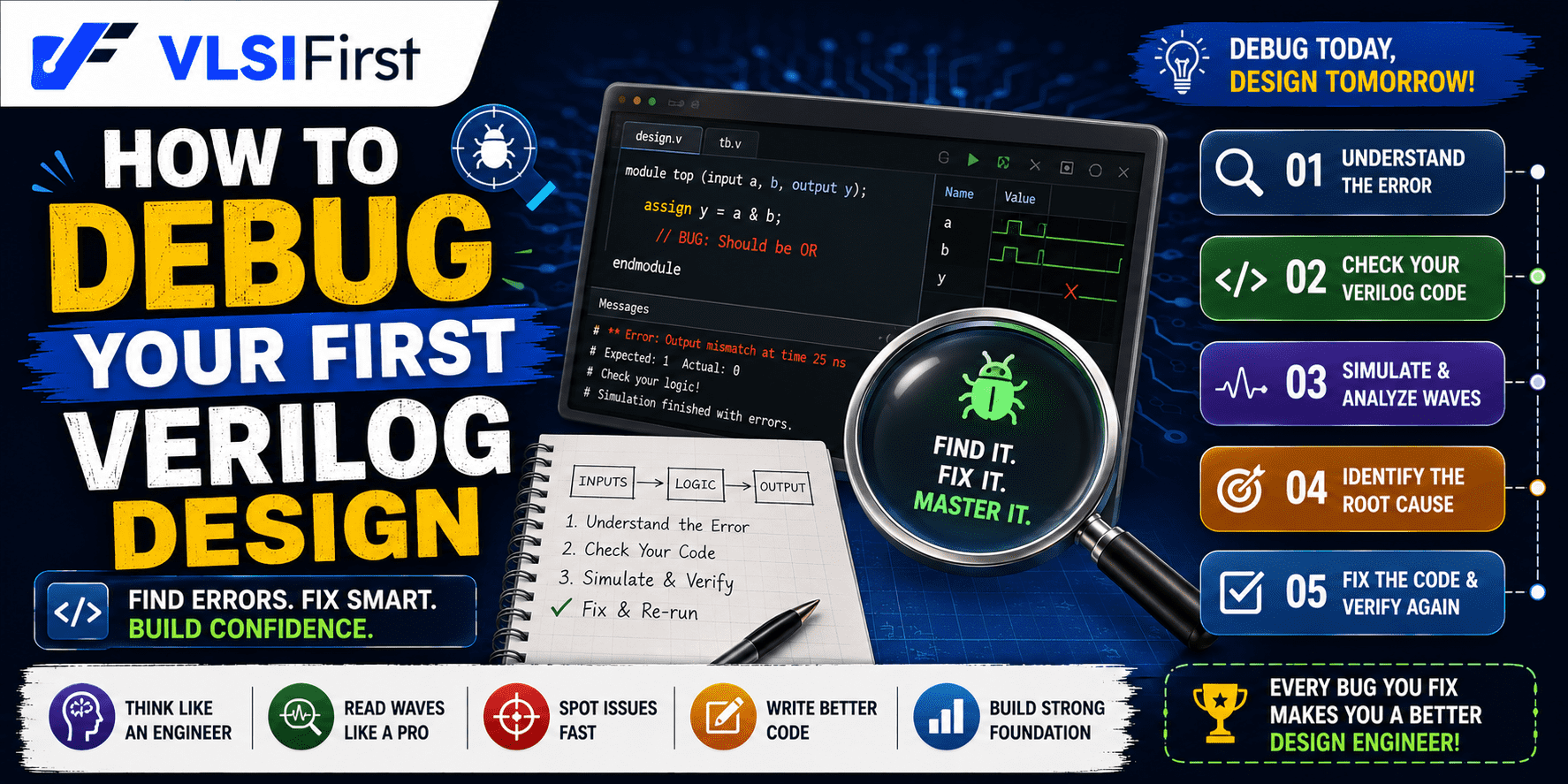
How to Debug Your First Verilog Design
Debugging your first Verilog design with practical RTL debug techniques, waveform analysis, testbench tips, FSM debugging, and common beginner mistakes. Read now!
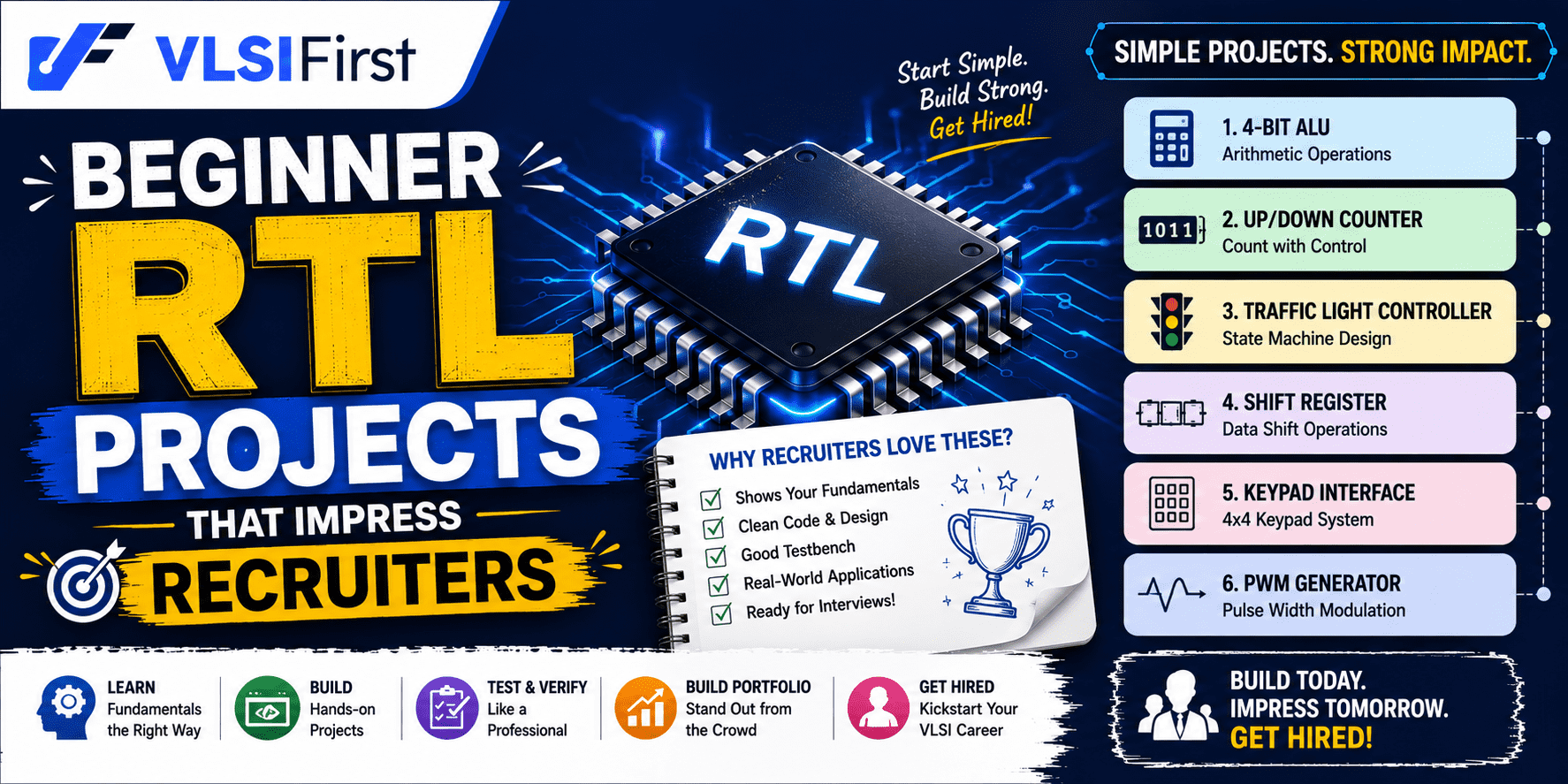
Beginner RTL Projects That Impress Recruiters
Discover beginner RTL projects that impress VLSI recruiters. Learn which Verilog projects build practical skills, strengthen your portfolio, and improve interview success.


Hours
2-98/1, Gurram Guda Road, Gurram Guda, Hyderabad, Rangareddy, Telangana, 501510
Copyright 2025 © VLSI Technologies Private Limited
Designed and developed by KandraDigitalCopyright 2025 © VLSI Technologies Private Limited
Designed, Developed & Marketing by KandraDigital