
One of the biggest misconceptions among engineering students is that only exceptionally intelligent or fast-learning individuals can succeed in VLSI.
Many students enter a VLSI classroom and immediately start comparing themselves with others.
They see classmates who:
- Understand Verilog quickly
- Solve digital design problems faster
- Answer trainer questions immediately
- Complete assignments ahead of schedule
As a result, they begin questioning themselves:
"Am I too slow for VLSI?"
"Will companies hire someone who takes longer to learn?"
"Maybe this field is only for toppers."
These doubts are more common than most students realize.
The good news is that VLSI is not a race to learn concepts first. It is a profession built on understanding, precision, consistency, and problem-solving. In fact, many successful semiconductor engineers were not necessarily the fastest learners during their training phase.
This article explains why slow learners can absolutely succeed in VLSI and how they can turn their learning style into a long-term advantage.
The Myth That Fast Learners Always Win
Engineering colleges often create the impression that speed equals intelligence.
Students who answer quickly are often seen as more capable.
However, professional VLSI work operates differently.
Semiconductor companies rarely reward engineers for learning concepts in a single day.
Instead, they value engineers who can:
- Understand systems deeply
- Analyze problems accurately
- Find root causes
- Debug effectively
- Deliver reliable solutions
A person who learns slowly but thoroughly can often outperform someone who learns quickly but forgets concepts later.
This is particularly true in semiconductor engineering, where precision matters far more than speed.
Why VLSI Is Different from Typical Academic Learning
In college, success is often measured through:
- Exam scores
- Assignment completion
- Memorization
- Short-term performance
VLSI careers require something different.
Engineers work on complex challenges such as:
- Timing violations
- RTL debugging
- Functional verification
- Clock domain crossings
- Physical design optimization
- Power analysis
These tasks cannot be solved through memorization alone.
They require deep conceptual understanding.
Students who spend extra time understanding "why" something works often build stronger foundations than those who simply move through topics quickly.
Slow Learners Often Develop Better Fundamentals
Many fast learners have a tendency to skip foundational details because they can understand high-level concepts quickly.
Slow learners often do the opposite.
They spend more time on:
- Digital Electronics
- Logic Design
- Semiconductor Basics
- RTL Fundamentals
- Timing Concepts
As a result, they build stronger conceptual foundations.
In VLSI interviews, strong fundamentals frequently matter more than superficial knowledge of advanced topics.
Understanding Matters More Than Finishing First
Imagine two students learning Static Timing Analysis.
Student A finishes the topic in one week.
Student B takes three weeks.
Six months later:
- Student A remembers only definitions.
- Student B can explain setup violations, hold violations, clock uncertainty, and timing closure strategies.
Which student is more valuable during interviews?
Usually, the second one.
Employers care about understanding and application, not how quickly a topic was completed during training.
VLSI Rewards Consistency More Than Talent
One of the most surprising realities in engineering careers is that consistency often beats raw talent.
A student who studies:
- 1 hour every day
- Practices regularly
- Revises concepts
- Works on projects consistently
will usually outperform someone who studies intensely for a few days and then loses momentum.
VLSI is a field where steady progress accumulates over time.
Slow Learners Tend to Ask Better Questions
Students who learn gradually often ask more questions.
Initially, they may see this as a weakness.
In reality, it can become a major advantage.
By asking questions, they:
- Clarify doubts
- Strengthen understanding
- Discover practical applications
- Avoid conceptual gaps
Experienced VLSI engineers spend a significant portion of their careers asking questions and investigating problems.
Curiosity is often more valuable than speed.
Problem Solving Matters More Than Quick Answers
Many students worry because they cannot answer technical questions immediately.
However, professional engineering rarely works that way.
Companies value engineers who can:
- Analyze situations
- Break down problems
- Investigate causes
- Develop solutions logically
These skills develop through practice and persistence rather than natural speed.
Slow Learning Often Leads to Better Retention
One hidden advantage of slower learning is retention.
When students spend time:
- Revising concepts
- Practicing examples
- Building projects
- Debugging errors
their knowledge tends to remain longer.
VLSI careers span decades.
Long-term retention is far more valuable than short-term learning speed.
The Danger of Constant Comparison
One of the biggest obstacles for slow learners is comparison.
Students often compare themselves to:
- Top performers
- Seniors
- LinkedIn success stories
- Friends in training programs
The problem is that comparison rarely tells the full story.
You may see someone's success.
You do not see:
- Their struggles
- Their failures
- Their learning journey
- Their years of preparation
Every engineer progresses at a different pace.
The goal is not to learn faster than everyone else.
The goal is to learn well enough to build a successful career.
Why Semiconductor Companies Care About Accuracy
A small design error in a chip can cost millions of dollars.
This is why semiconductor companies prioritize:
- Accuracy
- Attention to detail
- Thorough analysis
- Validation
- Reliability
These qualities are often associated with thoughtful learners rather than rushed learners.
Being methodical can become a professional advantage.
How Slow Learners Can Accelerate Their Progress
Being a slow learner does not mean accepting slow results forever.
There are practical ways to improve learning efficiency.
Build Strong Fundamentals First
Master:
- Digital Electronics
- CMOS Basics
- Verilog Fundamentals
- Number Systems
before jumping into advanced topics.
Focus on Hands-On Practice
Practical implementation improves understanding faster than passive learning.
Create Mini Projects
Projects connect theory with real-world application.
Even simple projects can dramatically improve confidence and retention.
Revise Frequently
Consistent revision reduces the feeling of starting over each time you study.
Many Successful Engineers Were Not Fast Learners
If you talk to experienced semiconductor professionals, you will hear a common pattern.
Many of them struggled initially with:
- Coding
- Timing concepts
- Verification methodologies
- Design implementation
What separated them from others was not natural brilliance.
It was persistence.
They continued learning when things became difficult.
That persistence eventually turned into expertise.
What Recruiters Actually Want
Recruiters rarely ask:
"How quickly did you learn Verilog?"
Instead, they evaluate:
- Understanding
- Practical skills
- Problem-solving ability
- Communication
- Project experience
- Learning attitude
A slow learner with strong fundamentals and project experience is often more attractive than a fast learner with weak understanding.
Final Thoughts
If you consider yourself a slow learner, remember this:
VLSI is not a sprint.
It is a long-term engineering career built on knowledge, precision, and continuous improvement.
The students who succeed are not always the fastest learners.
They are often the ones who:
- Stay consistent
- Ask questions
- Practice regularly
- Build projects
- Learn from mistakes
- Keep moving forward despite setbacks
In semiconductor engineering, deep understanding eventually matters more than early speed.
So don't measure your future by how quickly you understand a concept today.
Measure it by your willingness to keep learning tomorrow.
That mindset has helped countless engineers build successful VLSI careers, and it can help you do the same.

How to Test Your RTL Before Simulation: A Practical Pre-Simulation Checklist for Beginners
Learn how to test your RTL before simulation with a practical pre-simulation checklist. Improve Verilog quality, reduce debugging time, and build industry-ready RTL skills.
From Logic Diagram to Verilog Code – Complete Workflow
Learn the complete workflow from logic diagram to Verilog code, including specifications, RTL architec ture, coding, simulation, debugging, verification, and documentation.
Common Mistakes While Writing Verilog Code
Learn the most common Verilog coding mistakes beginners make and how to avoid them. Improve RTL coding, simulation, debugging, verification, and interview readiness.
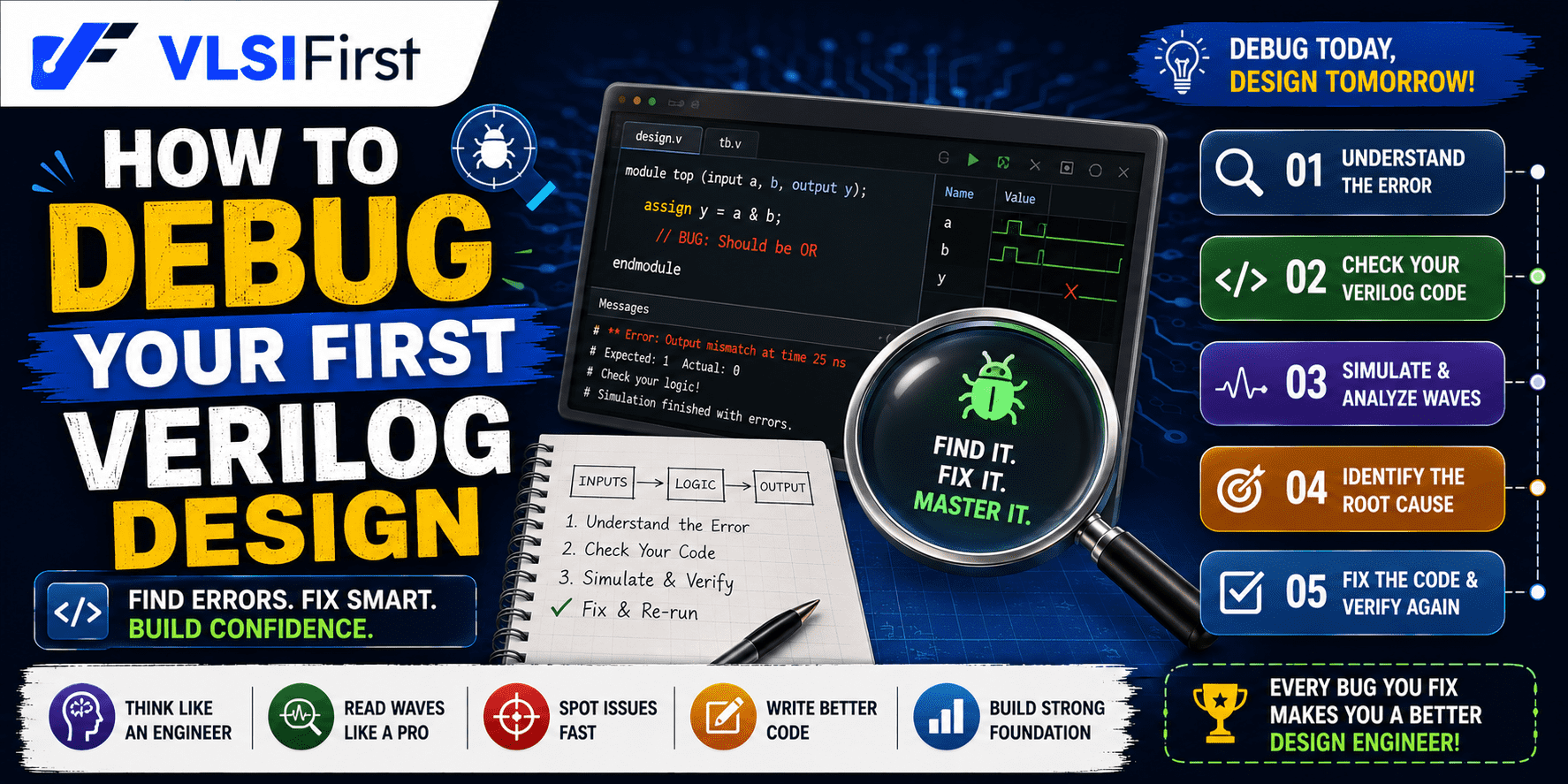
How to Debug Your First Verilog Design
Debugging your first Verilog design with practical RTL debug techniques, waveform analysis, testbench tips, FSM debugging, and common beginner mistakes. Read now!
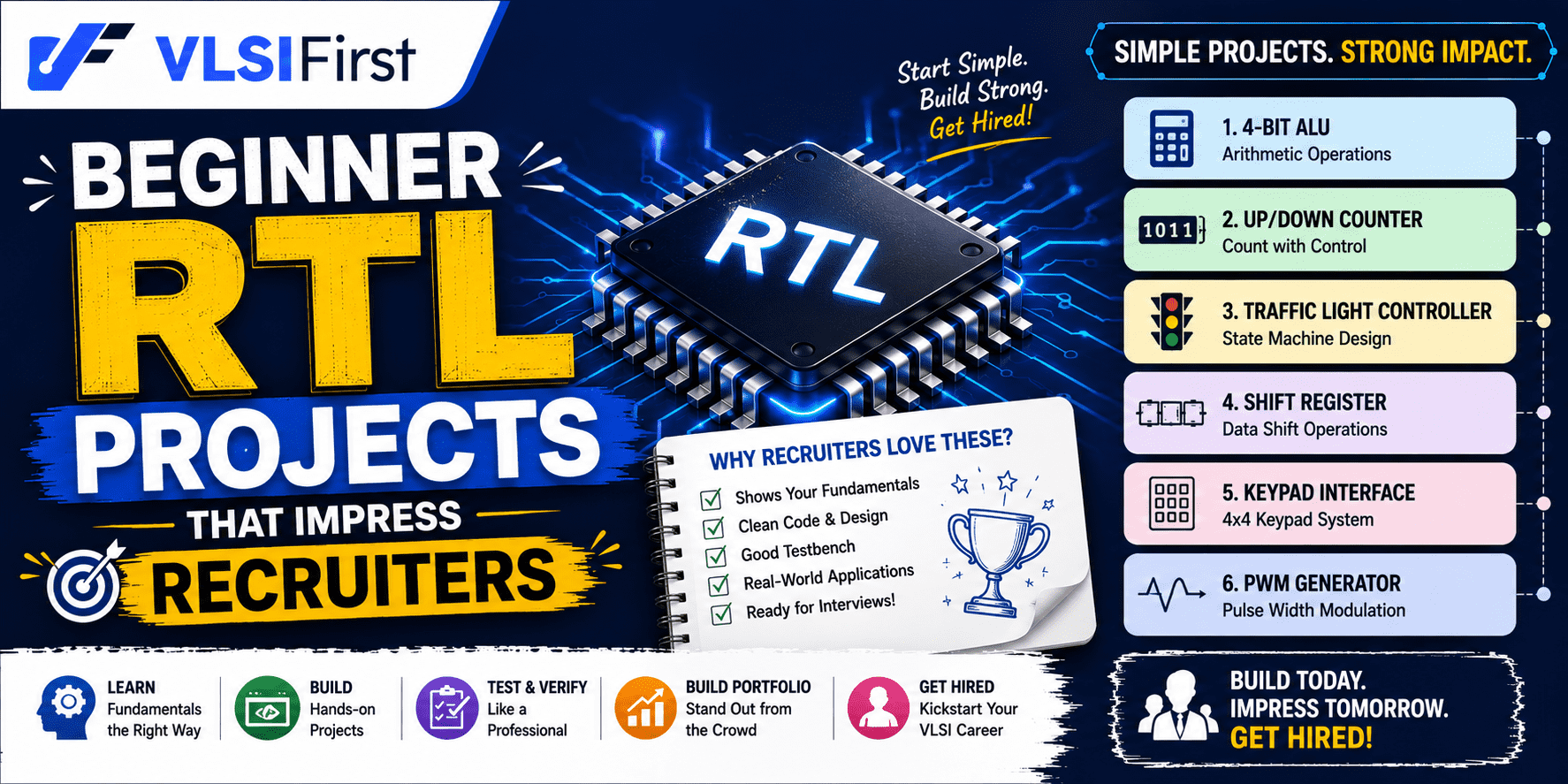
Beginner RTL Projects That Impress Recruiters
Discover beginner RTL projects that impress VLSI recruiters. Learn which Verilog projects build practical skills, strengthen your portfolio, and improve interview success.


Hours
2-98/1, Gurram Guda Road, Gurram Guda, Hyderabad, Rangareddy, Telangana, 501510
Copyright 2025 © VLSI Technologies Private Limited
Designed and developed by KandraDigitalCopyright 2025 © VLSI Technologies Private Limited
Designed, Developed & Marketing by KandraDigital