
For many years, students viewed VLSI primarily as a career option.
The common mindset was simple:
"Learn VLSI, get a semiconductor job, and build a career in chip design."
While that perspective is still valid, the reality is much bigger.
Today, VLSI is no longer just a specialized engineering role within a semiconductor company. It has evolved into a strategic skill that influences entire industries, national economies, technological innovation, and the future of artificial intelligence.
Countries are investing billions into semiconductor ecosystems. Technology giants are designing their own chips. Automotive manufacturers are hiring chip engineers. AI companies are racing to build faster hardware accelerators. Governments are treating semiconductor expertise as a matter of economic and technological security.
This transformation has fundamentally changed how VLSI should be viewed.
Instead of asking:
"Can VLSI help me get a job?"
Students should start asking:
"How can VLSI position me within one of the world's most strategically important industries?"
This shift in perspective is critical for anyone planning a long-term career in semiconductor engineering.
In this article, we'll explore why VLSI is increasingly becoming a strategic skill rather than just a job role and why this trend is creating enormous opportunities for the next generation of engineers.
Understanding the Difference Between a Job Role and a Strategic Skill
A job role is typically tied to a specific set of responsibilities.
Examples include:
- RTL Design Engineer
- Verification Engineer
- Physical Design Engineer
- DFT Engineer
- STA Engineer
A strategic skill, however, has broader significance.
It influences:
- Business decisions
- Industry competitiveness
- Product innovation
- National development
- Long-term technological leadership
Strategic skills remain valuable even when technologies, tools, or job titles change.
This is exactly what is happening with VLSI.
The knowledge required to design, verify, optimize, and manufacture advanced semiconductor devices is becoming increasingly important across multiple industries.
The Semiconductor Industry Is No Longer a Niche Sector
A decade ago, semiconductor engineering was often viewed as a niche specialization.
Today, chips power nearly every aspect of modern life.
Semiconductors are at the heart of:
- Artificial Intelligence
- Smartphones
- Cloud Computing
- Autonomous Vehicles
- Electric Vehicles
- Medical Devices
- Industrial Automation
- Aerospace Systems
- Defense Technologies
- Consumer Electronics
Every major technological advancement now depends on semiconductor innovation.
As a result, engineers with VLSI expertise are contributing to technologies that impact billions of people.
AI Growth Is Increasing the Importance of VLSI
Artificial Intelligence has become one of the biggest technology drivers of the decade.
However, AI cannot function without powerful hardware.
Every AI model relies on:
- GPUs
- AI accelerators
- High-bandwidth memory
- Advanced processors
- Specialized semiconductor architectures
While many students focus on AI software, the hardware powering AI is equally important.
This has created tremendous demand for engineers skilled in:
- Digital Design
- Verification
- Physical Design
- SoC Development
- Performance Optimization
As AI systems become larger and more complex, semiconductor expertise becomes increasingly strategic.
Countries Are Treating Semiconductors as Strategic Assets
One of the clearest signs that VLSI has become a strategic skill is government involvement.
Across the world, nations are investing heavily in semiconductor ecosystems.
Why?
Because semiconductor capability influences:
- Economic growth
- National security
- Technological independence
- Global competitiveness
Countries that possess strong semiconductor expertise gain significant advantages in future technologies.
This has increased demand for:
- Chip designers
- Verification specialists
- Physical Design engineers
- Semiconductor researchers
- Architecture experts
For students entering VLSI today, this means they are joining an industry that governments actively support.
Companies Now Design Their Own Chips
In the past, only dedicated semiconductor companies developed processors and SoCs.
Today, the landscape has changed dramatically.
Many technology companies now build custom silicon to optimize:
- Performance
- Power efficiency
- AI workloads
- Data center operations
- Edge computing devices
This trend has expanded VLSI opportunities far beyond traditional semiconductor firms.
Engineers with chip design expertise now contribute to:
- Consumer technology
- Cloud infrastructure
- Automotive platforms
- AI products
- Industrial systems
As a result, VLSI knowledge has become a strategic business advantage.
VLSI Skills Create Long-Term Relevance
One reason VLSI is becoming a strategic skill is because its core principles remain valuable for decades.
Technologies evolve.
Tools change.
Design methodologies improve.
However, fundamental concepts such as:
- Digital Logic
- Timing Analysis
- RTL Design
- Hardware Architecture
- Verification Methodologies
- System-Level Design
remain relevant across multiple technology generations.
This gives VLSI engineers a unique advantage.
Their expertise compounds over time.
Strategic Skills Are Difficult to Replace
Another characteristic of strategic skills is that they are difficult to automate completely.
Modern EDA tools increasingly use:
- Machine Learning
- Predictive Analytics
- Automation
- AI-Assisted Optimization
However, successful chip development still requires engineers to:
- Make architectural decisions
- Analyze trade-offs
- Validate design intent
- Solve complex problems
- Debug unexpected failures
AI can assist semiconductor workflows, but engineering judgment remains essential.
This makes experienced VLSI professionals highly valuable.
VLSI Supports Multiple Career Pathways
Strategic skills often create diverse career opportunities.
VLSI is no exception.
Engineers can grow into:
- Technical Leads
- SoC Architects
- Verification Experts
- Timing Specialists
- DFT Consultants
- Product Engineers
- Semiconductor Researchers
- Engineering Managers
The skill itself remains valuable even as responsibilities evolve.
Why Employers Value Strategic Thinkers
Modern semiconductor companies increasingly seek engineers who understand more than their immediate tasks.
Employers value professionals who can:
- Understand complete design flows
- Evaluate system-level impacts
- Collaborate across teams
- Anticipate future challenges
- Drive innovation
This requires moving beyond tool execution and developing broader engineering thinking.
What Students Should Learn from This Shift
Many students still evaluate careers based solely on:
- Placement statistics
- Starting salary
- Course duration
- Job titles
While these factors matter, they do not determine long-term success.
Students should also consider:
- Industry importance
- Future demand
- Skill longevity
- Growth opportunities
- Strategic relevance
Viewed through this lens, VLSI becomes much more than a career choice.
It becomes an investment in a future-critical skill.
How to Build Strategic Value as a VLSI Engineer
If you want to benefit from this industry transformation, focus on developing capabilities that extend beyond technical execution.
Strengthen Fundamentals
Master:
- Digital Electronics
- RTL Design
- Timing Analysis
- Verification Concepts
Understand Complete Chip Development Flows
Learn how:
RTL → Verification → Synthesis → STA → Physical Design → Signoff
fit together.
This broader understanding increases your value significantly.
Develop Problem-Solving Skills
Technical growth comes from solving increasingly complex engineering challenges.
Learn Automation and Scripting
Modern semiconductor workflows increasingly rely on:
- Python
- TCL
- Shell scripting
These skills improve productivity and prepare you for AI-assisted workflows.
Stay Updated with Industry Trends
Follow developments in:
- AI hardware
- RISC-V
- Chiplets
- Advanced Packaging
- Automotive Electronics
Engineers who understand industry direction often make better career decisions.
The Future of VLSI Professionals
Over the next decade, the demand for semiconductor expertise is expected to expand further.
Future opportunities will emerge in:
- AI Processors
- Edge AI Devices
- Autonomous Systems
- High-Performance Computing
- Quantum Computing Infrastructure
- Advanced Semiconductor Manufacturing
Engineers with strong VLSI foundations will be positioned to contribute to these technologies.
Final Thoughts
The biggest mistake students can make today is viewing VLSI as simply another engineering job.
The semiconductor industry has evolved far beyond that.
VLSI is now a strategic skill that influences:
- Artificial Intelligence
- National Technology Development
- Global Innovation
- Automotive Electronics
- Cloud Infrastructure
- Future Computing Platforms
This shift creates opportunities that extend well beyond traditional job roles.
Students who develop strong semiconductor expertise today are not merely preparing for employment.
They are preparing to participate in one of the most important technological transformations of the modern era.
And that is why VLSI is no longer just a career path.
It is increasingly becoming a strategic skill that will shape the future of technology itself.

How to Test Your RTL Before Simulation: A Practical Pre-Simulation Checklist for Beginners
Learn how to test your RTL before simulation with a practical pre-simulation checklist. Improve Verilog quality, reduce debugging time, and build industry-ready RTL skills.
From Logic Diagram to Verilog Code – Complete Workflow
Learn the complete workflow from logic diagram to Verilog code, including specifications, RTL architec ture, coding, simulation, debugging, verification, and documentation.
Common Mistakes While Writing Verilog Code
Learn the most common Verilog coding mistakes beginners make and how to avoid them. Improve RTL coding, simulation, debugging, verification, and interview readiness.
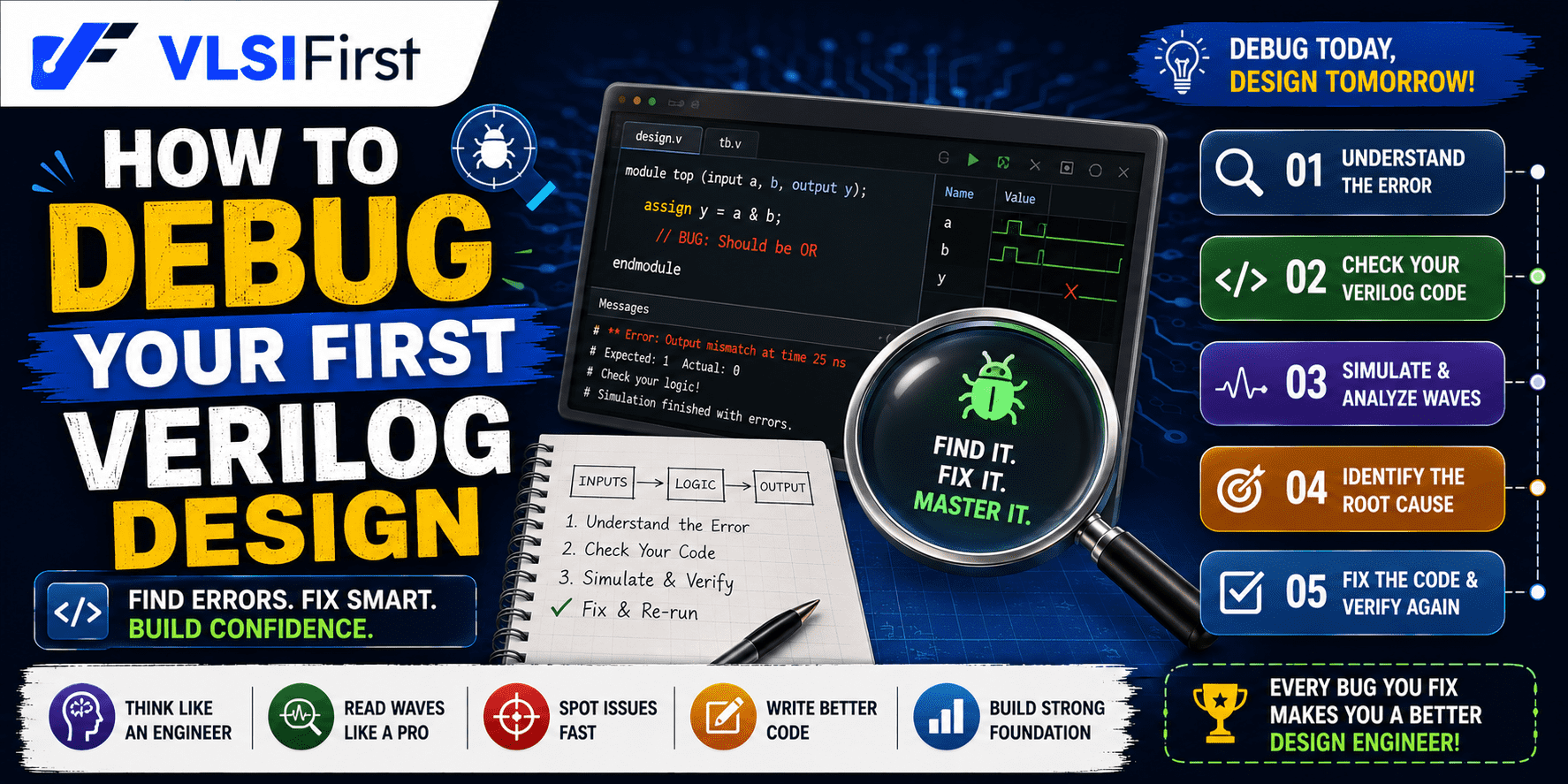
How to Debug Your First Verilog Design
Debugging your first Verilog design with practical RTL debug techniques, waveform analysis, testbench tips, FSM debugging, and common beginner mistakes. Read now!
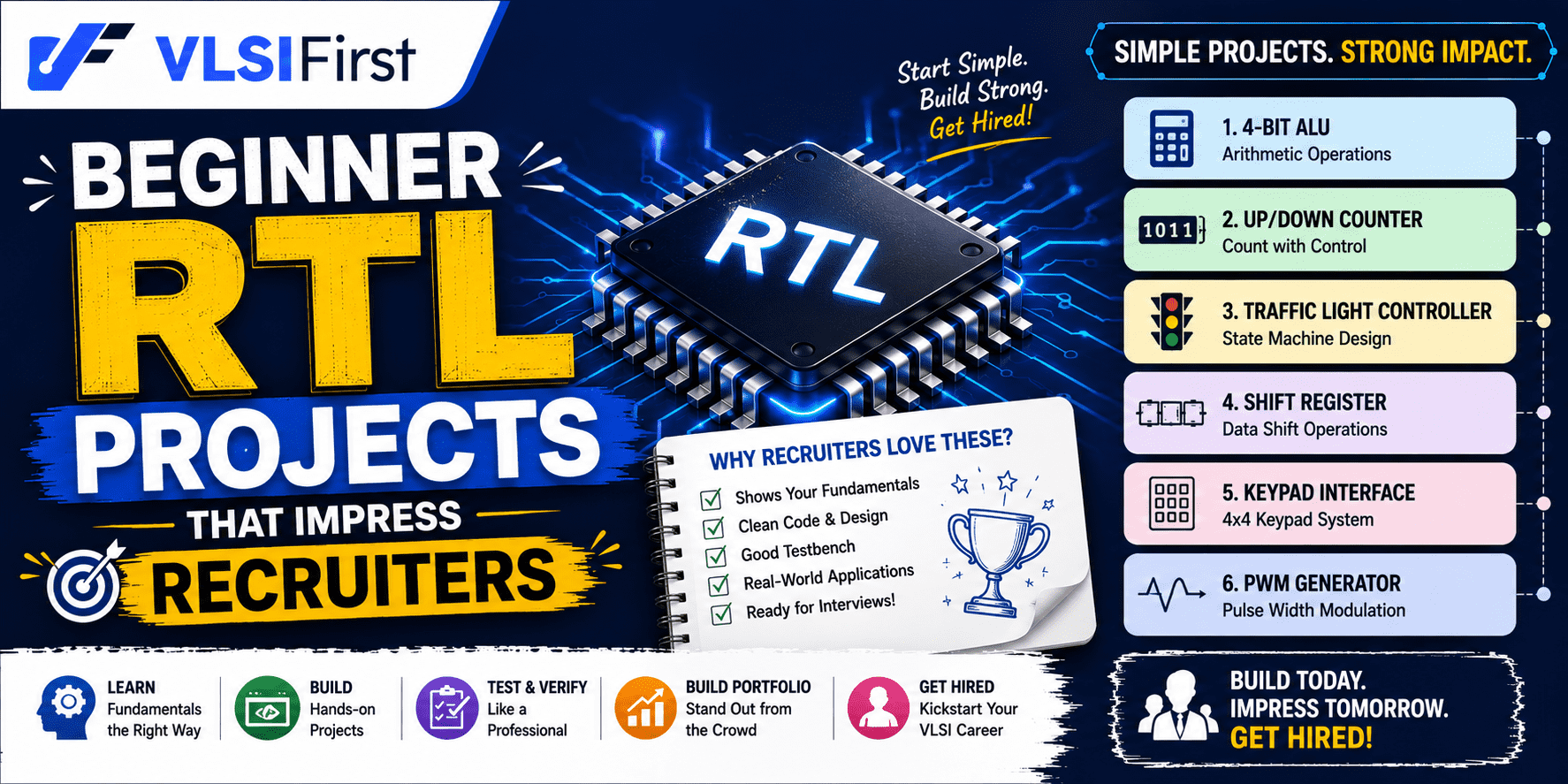
Beginner RTL Projects That Impress Recruiters
Discover beginner RTL projects that impress VLSI recruiters. Learn which Verilog projects build practical skills, strengthen your portfolio, and improve interview success.


Hours
2-98/1, Gurram Guda Road, Gurram Guda, Hyderabad, Rangareddy, Telangana, 501510
Copyright 2025 © VLSI Technologies Private Limited
Designed and developed by KandraDigitalCopyright 2025 © VLSI Technologies Private Limited
Designed, Developed & Marketing by KandraDigital