
The VLSI industry is known for offering excellent long-term career opportunities. With the rapid growth of AI hardware, automotive electronics, high-performance computing, semiconductor manufacturing, and advanced chip design, skilled VLSI engineers are in demand across the globe.
However, not every engineer experiences continuous career growth.
Many professionals start their careers with enthusiasm, secure a job in a semiconductor company, gain a few years of experience, and then suddenly find themselves in a situation where promotions slow down, learning stops, and career progress becomes stagnant.
This phenomenon is known as career stagnation.
The good news is that career stagnation is not inevitable. In most cases, it can be avoided through the right mindset, continuous learning, strategic skill development, and proactive career planning.
Whether you are a fresher preparing for your first VLSI job or an engineer with several years of experience, understanding how to avoid stagnation can help you build a rewarding and future-proof semiconductor career.
In this article, we will explore the common causes of career stagnation in VLSI and practical strategies to ensure continuous growth throughout your professional journey.
What Does Career Stagnation Mean in VLSI?
Career stagnation does not necessarily mean losing your job.
Instead, it refers to situations where:
- Your technical skills stop improving.
- You keep performing the same tasks for years.
- Promotions become infrequent.
- Salary growth slows significantly.
- You feel disconnected from industry advancements.
- Your market value remains unchanged despite years of experience.
Many engineers mistakenly assume that years of experience automatically translate into career growth.
In reality, the semiconductor industry rewards value creation, technical expertise, and problem-solving ability, not simply time spent in a role.
Why Career Stagnation Happens in VLSI
Before discussing solutions, let's understand the common reasons engineers stop progressing.
1. Becoming a Tool Operator Instead of an Engineer
Many engineers become highly dependent on specific EDA tools.
They know:
- Commands
- Flows
- Scripts
- Tool options
But they may not fully understand:
- Design concepts
- Timing behavior
- Architecture decisions
- Debugging methodologies
When tools change, their value decreases because their expertise is tied to the tool rather than the engineering concepts behind it.
2. Staying in a Comfort Zone
Some engineers become comfortable performing repetitive tasks.
For example:
- Running regressions
- Executing verification tests
- Managing standard timing reports
- Following predefined flows
While these activities are important, career growth usually comes from taking ownership of more complex responsibilities.
3. Ignoring Industry Evolution
The semiconductor industry changes rapidly.
Recent trends include:
- AI-assisted chip design
- Chiplet architectures
- Advanced packaging
- Automotive semiconductor growth
- RISC-V adoption
- Hardware acceleration
Engineers who ignore these developments risk becoming less relevant over time.
4. Weak Problem-Solving Skills
Companies promote engineers who solve difficult problems.
Engineers who simply execute assigned tasks may remain at the same level for years.
Problem-solving ability often becomes the key differentiator between:
- Junior engineers
- Senior engineers
- Technical leaders
Signs That Your VLSI Career Is Becoming Stagnant
You should take action if you notice the following signs:
- Learning has stopped.
- You rarely face new technical challenges.
- Your role has not changed significantly in years.
- You avoid difficult assignments.
- You depend heavily on teammates for debugging.
- You are unfamiliar with current industry trends.
- Recruiters show limited interest in your profile.
Recognizing these signs early can help prevent long-term career limitations.
Strategy 1: Build Deep Technical Fundamentals
One of the biggest advantages of VLSI is that strong fundamentals remain valuable for decades.
Focus on strengthening your understanding of:
- Digital electronics
- CMOS concepts
- Timing analysis
- RTL design
- Verification methodologies
- Physical design fundamentals
- DFT concepts
Engineers with strong fundamentals adapt more easily to new technologies and tools.
Strategy 2: Learn Beyond Your Current Role
Many engineers become highly specialized but lack awareness of the overall design flow.
For example:
A verification engineer should understand:
- RTL design
- Synthesis
- STA basics
- Physical design considerations
Similarly, a physical design engineer should understand:
- RTL architecture
- Timing constraints
- Verification flow
Understanding adjacent domains increases your technical value significantly.
Strategy 3: Develop Debugging Expertise
Debugging is one of the most valuable skills in the semiconductor industry.
Companies highly value engineers who can:
- Identify root causes quickly
- Analyze failures efficiently
- Resolve timing violations
- Debug complex SoC interactions
The ability to solve difficult technical problems often accelerates promotions and leadership opportunities.
Strategy 4: Take Ownership of Deliverables
Career growth often begins when engineers stop thinking like task executors and start thinking like owners.
Ownership means:
- Understanding project goals
- Managing risks
- Driving solutions
- Communicating proactively
- Taking accountability for outcomes
Engineers who demonstrate ownership often become team leads and technical leaders faster.
Strategy 5: Learn Automation and Scripting
Automation is becoming increasingly important across semiconductor workflows.
Learning:
- Python
- TCL
- Shell scripting
can improve productivity and help you contribute beyond routine engineering tasks.
Automation skills also position you well for AI-assisted semiconductor workflows.
Strategy 6: Stay Updated with Industry Trends
The most successful engineers actively monitor semiconductor developments.
Areas worth following include:
- AI hardware
- Chiplet design
- RISC-V processors
- Advanced nodes
- Automotive electronics
- High-performance computing
Understanding industry direction helps you make smarter career decisions.
Strategy 7: Build a Specialization
General knowledge is important, but long-term growth often comes from becoming highly skilled in a specific area.
Examples include:
- RTL Design
- Functional Verification
- Physical Design
- STA
- DFT
- Low Power Design
- SoC Integration
Specialization helps establish professional credibility and increases market demand.
Strategy 8: Improve Communication Skills
Many engineers underestimate the importance of communication.
As you progress, your responsibilities expand to include:
- Design reviews
- Technical discussions
- Team coordination
- Customer interactions
- Project planning
Strong communication skills often distinguish senior engineers from technical leaders.
Strategy 9: Build a Learning Habit
One of the biggest differences between growing engineers and stagnant engineers is continuous learning.
Consider:
- Reading technical papers
- Attending webinars
- Exploring new methodologies
- Working on side projects
- Studying emerging technologies
Even 30 minutes of daily learning can create a significant advantage over time.
Strategy 10: Think Like a Future Architect
Many engineers focus only on today's tasks.
Instead, start asking:
- Why was this architecture chosen?
- What are the trade-offs?
- How does this block interact with the entire SoC?
- What would I improve?
System-level thinking is a key characteristic of future technical architects.
Common Mistakes That Limit Career Growth
Avoid these career-damaging habits:
Waiting for the Company to Train You
Successful engineers take responsibility for their own learning.
Chasing Only Salary Hikes
Short-term salary gains may not always support long-term technical growth.
Avoiding Difficult Projects
Challenging projects often create the biggest career breakthroughs.
Focusing Only on Promotions
Focus first on becoming more valuable. Promotions usually follow.
Ignoring Industry Changes
Technology evolves quickly. Staying current is essential.
The Future Belongs to Adaptable Engineers
The semiconductor industry is entering an exciting era driven by:
- Artificial Intelligence
- Automotive electronics
- Advanced semiconductor manufacturing
- Edge computing
- AI accelerators
- Cloud infrastructure
Engineers who continuously upgrade their skills will have access to tremendous opportunities over the next decade.
Final Thoughts
Career stagnation in VLSI is not caused by a lack of opportunities.
More often, it happens when engineers stop learning, stop challenging themselves, and stop adapting to industry changes.
The engineers who continue growing are usually those who:
- Strengthen fundamentals
- Solve difficult problems
- Learn beyond their job description
- Understand complete design flows
- Stay updated with industry trends
- Develop leadership and communication skills
Remember, a successful VLSI career is not built through years of experience alone.
It is built through continuous improvement, technical depth, and the willingness to evolve with the semiconductor industry.
If you consistently invest in your skills and embrace new challenges, you can avoid career stagnation and build a rewarding journey from fresher to technical architect and beyond.

How to Test Your RTL Before Simulation: A Practical Pre-Simulation Checklist for Beginners
Learn how to test your RTL before simulation with a practical pre-simulation checklist. Improve Verilog quality, reduce debugging time, and build industry-ready RTL skills.
From Logic Diagram to Verilog Code – Complete Workflow
Learn the complete workflow from logic diagram to Verilog code, including specifications, RTL architec ture, coding, simulation, debugging, verification, and documentation.
Common Mistakes While Writing Verilog Code
Learn the most common Verilog coding mistakes beginners make and how to avoid them. Improve RTL coding, simulation, debugging, verification, and interview readiness.
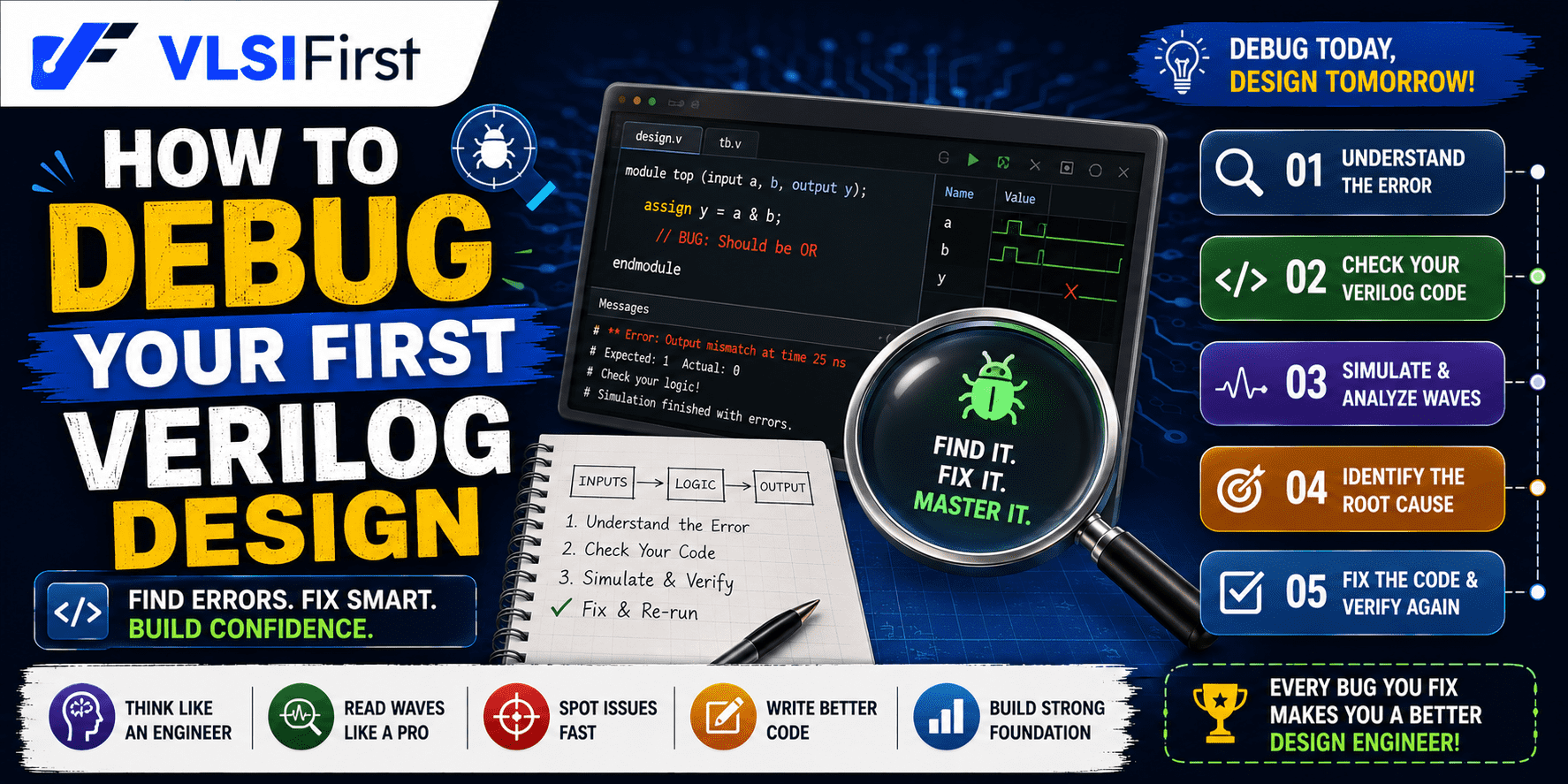
How to Debug Your First Verilog Design
Debugging your first Verilog design with practical RTL debug techniques, waveform analysis, testbench tips, FSM debugging, and common beginner mistakes. Read now!
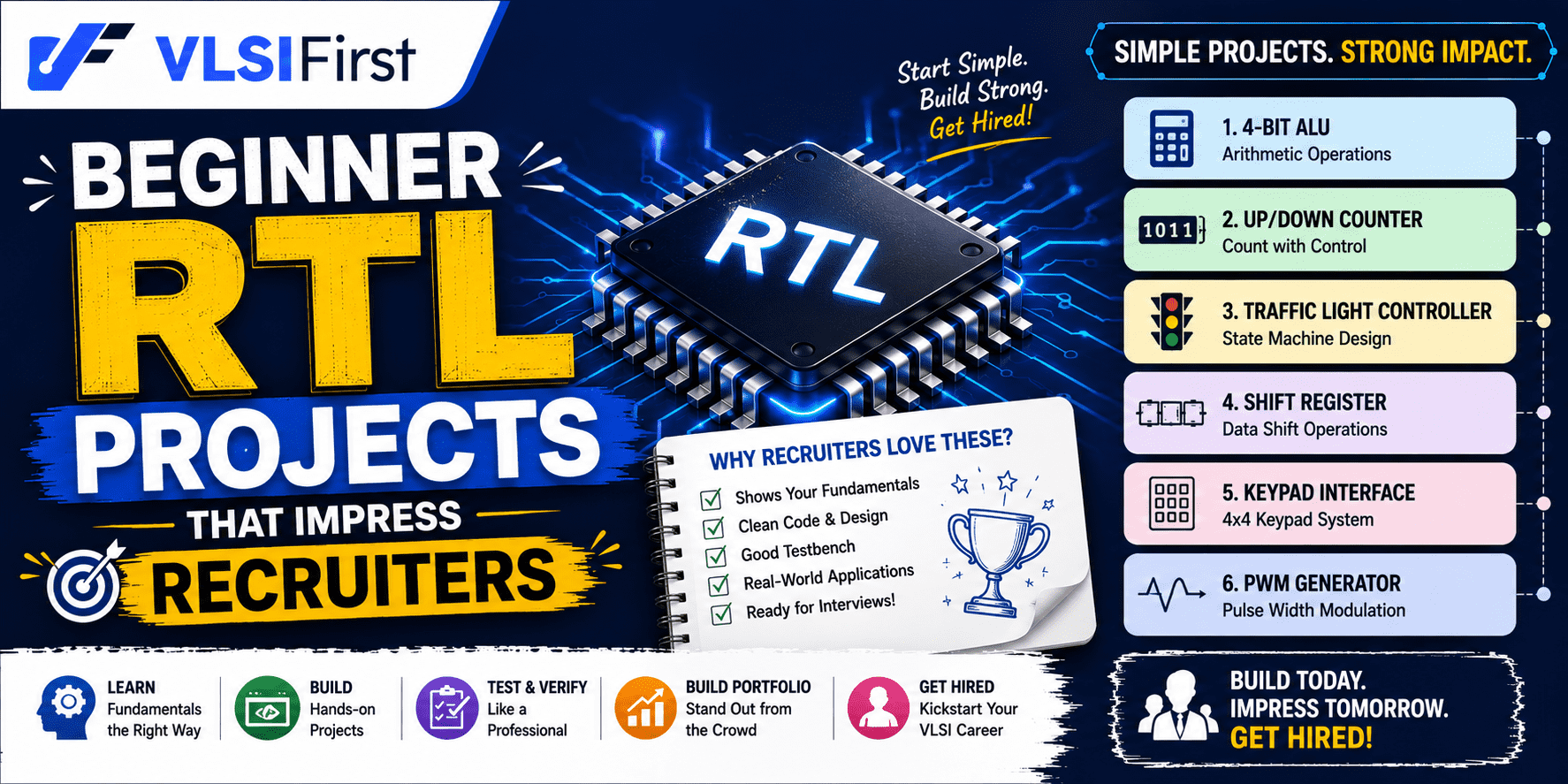
Beginner RTL Projects That Impress Recruiters
Discover beginner RTL projects that impress VLSI recruiters. Learn which Verilog projects build practical skills, strengthen your portfolio, and improve interview success.


Hours
2-98/1, Gurram Guda Road, Gurram Guda, Hyderabad, Rangareddy, Telangana, 501510
Copyright 2025 © VLSI Technologies Private Limited
Designed and developed by KandraDigitalCopyright 2025 © VLSI Technologies Private Limited
Designed, Developed & Marketing by KandraDigital