
Many students preparing for VLSI interviews focus heavily on:
- memorizing concepts
- revising notes
- watching tutorials
- learning definitions
But during real interviews, they often struggle when interviewers ask:
“How would you solve this?”
“What happens if this timing fails?”
“Why is this FSM stuck?”
“How will you debug this waveform?”
This is where problem-solving skills become critical.
In fact, one of the biggest reasons students fail VLSI interviews is not lack of theory, but lack of analytical thinking and debugging ability.
This blog explains:
- what problem-solving means in VLSI
- why recruiters test it heavily
- how to build it step-by-step
- practical exercises that improve interview performance
Why Problem-Solving Matters So Much in VLSI
The semiconductor industry is built around solving complex engineering problems.
Every day, engineers deal with:
- logic bugs
- timing failures
- simulation mismatches
- protocol issues
- synthesis problems
That’s why interviewers care less about memorized answers and more about how you think under pressure.
Even recent VLSI interview preparation discussions emphasize that logical thinking and debugging approach are major evaluation criteria during interviews.
What Interviewers Actually Test
Most interviewers are not expecting perfect answers immediately.
Instead, they want to evaluate:
- your thought process
- logical reasoning
- debugging approach
- ability to break down problems
For example:
Instead of asking:
- “Define setup time”
They may ask:
- “What happens if setup time is violated?”
- “How would you debug timing failure?”
This tests understanding, not memorization.
The Biggest Mistake Students Make
Many students prepare like this:
- reading PDFs
- memorizing interview questions
- learning syntax only
But VLSI interviews increasingly involve:
- scenario-based questions
- debugging exercises
- logic-building problems
Industry interview guides repeatedly mention debugging and analytical thinking as major hiring differentiators.
What Problem-Solving Means in VLSI
Problem-solving in VLSI usually includes:
1. Logical Analysis
Example:
- understanding circuit behavior
- predicting outputs
- analyzing FSM transitions
2. Debugging
Example:
- identifying simulation mismatches
- tracing waveform failures
- locating timing issues
Debugging is considered one of the most important real-world VLSI engineering skills.
3. Design Thinking
Example:
- optimizing logic
- reducing latency
- improving timing
4. Structured Thinking
Example:
- solving problems step-by-step
- explaining reasoning clearly
Step-by-Step Guide to Build Problem-Solving Skills
Now let’s focus on practical improvement methods.
1. Strengthen Digital Electronics Fundamentals
Strong fundamentals are the foundation of problem-solving.
Focus on:
- combinational circuits
- sequential circuits
- FSMs
- multiplexers
- timing concepts
Most VLSI interviews begin with digital fundamentals because they reveal how deeply students understand logic.
2. Practice Circuit Design Problems
Do NOT just read theory.
Solve practical questions like:
- design a sequence detector
- build counters using flip-flops
- implement adders using multiplexers
Community discussions also recommend circuit-building exercises to improve logical thinking.
3. Write RTL Code Regularly
Coding improves engineering thinking.
Practice:
- FSM coding
- ALU design
- FIFO implementation
- counters and shift registers
Writing RTL helps you understand hardware behavior deeply.
Interview preparation resources consistently highlight RTL practice as essential for problem-solving development.
4. Learn Debugging Systematically
This is one of the fastest ways to improve.
Instead of only running successful simulations, intentionally create bugs.
Examples:
- wrong sensitivity list
- blocking vs non-blocking mistakes
- incorrect FSM transitions
Then debug them.
Industry experts repeatedly emphasize that debugging ability differentiates strong candidates during interviews.
5. Analyze Waveforms Carefully
Waveform debugging builds analytical thinking.
Practice:
- signal tracing
- identifying timing mismatches
- understanding state transitions
This is especially important for verification roles.
6. Solve Timing Problems
Timing analysis develops engineering logic.
Practice concepts like:
- setup time
- hold time
- clock skew
- propagation delay
Many interviewers use timing scenarios to test problem-solving ability.
7. Explain Your Thinking Out Loud
This is extremely important.
Even Reddit discussions from experienced engineers suggest that interviewers often care more about your approach than immediate correctness.
Practice speaking while solving problems:
- explain assumptions
- break down logic
- discuss alternatives
This improves both:
- clarity
- interview confidence
8. Build Real Projects
Projects naturally improve problem-solving.
Good project work teaches:
- debugging
- optimization
- integration
- verification strategy
Projects are one of the strongest ways to demonstrate practical engineering ability.
9. Practice Scenario-Based Questions
Modern VLSI interviews increasingly focus on scenarios.
Examples:
- “How would you verify this protocol?”
- “How would you debug intermittent failure?”
- “What if coverage is not improving?”
Recent verification interview experiences show companies heavily test real-world thinking and debugging strategy.
10. Improve Patience and Calmness
Many students panic during difficult questions.
But engineering problem-solving requires calm analysis.
A good approach:
- understand the problem
- simplify it
- solve step-by-step
Even experienced engineers recommend staying calm and speaking thoughts clearly during interviews.
Best Topics to Practice for Problem-Solving
Focus heavily on:
Digital Electronics
- FSMs
- counters
- logic minimization
Verilog/SystemVerilog
- RTL coding
- testbenches
- assertions
Timing Analysis
- setup/hold violations
- clocking issues
Verification
- debugging
- constrained randomization
- coverage
Protocols
- AXI
- SPI
- UART
- I2C
Protocol understanding is increasingly tested in design and verification interviews.
Common Mistakes That Hurt Problem-Solving Skills
1. Memorizing Without Understanding
This creates shallow knowledge.
2. Avoiding Difficult Problems
Growth happens when solving unfamiliar scenarios.
3. Not Practicing Debugging
Many students only practice “ideal” simulations.
Real engineering involves failures.
4. Learning Passively
Watching tutorials alone is not enough.
You must:
- code
- debug
- analyze
- explain
How Long Does It Take to Improve?
With consistent practice:
- 1 month → noticeable improvement
- 3 months → strong confidence
- 6 months → interview-level maturity
The key is consistency over intensity.
Summary
So, how do you build problem-solving skills for VLSI interviews?
Focus on:
- digital fundamentals
- RTL coding
- debugging practice
- waveform analysis
- timing scenarios
- project work
Most importantly learn to think logically and explain your approach clearly.
Because in VLSI interviews, Interviewers are not only testing what you know, they are testing how you think.
If you feel weak in problem-solving today:
Don’t get discouraged.
Problem-solving is NOT an inborn talent.
It is a skill developed through:
- practice
- debugging
- repetition
- real project exposure
Start solving small problems daily.
Over time, your confidence and interview performance will improve naturally.

How to Test Your RTL Before Simulation: A Practical Pre-Simulation Checklist for Beginners
Learn how to test your RTL before simulation with a practical pre-simulation checklist. Improve Verilog quality, reduce debugging time, and build industry-ready RTL skills.
From Logic Diagram to Verilog Code – Complete Workflow
Learn the complete workflow from logic diagram to Verilog code, including specifications, RTL architec ture, coding, simulation, debugging, verification, and documentation.
Common Mistakes While Writing Verilog Code
Learn the most common Verilog coding mistakes beginners make and how to avoid them. Improve RTL coding, simulation, debugging, verification, and interview readiness.
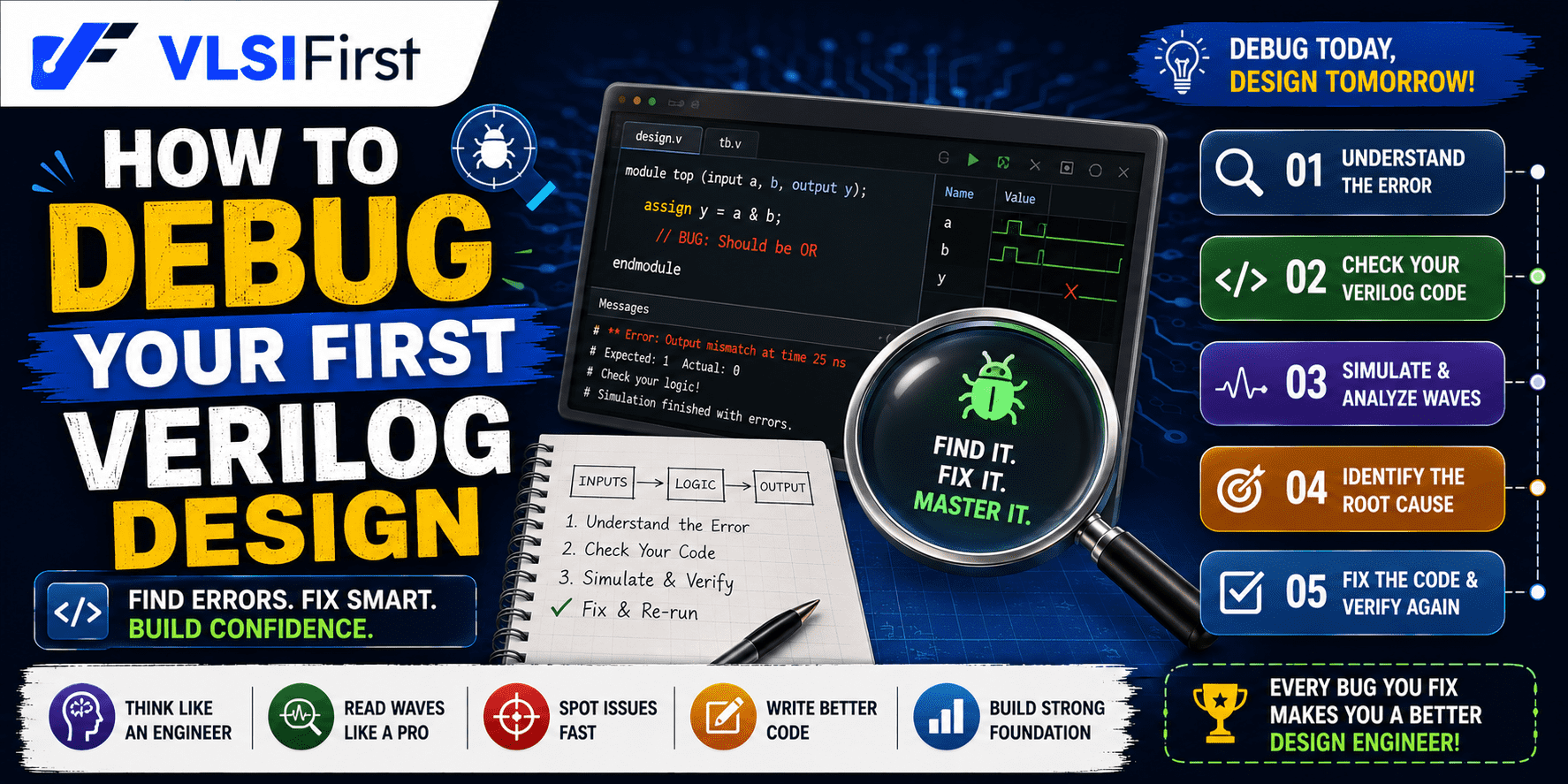
How to Debug Your First Verilog Design
Debugging your first Verilog design with practical RTL debug techniques, waveform analysis, testbench tips, FSM debugging, and common beginner mistakes. Read now!

Beginner RTL Projects That Impress Recruiters
Discover beginner RTL projects that impress VLSI recruiters. Learn which Verilog projects build practical skills, strengthen your portfolio, and improve interview success.


Hours
2-98/1, Gurram Guda Road, Gurram Guda, Hyderabad, Rangareddy, Telangana, 501510
Copyright 2025 © VLSI Technologies Private Limited
Designed and developed by KandraDigitalCopyright 2025 © VLSI Technologies Private Limited
Designed, Developed & Marketing by KandraDigital