
Completing a VLSI project is a significant achievement, but the project itself is only part of what recruiters, trainers, and interviewers evaluate. Equally important is how you present and document your work. A well-prepared VLSI project report demonstrates that you understand not only the final design but also the engineering process behind it.
Many students spend weeks developing an RTL design, verification environment, or FPGA implementation, yet prepare their project report in just a few hours. The result is often a document filled with screenshots, copied theory, and minimal explanation of the actual work performed. Such reports fail to showcase the student's technical abilities.
On the other hand, a professional project report highlights your design decisions, implementation methodology, verification approach, challenges faced, and lessons learned. It becomes a valuable reference during interviews and reflects the structured thinking expected in the semiconductor industry.
This article explains what makes a good VLSI project report, the essential sections it should include, common mistakes to avoid, and how you can create documentation that leaves a positive impression on recruiters.
Why Is a Project Report Important?
A VLSI project report is more than a college submission. It serves as documented proof of your technical capabilities and engineering approach.
A well-written report helps you:
- Explain your project confidently during interviews.
- Demonstrate practical implementation skills.
- Showcase problem-solving ability.
- Highlight debugging and verification experience.
- Present your work professionally.
- Build a stronger technical portfolio.
Recruiters often ask candidates to explain projects listed on their resumes. A detailed report makes those discussions far easier and more convincing.
Start with a Clear Project Objective
Every report should begin by explaining the purpose of the project.
Answer questions such as:
- What problem does the project solve?
- Why was this project selected?
- Which VLSI concepts does it demonstrate?
- What are the expected outcomes?
For example, instead of writing:
"Design of FIFO"
explain:
"The objective of this project is to design and verify a parameterized synchronous FIFO that enables reliable temporary data storage between producer and consumer modules while maintaining data integrity under different operating conditions."
A clear objective immediately gives readers context.
Include a Functional Overview
Before discussing implementation details, explain how the design works from a functional perspective.
Describe:
- Inputs
- Outputs
- Operating conditions
- Internal functionality
- Expected behavior
Avoid overwhelming readers with Verilog syntax in this section. Focus on explaining the system logically.
Present the Design Architecture
One of the most valuable sections in a VLSI report is the architecture overview.
Include:
- Block diagram
- Module hierarchy
- Signal flow
- Major functional blocks
- Communication between modules
This section demonstrates that you understand system-level design rather than only writing code.
If your project includes multiple modules such as controllers, counters, memory blocks, or FSMs, explain the role of each one.
Explain the Design Methodology
Recruiters are interested in how you developed the project, not just the final result.
Describe your workflow, such as:
- Requirement analysis
- Logic design
- RTL coding
- Testbench development
- Simulation
- Debugging
- Verification
- Documentation
This structured explanation reflects professional engineering practices.
Discuss RTL Design Decisions
Don't simply attach Verilog files to your report.
Instead, explain important design choices, such as:
- Why you selected a particular architecture.
- Why specific registers were required.
- How counters were implemented.
- Why an FSM was used.
- How data moves through the design.
Showing your reasoning demonstrates deeper understanding.
Include Key RTL Snippets—Not Entire Files
Many students paste hundreds of lines of Verilog code into their reports.
This makes the report difficult to read.
Instead:
- Include only important code snippets.
- Explain what each snippet accomplishes.
- Highlight interesting implementation techniques.
The complete source code can be provided separately if required.
Document the Verification Strategy
Verification is an essential part of RTL development.
Describe:
- Testbench architecture
- Clock generation
- Reset methodology
- Input stimulus
- Expected outputs
- Corner-case testing
Explain why each test case was selected rather than simply listing simulation screenshots.
Explain Debugging Challenges
One of the most overlooked sections is debugging.
Recruiters appreciate candidates who can identify and solve problems systematically.
Document:
- Bugs encountered
- Root causes
- Debugging techniques
- Waveform analysis
- Final solutions
Examples include:
- Incorrect FSM transitions
- Counter overflow
- Reset initialization errors
- Signal width mismatches
- Timing-related issues
This section demonstrates practical engineering experience.
Include Simulation Results
Simulation results should support your explanation, not replace it.
When presenting waveforms:
- Clearly label signals.
- Explain what readers should observe.
- Mention expected behavior.
- Highlight successful verification.
Avoid inserting screenshots without context.
Discuss Project Limitations
No engineering project is perfect.
Mention limitations such as:
- Unsupported operating modes.
- Limited verification coverage.
- Simplified assumptions.
- Resource constraints.
- Areas for optimization.
Acknowledging limitations shows maturity and analytical thinking.
Suggest Future Improvements
Every project can be enhanced.
Possible improvements include:
- Additional features
- Better parameterization
- Performance optimization
- Extended verification
- FPGA implementation
- Low-power optimization
Future enhancement ideas demonstrate curiosity and long-term thinking.
Maintain Professional Formatting
Presentation matters.
A good report should have:
- Consistent headings
- Proper numbering
- Uniform fonts
- High-quality diagrams
- Readable tables
- Well-labeled figures
- Correct grammar
A professionally formatted report reflects attention to detail.
Cite References Properly
If you referred to textbooks, IEEE papers, technical documentation, or standards, acknowledge them appropriately.
Avoid copying theory from online sources.
Instead:
- Write explanations in your own words.
- Reference original materials.
- Mention standards where applicable.
Original writing strengthens both credibility and learning.
Add a Learning Outcomes Section
Many reports end immediately after the conclusion.
Instead, summarize what you learned.
For example:
- RTL coding techniques
- FSM implementation
- Testbench development
- Debugging methodologies
- Simulation workflow
- Documentation practices
This section demonstrates continuous improvement.
Common Mistakes in VLSI Project Reports
Many beginner reports suffer from the following problems:
- Excessive copied theory.
- Very little explanation of the actual implementation.
- Poor-quality screenshots.
- Missing architecture diagrams.
- No verification methodology.
- No debugging discussion.
- Unorganized formatting.
- Incomplete conclusions.
- No future enhancements.
- Lack of originality.
Avoiding these mistakes significantly improves report quality.
What Recruiters Look For
During interviews, recruiters rarely expect a perfect project. Instead, they want evidence that you genuinely understand what you built.
A strong project report should help you confidently answer questions like:
- Why did you choose this project?
- Explain your architecture.
- How did you verify the design?
- What was your biggest debugging challenge?
- What improvements would you make?
- Which module was the most difficult to implement?
If your report prepares you to answer these questions naturally, it has already achieved its purpose.
Build Projects That Are Worth Documenting
The quality of your report depends on the quality of your project. Practical RTL designs, functional verification assignments, FPGA implementations, and industry-inspired case studies provide far richer learning experiences than simple academic exercises.
Projects such as FIFO controllers, UART, SPI, I²C interfaces, ALUs, sequence detectors, memory controllers, and finite state machine-based designs not only strengthen technical skills but also give you meaningful material to discuss in your report.
Learn Professional Documentation Through Practical Training
Developing high-quality project documentation becomes easier when you work on structured assignments under experienced mentors. Practical training exposes students to design reviews, coding standards, verification methodologies, documentation techniques, and engineering workflows commonly followed in semiconductor companies.
VLSIFirst offers project-oriented learning through programs such as Semiconductor Fundamentals, Digital Electronics for VLSI, RTL Design and Verification, SystemVerilog & UVM, FPGA Design, ASIC Design, Physical Design, Static Timing Analysis (STA), Design for Test (DFT), Custom Layout Design, Low Power VLSI Design, and the Full Chip Design Program. These courses emphasize end-to-end project execution—from architecture planning and RTL coding to simulation, debugging, verification, documentation, and interview preparation.
Final Thoughts
A good VLSI project report is not measured by its page count but by its clarity, technical depth, and originality. It should tell the complete story of your engineering journey—from understanding the problem and designing the architecture to implementing the solution, verifying functionality, overcoming challenges, and reflecting on lessons learned.
Treat your project report as an extension of your technical skills rather than a formal document created only for academic evaluation. When written thoughtfully, it becomes a powerful tool for interviews, portfolio building, and career growth in the semiconductor industry.
Ultimately, recruiters remember candidates who can explain why they designed something, how they solved problems, and what they learned from the experience. A well-crafted VLSI project report helps you do exactly that.
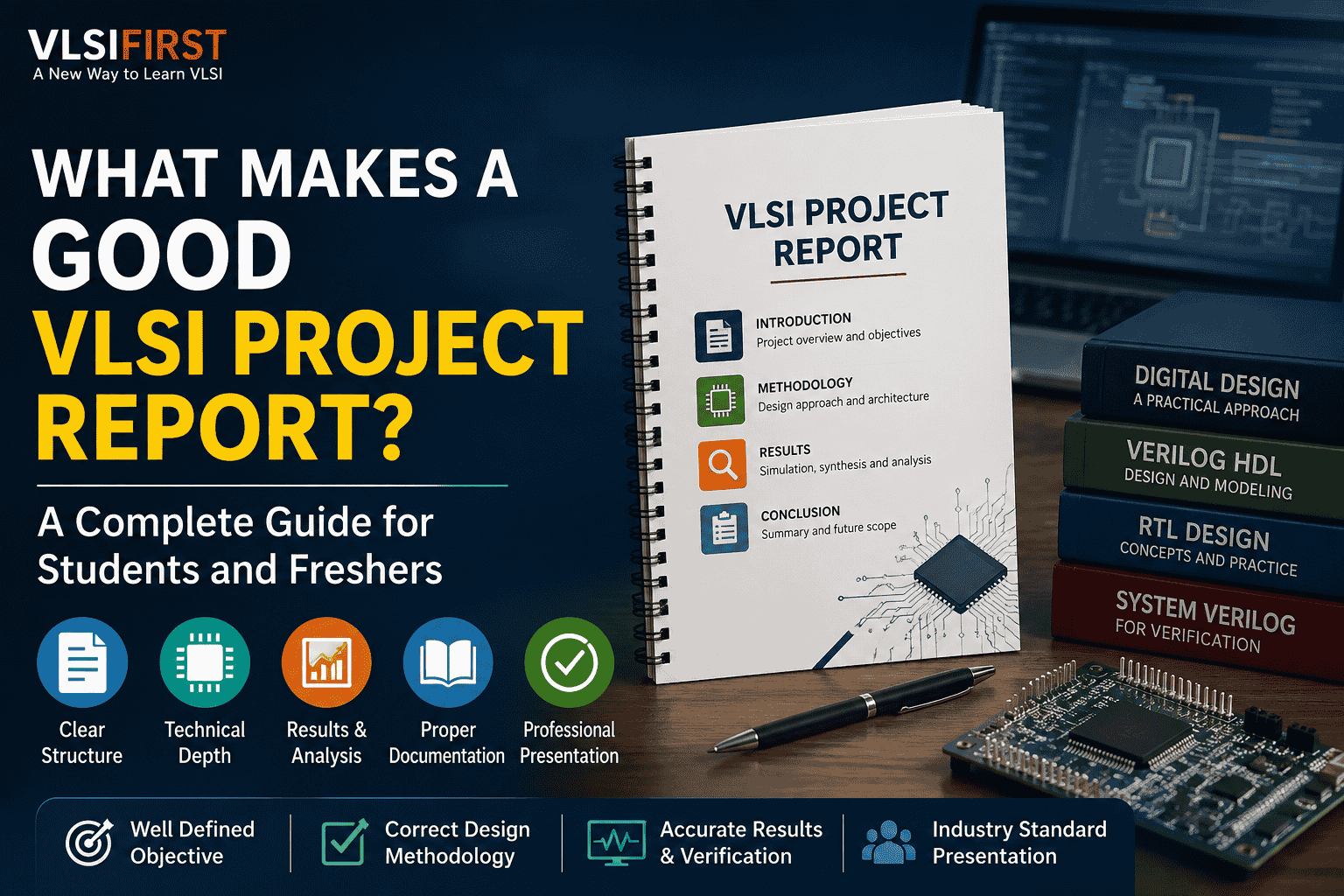
What Makes a Good VLSI Project Report? A Complete Guide for Students and Freshers
Learn how to write a professional VLSI project report with the right structure, RTL documentation, verification strategy, debugging details, and interview-ready presentation tips.
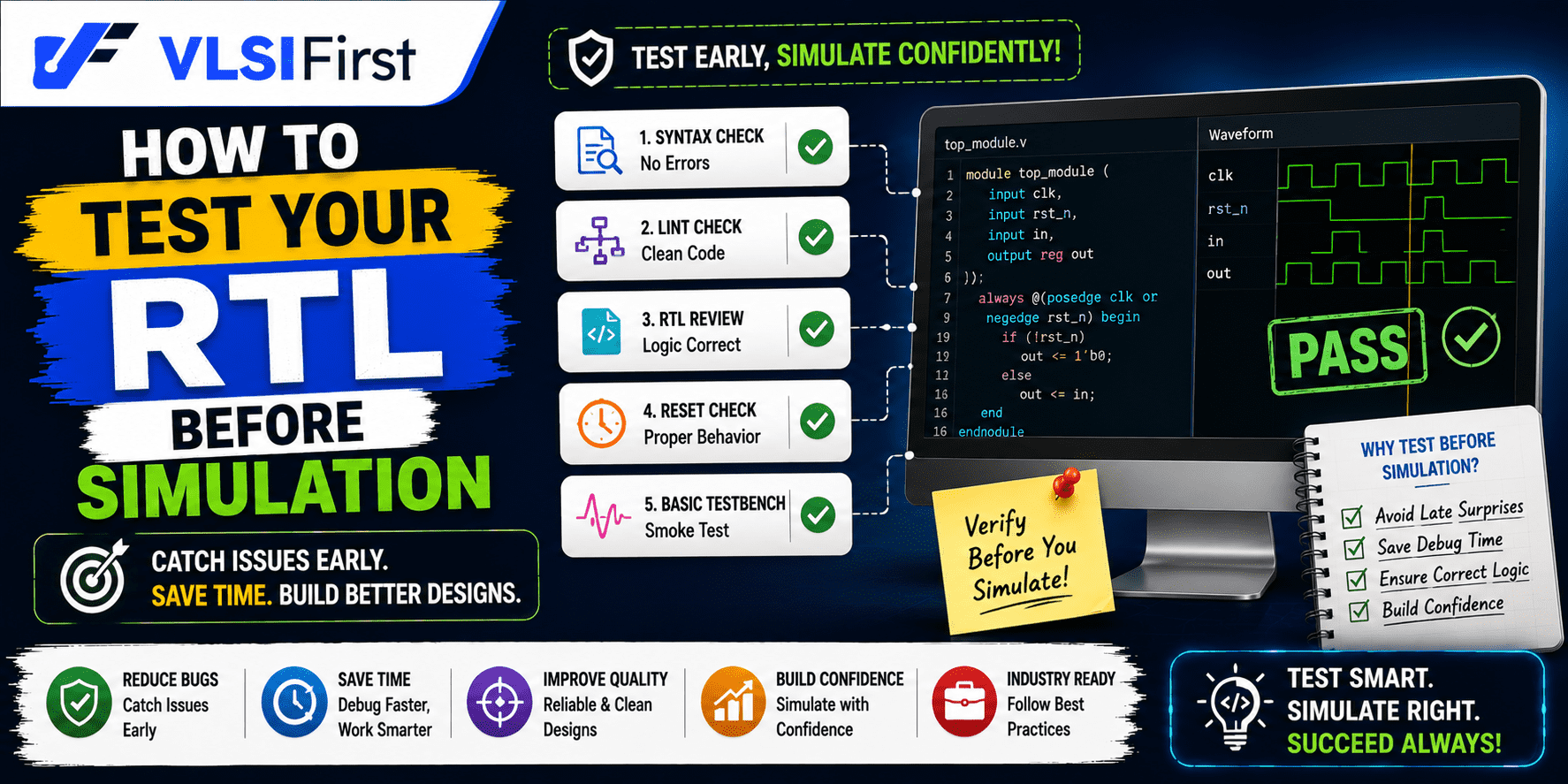
How to Test Your RTL Before Simulation: A Practical Pre-Simulation Checklist for Beginners
Learn how to test your RTL before simulation with a practical pre-simulation checklist. Improve Verilog quality, reduce debugging time, and build industry-ready RTL skills.

From Logic Diagram to Verilog Code – Complete Workflow
Learn the complete workflow from logic diagram to Verilog code, including specifications, RTL architec ture, coding, simulation, debugging, verification, and documentation.
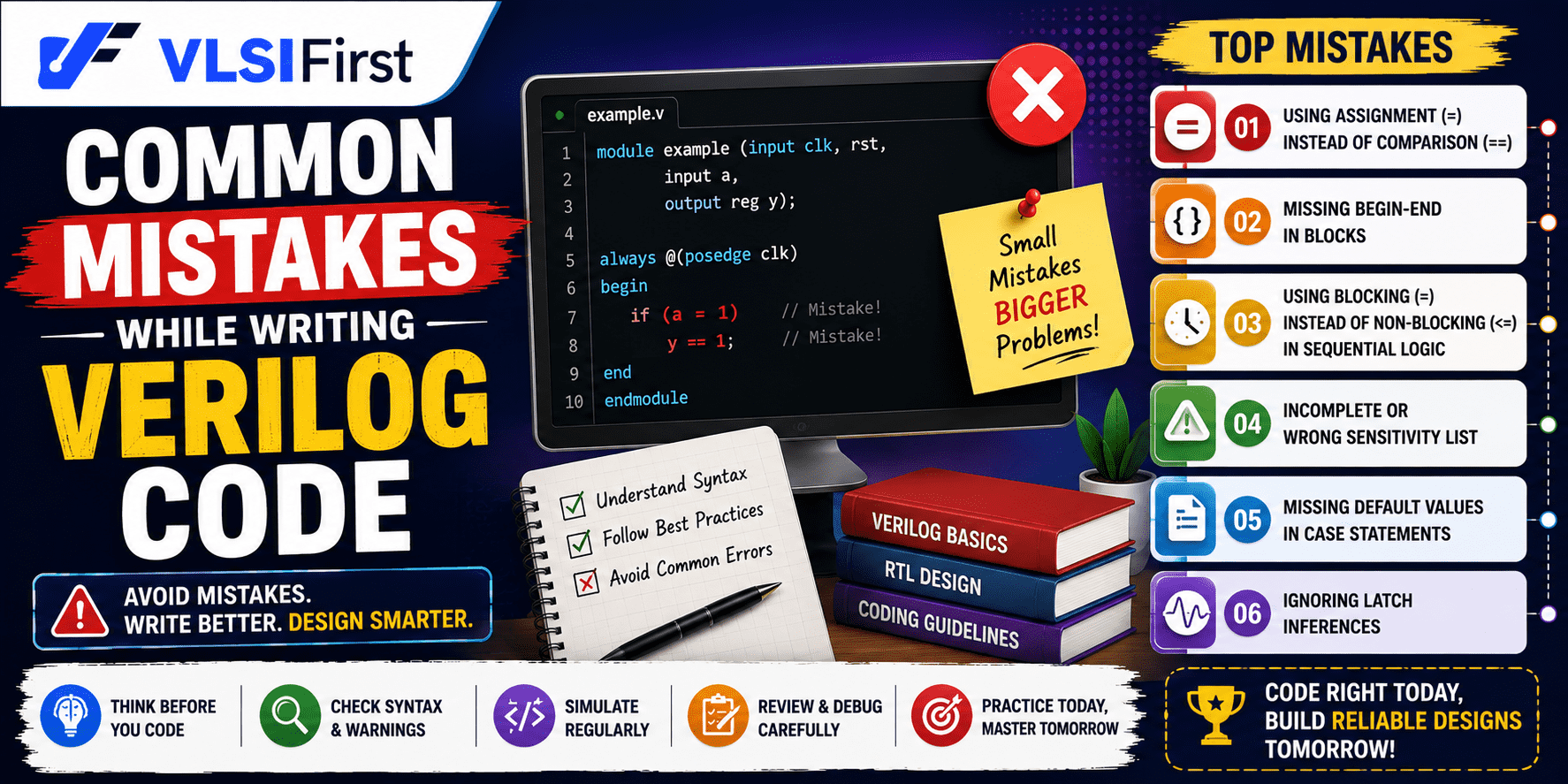
Common Mistakes While Writing Verilog Code
Learn the most common Verilog coding mistakes beginners make and how to avoid them. Improve RTL coding, simulation, debugging, verification, and interview readiness.
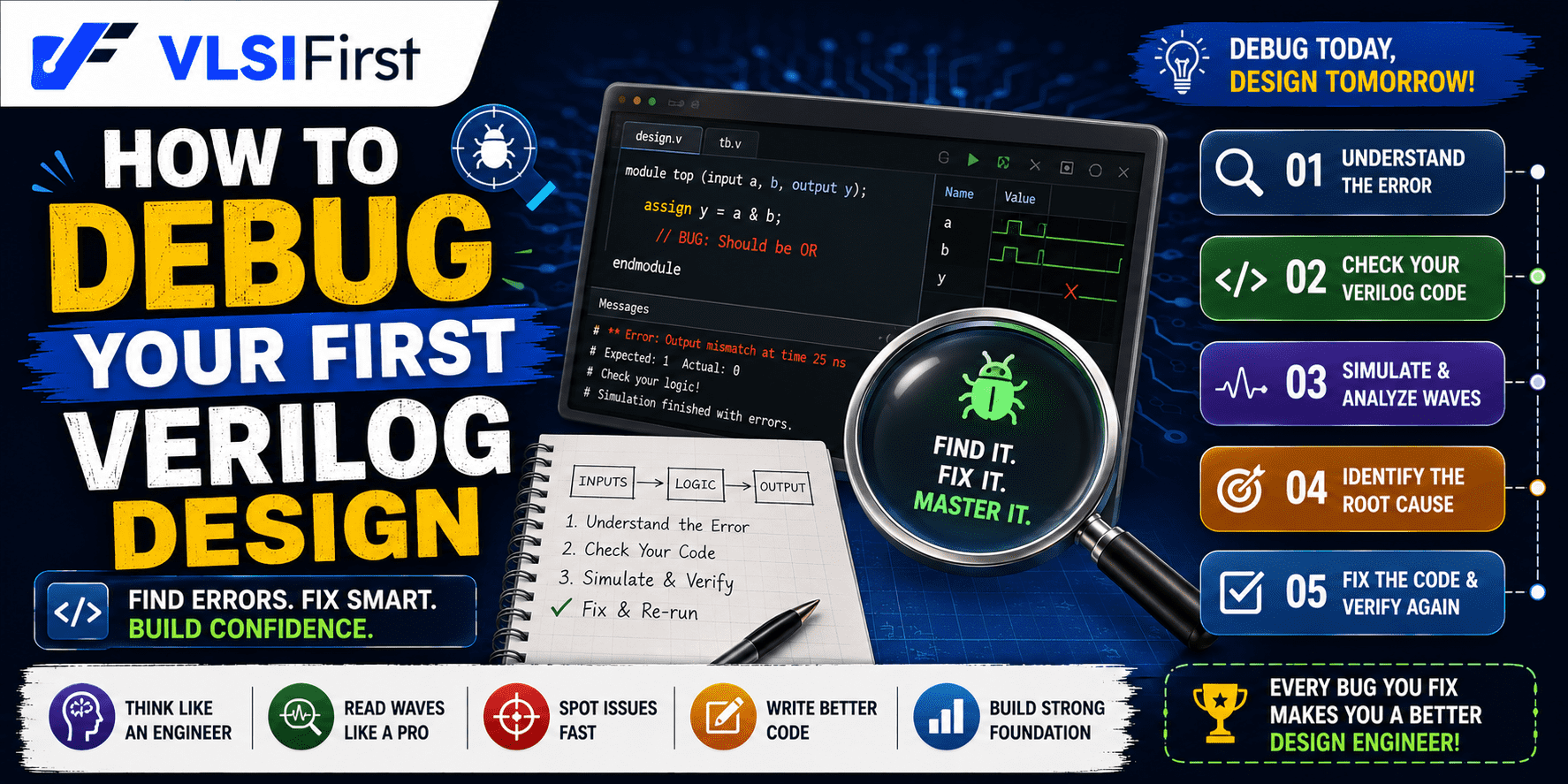
How to Debug Your First Verilog Design
Debugging your first Verilog design with practical RTL debug techniques, waveform analysis, testbench tips, FSM debugging, and common beginner mistakes. Read now!


Hours
2-98/1, Gurram Guda Road, Gurram Guda, Hyderabad, Rangareddy, Telangana, 501510
Copyright 2025 © VLSI Technologies Private Limited
Designed and developed by KandraDigitalCopyright 2025 © VLSI Technologies Private Limited
Designed, Developed & Marketing by KandraDigital