
Field Programmable Gate Arrays (FPGAs) play a vital role in modern VLSI design and digital system development. For VLSI students, working on FPGA-based projects is one of the best ways to bridge the gap between theoretical concepts and real-world hardware implementation. Unlike simulations alone, FPGA projects provide hands-on experience with RTL coding, synthesis, timing, and hardware debugging.
Why FPGA Projects Are Important for VLSI Students
Before diving into projects, it’s important to understand why FPGA-based learning is essential in VLSI:
- Enhances understanding of RTL design and hardware behavior
- Improves proficiency in Verilog or VHDL
- Introduces real-world concepts like timing constraints, synthesis, and resource utilization
- Builds a strong project portfolio for VLSI and semiconductor roles
- Prepares students for ASIC design flow and verification
FPGA projects act as a stepping stone toward advanced topics such as SoC design, physical design, and verification.
Tools and Skills Required for Beginner FPGA Projects
To get started with FPGA projects, VLSI students should be familiar with:
- HDL Languages: Verilog or VHDL
- FPGA Tools: Xilinx Vivado, Intel Quartus Prime
- Simulation Tools: ModelSim or Vivado Simulator
- Basic Digital Design Concepts: Flip-flops, counters, FSMs, multiplexers
- FPGA Boards (Optional but Recommended): Basys 3, Nexys A7, DE10-Lite
1. LED Blinking Using FPGA
Project Overview
This is the most basic FPGA project and a perfect starting point for VLSI beginners. The project involves blinking one or more LEDs using a clock divider.
Key Concepts Learned
- Clock division
- FPGA pin assignment
- Sequential logic design
Why It’s Useful
It introduces students to the complete FPGA flow—from writing Verilog code to generating a bitstream and programming the board.
2. Digital Counter Using Verilog
Project Overview
A digital counter (up-counter, down-counter, or mod-N counter) is a foundational VLSI project that uses flip-flops and combinational logic.
Key Concepts Learned
- Registers and flip-flops
- Synchronous reset and enable
- Timing and clock behavior
Extensions
- Display count on LEDs or a 7-segment display
- Add pause and reset functionality
3. 7-Segment Display Controller
Project Overview
This project involves driving a 7-segment display to show numbers or characters using an FPGA.
Key Concepts Learned
- Combinational logic
- Display encoding
- Multiplexing
Why VLSI Students Should Try It
It improves understanding of hardware interfacing and real-time output control.
4. Traffic Light Controller Using FSM
Project Overview
A traffic light controller is implemented using a Finite State Machine (FSM) to control signal transitions.
Key Concepts Learned
- Moore and Mealy FSMs
- State encoding
- Sequential control logic
Industry Relevance
FSMs are heavily used in control units, communication protocols, and processors.
5. UART Transmitter and Receiver
Project Overview
UART (Universal Asynchronous Receiver Transmitter) enables serial communication between FPGA and a PC.
Key Concepts Learned
- Serial communication
- Baud rate generation
- Shift registers
Why This Project Matters
Communication interfaces are widely used in SoC and embedded VLSI systems.
6. Digital Stopwatch Using FPGA
Project Overview
This project implements a stopwatch with start, stop, and reset features.
Key Concepts Learned
- Counters and clock dividers
- Button debouncing
- Multi-module RTL design
Practical Value
It demonstrates how multiple blocks work together in a real-time digital system.
7. Simple ALU (Arithmetic Logic Unit)
Project Overview
Design a basic ALU capable of performing arithmetic and logical operations like addition, subtraction, AND, OR, and XOR.
Key Concepts Learned
- Combinational logic design
- Control signals
- Modular coding in Verilog
VLSI Importance
The ALU is the heart of processors and microcontrollers, making this project extremely valuable.
8. PWM Signal Generator
Project Overview
Pulse Width Modulation (PWM) is used in motor control, power electronics, and signal processing.
Key Concepts Learned
- Duty cycle control
- Counters and comparators
- Timing analysis
Real-World Applications
Used in automotive electronics, robotics, and embedded systems.
9. FIFO Memory Design
Project Overview
Implement a simple FIFO (First-In First-Out) memory buffer using FPGA registers.
Key Concepts Learned
- Memory structures
- Read/write pointers
- Overflow and underflow conditions
Industry Use
FIFO buffers are essential in data transfer and clock domain crossing.
10. Basic Calculator Using FPGA
Project Overview
This project performs arithmetic operations based on user input via switches or buttons.
Key Concepts Learned
- Input decoding
- Arithmetic modules
- Display interfacing
Why Beginners Should Build It
It combines multiple VLSI concepts into a single functional system.
How These FPGA Projects Help in VLSI Careers
Completing these beginner FPGA projects helps students:
- Gain confidence in RTL coding and debugging
- Understand hardware timing and synthesis
- Build strong resumes for VLSI internships and entry-level roles
- Transition smoothly into ASIC design, verification, and physical design
Tips to Succeed in FPGA Projects
- Start with simulation before hardware implementation
- Write clean, modular Verilog code
- Understand timing constraints and clock behavior
- Document your design and results clearly
- Gradually enhance projects with extra features
Conclusion
Beginner-friendly FPGA projects are essential for VLSI students who want to develop strong hardware design skills. These projects not only reinforce theoretical concepts but also prepare students for industry-level challenges in VLSI design and semiconductor engineering.
By starting with simple FPGA designs and gradually increasing complexity, students can build a solid foundation in Verilog, digital logic, and system design. Whether your goal is higher studies, internships, or a career in VLSI, hands-on FPGA projects are a powerful learning tool that should not be overlooked.
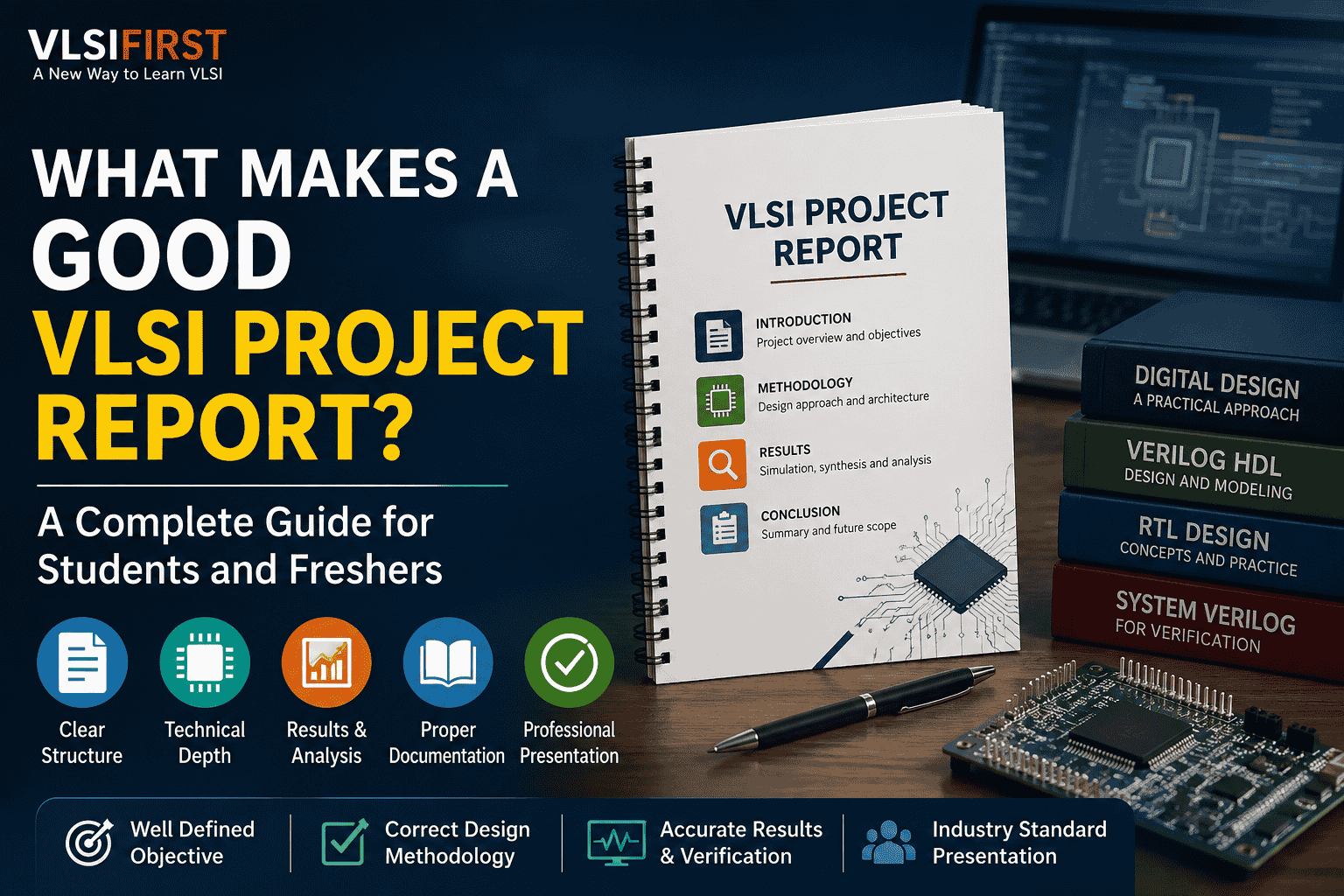
What Makes a Good VLSI Project Report? A Complete Guide for Students and Freshers
Learn how to write a professional VLSI project report with the right structure, RTL documentation, verification strategy, debugging details, and interview-ready presentation tips.
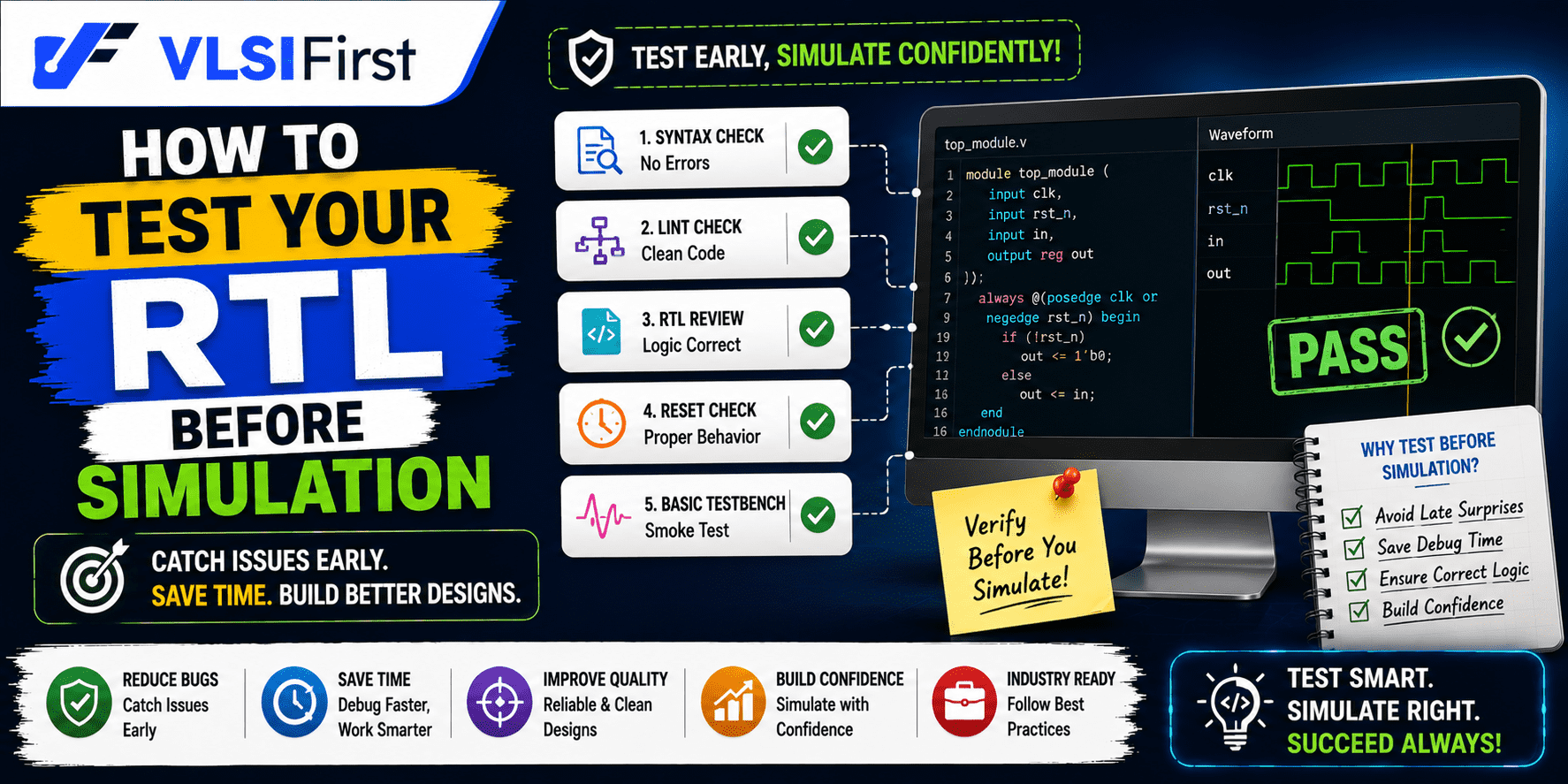
How to Test Your RTL Before Simulation: A Practical Pre-Simulation Checklist for Beginners
Learn how to test your RTL before simulation with a practical pre-simulation checklist. Improve Verilog quality, reduce debugging time, and build industry-ready RTL skills.

From Logic Diagram to Verilog Code – Complete Workflow
Learn the complete workflow from logic diagram to Verilog code, including specifications, RTL architec ture, coding, simulation, debugging, verification, and documentation.
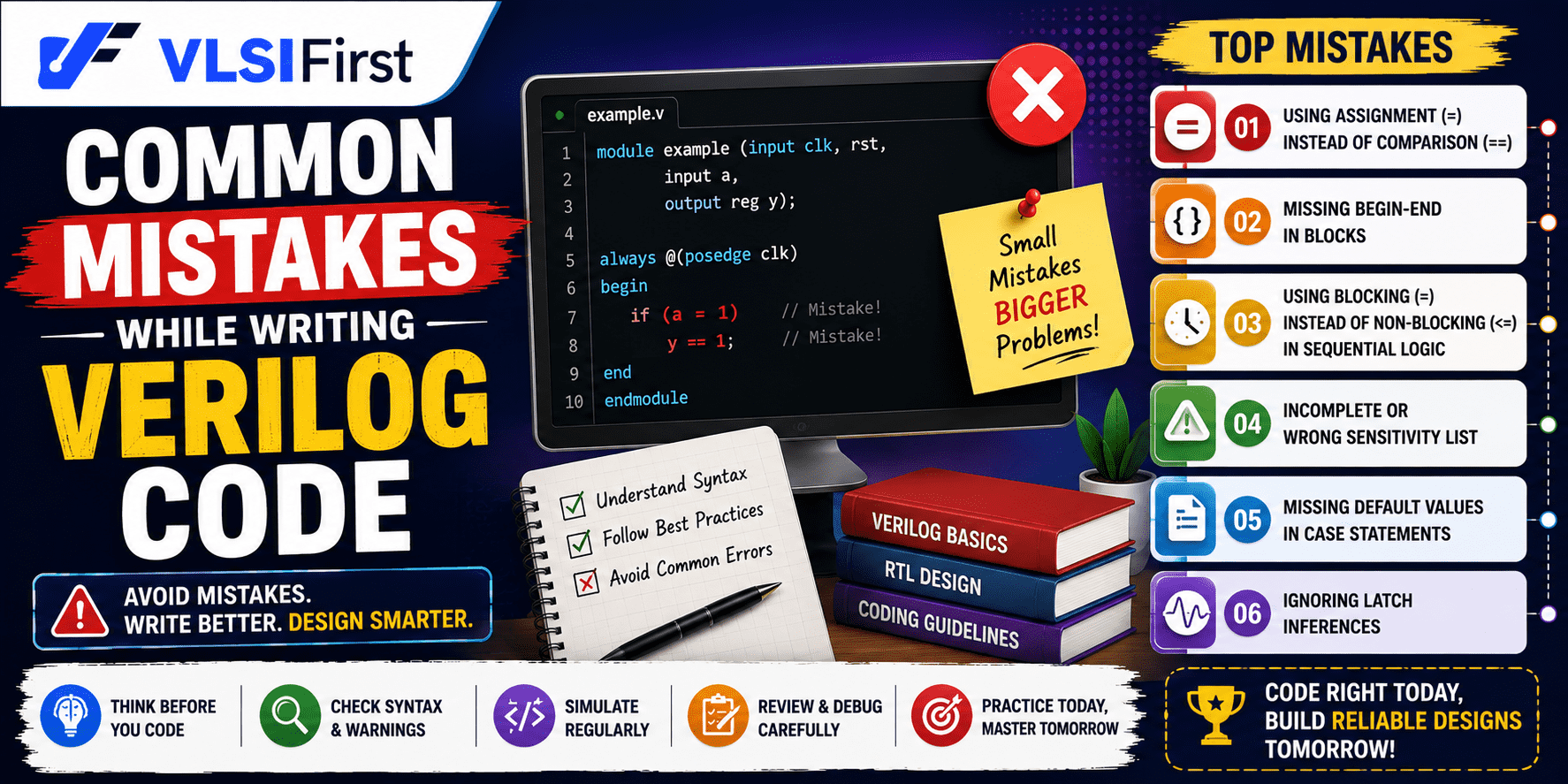
Common Mistakes While Writing Verilog Code
Learn the most common Verilog coding mistakes beginners make and how to avoid them. Improve RTL coding, simulation, debugging, verification, and interview readiness.
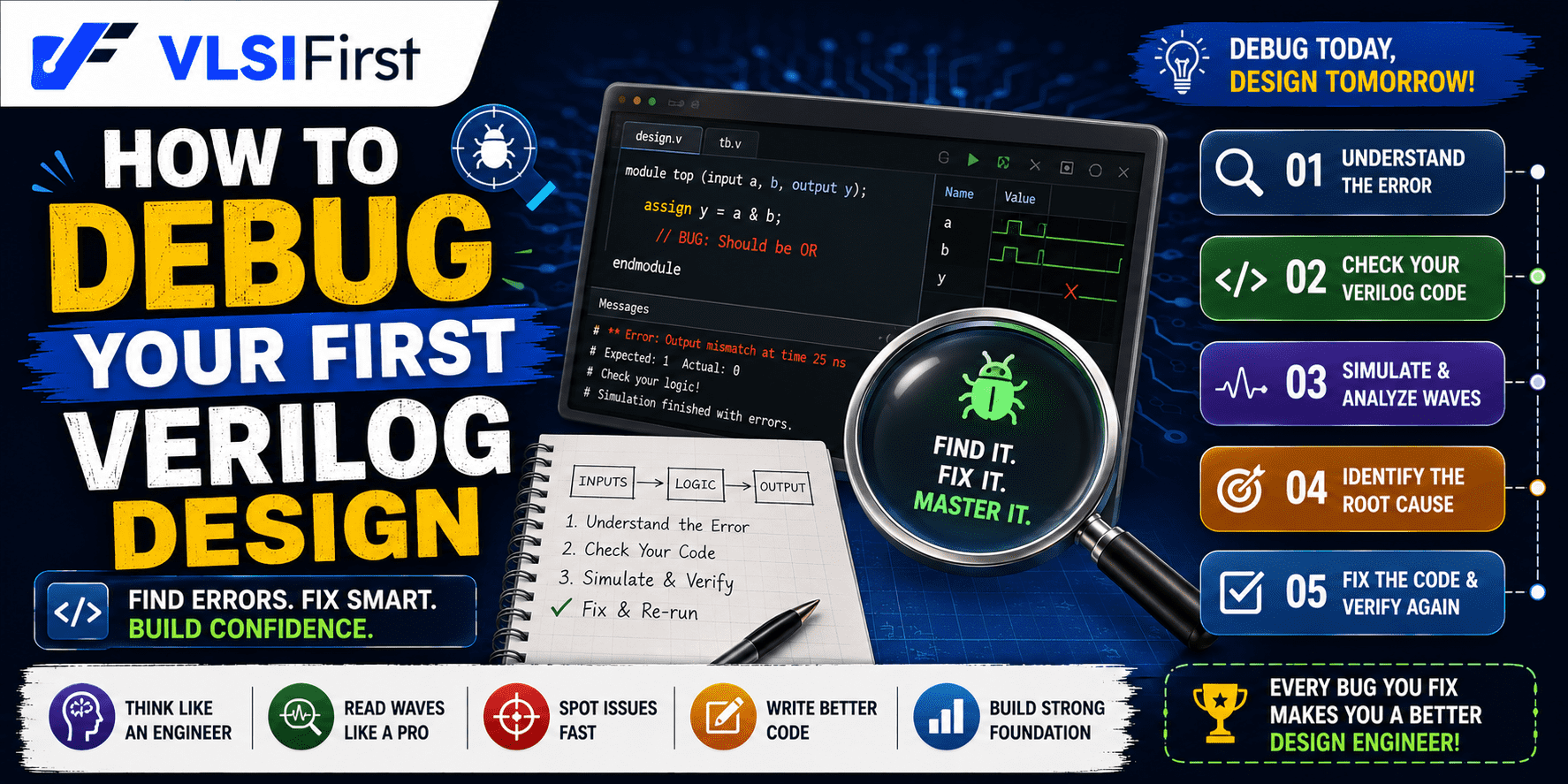
How to Debug Your First Verilog Design
Debugging your first Verilog design with practical RTL debug techniques, waveform analysis, testbench tips, FSM debugging, and common beginner mistakes. Read now!
.


Hours
2-98/1, Gurram Guda Road, Gurram Guda, Hyderabad, Rangareddy, Telangana, 501510
Copyright 2025 © VLSI Technologies Private Limited
Designed and developed by KandraDigitalCopyright 2025 © VLSI Technologies Private Limited
Designed, Developed & Marketing by KandraDigital