
The semiconductor industry is undergoing a global renaissance. With AI accelerators, autonomous vehicles, AR/VR, 5G/6G infrastructure, edge computing, and cloud megascale datacenters demanding faster and more efficient chips, the demand for skilled VLSI engineers has skyrocketed. Countries like India, the U.S., Taiwan, South Korea, and Japan are investing billions into domestic chip design and manufacturing.
As a result, companies are hiring VLSI engineers at an unprecedented pace — and paying extremely well.
Naturally, graduates from ECE, EEE, and CSE streams find VLSI as a promising pathway to a high-growth, high-salary career. But here’s the catch:
College education alone isn’t enough.
Most students graduate without industry-ready skills in digital design, RTL coding, verification, physical design, STA, DFT, or synthesis. Hiring managers want engineers who can contribute from day one. This is exactly where VLSIFIRST has emerged as one of the most respected and effective platforms for helping graduates enter the semiconductor industry faster, more confidently, and with top-tier skill sets.
VLSI Is a High-Salary, High-Demand Industry — but Skill-Driven
Before we explore why VLSIFIRST is ideal for graduates, it’s important to understand why VLSI is considered a premiumcareer path:
High Demand + Talent Shortage
- Semiconductor companies report a massive talent gap in chip design and physical design roles.
- Entry-level VLSI engineers are in short supply, especially those with hands-on skills.
High Salaries
- Freshers with verified skills often start at ₹6–14 LPA, compared to typical IT service roles offering ₹3–5 LPA.
- Specialized roles like Verification, Physical Design, and STA offer even higher CTCs.
Stable, long-term career
Unlike volatile IT roles or rapidly changing software tech stacks, VLSI skills remain relevant for years.
This combination of job stability, high salary, and global demand makes VLSI one of the most rewarding careers for ECE, EEE, and even CSE graduates who want to go beyond traditional software roles.
Why VLSIFIRST Is the Best Platform for VLSI Career Aspirants
VLSIFIRST has built a strong reputation for producing industry-ready freshers who can directly contribute to design and verification teams. Their training ecosystem is built specifically for ECE/EEE/CSE graduates seeking strong careers in chip design
Below are the core reasons why VLSIFIRST stands out.
Industry-Ready Curriculum Designed by Senior VLSI Engineers
Unlike generic online courses, VLSIFIRST training modules are created and constantly updated by senior engineers working in the semiconductor industry. Some of the major skill areas covered include:
Digital Electronics & CMOS Fundamentals
- Logic design
- Timing concepts
- Combinational & sequential circuits
- Flip-flops, FSMs, counters, adders, arithmetic units
These are prerequisites for any VLSI job.
RTL Design Using Verilog/SystemVerilog
- Procedural blocks
- FSM implementation
- Parameterization
- Synthesizable design practices
Understanding RTL coding is essential for design, verification, and physical design engineers.
Today, more than 70% of VLSI jobs fall under verification.
VLSIFIRST covers:
- SystemVerilog constructs
- Constraint random verification
- UVM testbench development
- Coverage-driven methodology
- Assertions (SVA)
VLSI Physical Design
This is where actual chip layout is built.
Students learn:
- Synthesis flow
- Floorplanning
- Placement
- CTS
- Routing
- Timing closure
- IR drop & EM analysis
Synthesis & STA
- Logical equivalence
- Timing reports
- Slack analysis
- Constraints (SDC)
- Setup/hold debugging
Each module emphasizes hands-on work, making graduates job-ready.
Hands-On Projects That Build Real Expertise
VLSI is a practical field. Recruiters want to see proof of hands-on work, not just theory. VLSIFIRST ensures every learner completes multiple real-world projects such as:
Design Projects:
- ALU design
- UART, SPI, I2C
- FIFO/dual-port RAM
- Pipelined processors
- FSM-based controllers
Verification Projects:
- UVM-based testbench for bus protocols
- Functional coverage implementation
- Scoreboard + checker creation
Physical Design Projects:
- Floorplanning a block
- Clock tree optimization
- Routing with congestion reduction
- Timing violation fixing
These projects become part of the student’s portfolio, helping them stand out during interviews.
Mentor-Based Training With 1:1 Guidance
One of VLSIFIRST’s biggest advantages is mentorship.
Students are guided by engineers who have worked at top semiconductor companies.
This includes:
- Doubt-clearing sessions
- Resume reviews
- Code correction
- Project guidance
- Interview preparation
- Mock technical rounds
For fresh graduates, this is invaluable.
Mentorship accelerates learning, builds confidence, and ensures industry-level quality in projects.
Placement Support + Industry Connections
One major reason students choose VLSIFIRST is its strong placement support. Their team collaborates with:
- Chip design companies
- ASIC/SoC startups
- EDA companies
- R&D centers
Placement assistance includes:
- Resume-building focused on VLSI roles
- Portfolio creation
- Mock interview rounds
- HR and soft-skills coaching
- Job referrals to partner companies
Graduates are often placed in roles such as:
- RTL Design Engineer
- Verification Engineer
- VLSI Physical Design Engineer
- STA Engineer
- DFT Engineer
The structured pathway dramatically improves placement success for ECE/EEE/CSE graduates.
Ideal for ECE, EEE, and CSE Graduates — Here’s Why
Why ECE Graduates Benefit Most
ECE students already study electronics, digital systems, and communication fundamentals. VLSIFIRST helps them transition smoothly into VLSI by strengthening:
- Digital logic
- CMOS principles
- RTL design
- Verification
- PD & STA concepts
Why EEE Graduates Are a Great Fit
EEE students have strong circuit understanding and mathematical reasoning. VLSIFIRST bridges the gap in:
- Digital electronics
- HDL coding
- Chip design flows
- EDA tool usage
EEE graduates often excel in physical design and STA roles.
Why CSE Graduates Can Also Shine in VLSI
CSE graduates bring strong programming skills — a big advantage for Verification & DFT roles. VLSIFIRST equips them with:
- Digital logic foundations
- SystemVerilog & UVM
- Scripting (Python/Tcl)
- Algorithmic thinking for design
Many top verification engineers come from CSE backgrounds.
Focus on Tool Training + EDA Exposure
VLSI companies use advanced tools like:
- Synopsys DC, ICC2
- Cadence Innovus
- Mentor QuestaSim
- Cadence Xcelium
- Primetime
- SpyGlass
- Calibre DRC/LVS
VLSIFIRST introduces students to industry-standard flows, ensuring graduates are ready to work in professional environments.
VLSI Career Growth Is Faster Than Traditional IT
Graduates who start in VLSI often climb the career ladder faster because:
- Skills are specialized
- Roles are high-impact
- Competition is low
- Projects are long-term
- Salaries grow rapidly
A VLSI engineer with 5–7 years of experience easily earns ₹18–35 LPA, depending on role and company.
With the semiconductor sector booming globally, career stability is unmatched.
VLSIFIRST Provides a Clear, Guided Path From Graduate to Engineer
Most freshers wonder:
“Where do I start? What should I learn first? What role suits me? How long will it take to get a job?”
VLSIFIRST solves this by giving a structured roadmap:
- Fundamentals – Digital + CMOS
- Choose a specialization – RTL, Verification, or Physical Design
- Skill-building projects
- Tool exposure
- Portfolio creation
- Mock interviews
- Placement support
- This clarity is what makes students confident and job-ready.
Conclusion:
VLSIFIRST Is the Best Launchpad for a High-Paying VLSI Career. For ECE, EEE, and CSE graduates, VLSI is one of the most rewarding career paths today. But success depends entirely on developing industry-ready, hands-on skills.
VLSIFIRST provides:
- A structured learning experience
- Real-world projects
- Expert mentorship
- Strong placement support
- Comprehensive understanding of chip design
If your goal is a high-paying, stable, long-term career, VLSIFIRST is one of the best platforms to accelerate your journey into the semiconductor industry.
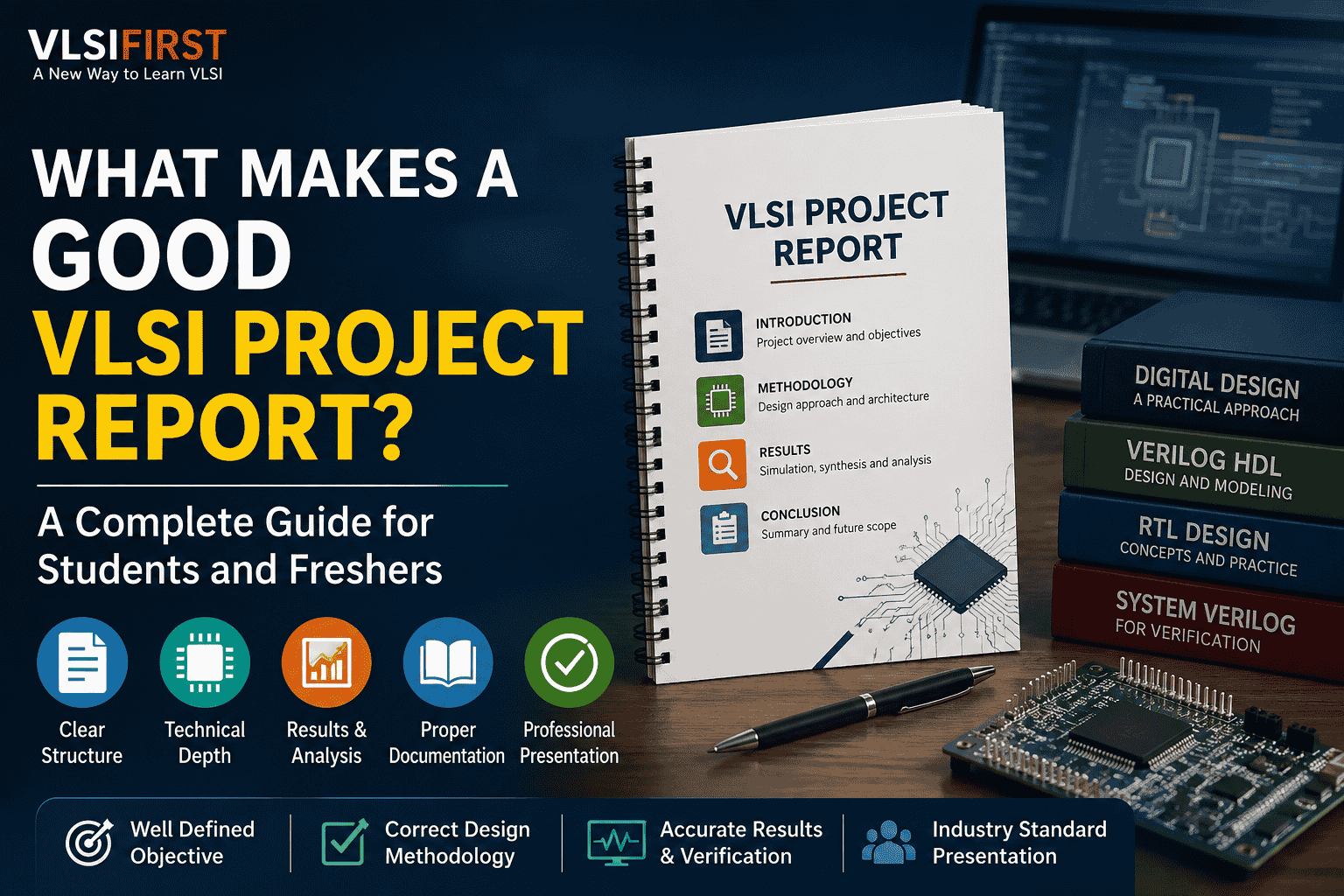
What Makes a Good VLSI Project Report? A Complete Guide for Students and Freshers
Learn how to write a professional VLSI project report with the right structure, RTL documentation, verification strategy, debugging details, and interview-ready presentation tips.
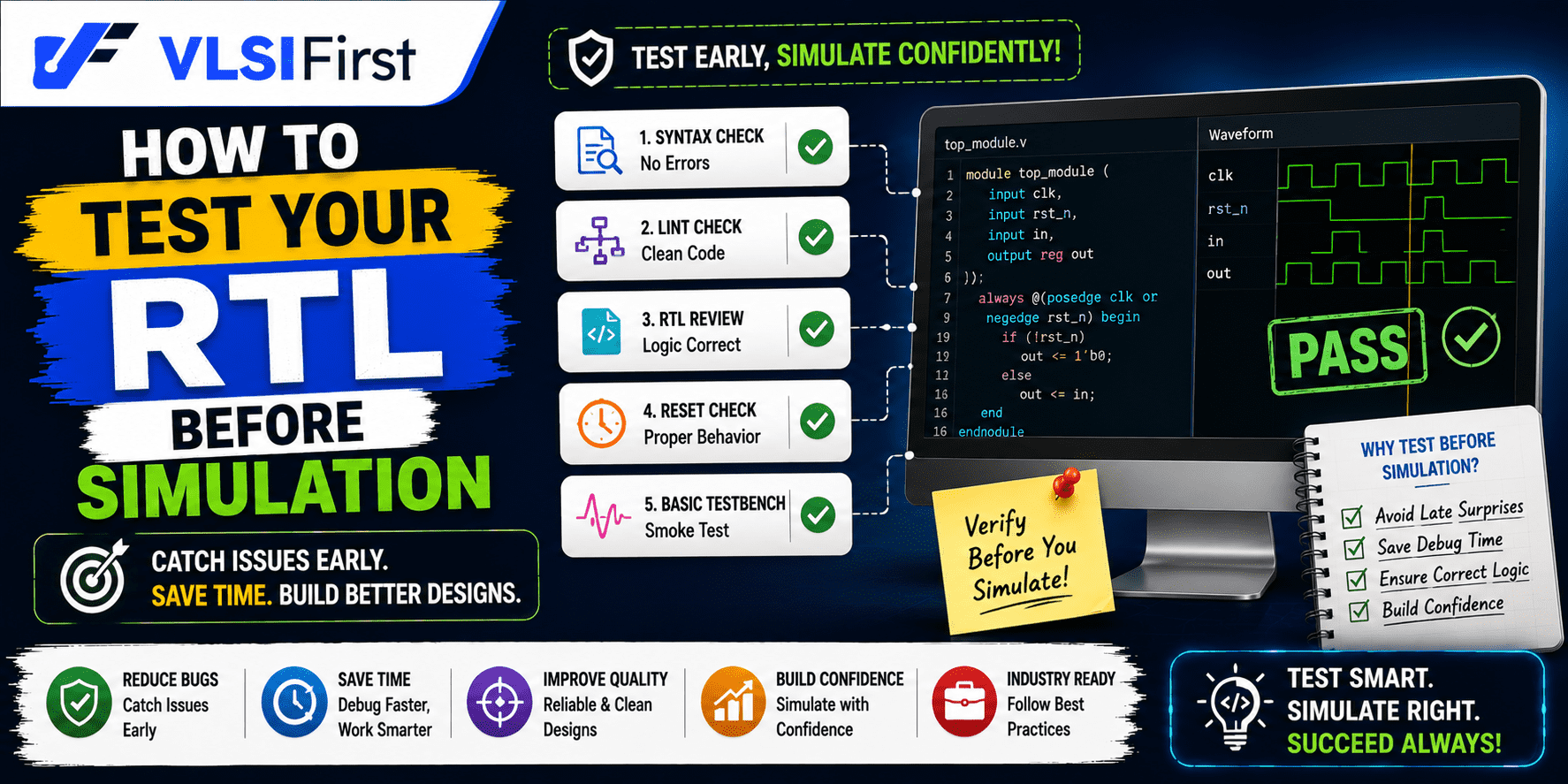
How to Test Your RTL Before Simulation: A Practical Pre-Simulation Checklist for Beginners
Learn how to test your RTL before simulation with a practical pre-simulation checklist. Improve Verilog quality, reduce debugging time, and build industry-ready RTL skills.

From Logic Diagram to Verilog Code – Complete Workflow
Learn the complete workflow from logic diagram to Verilog code, including specifications, RTL architec ture, coding, simulation, debugging, verification, and documentation.
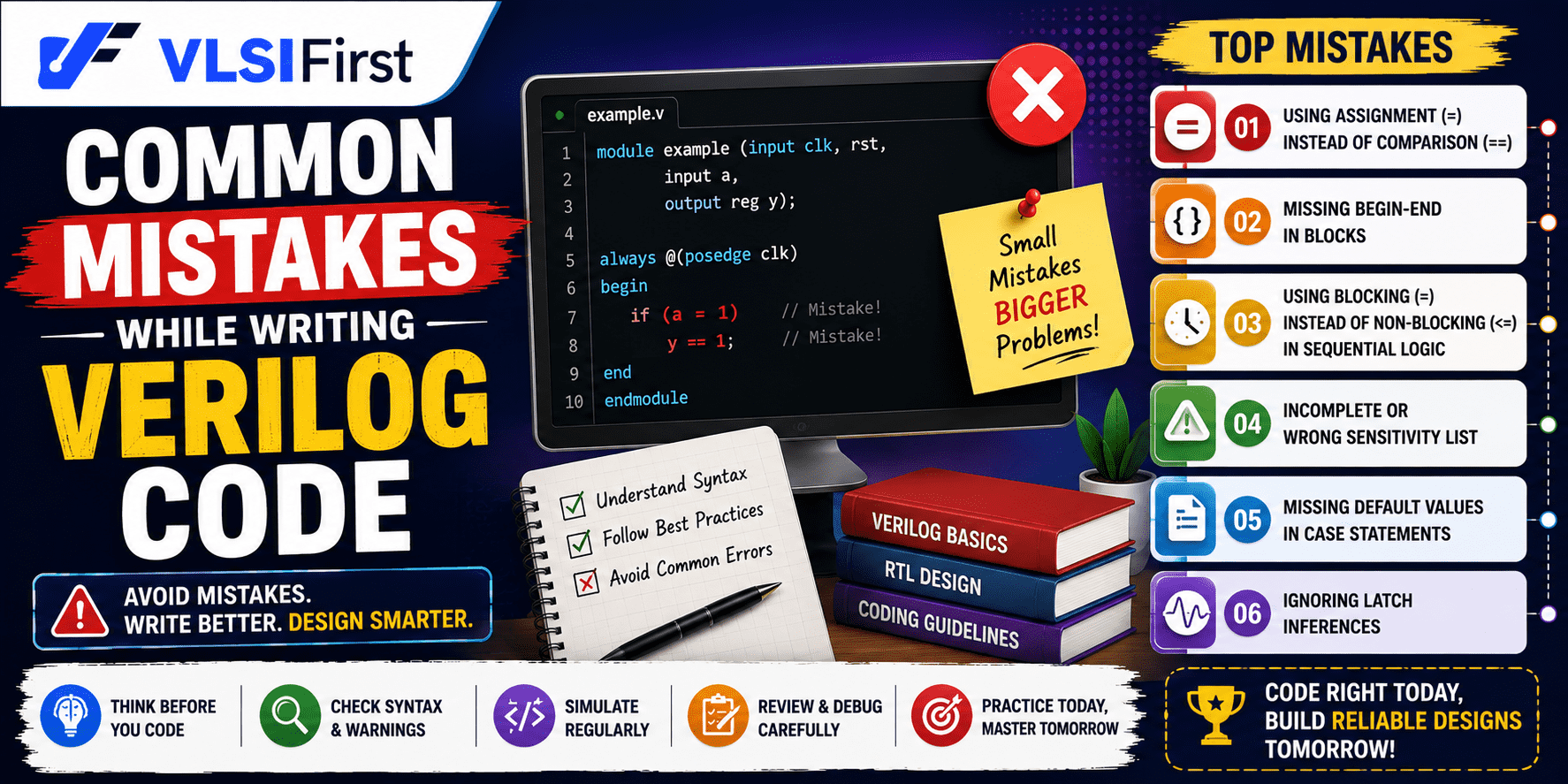
Common Mistakes While Writing Verilog Code
Learn the most common Verilog coding mistakes beginners make and how to avoid them. Improve RTL coding, simulation, debugging, verification, and interview readiness.
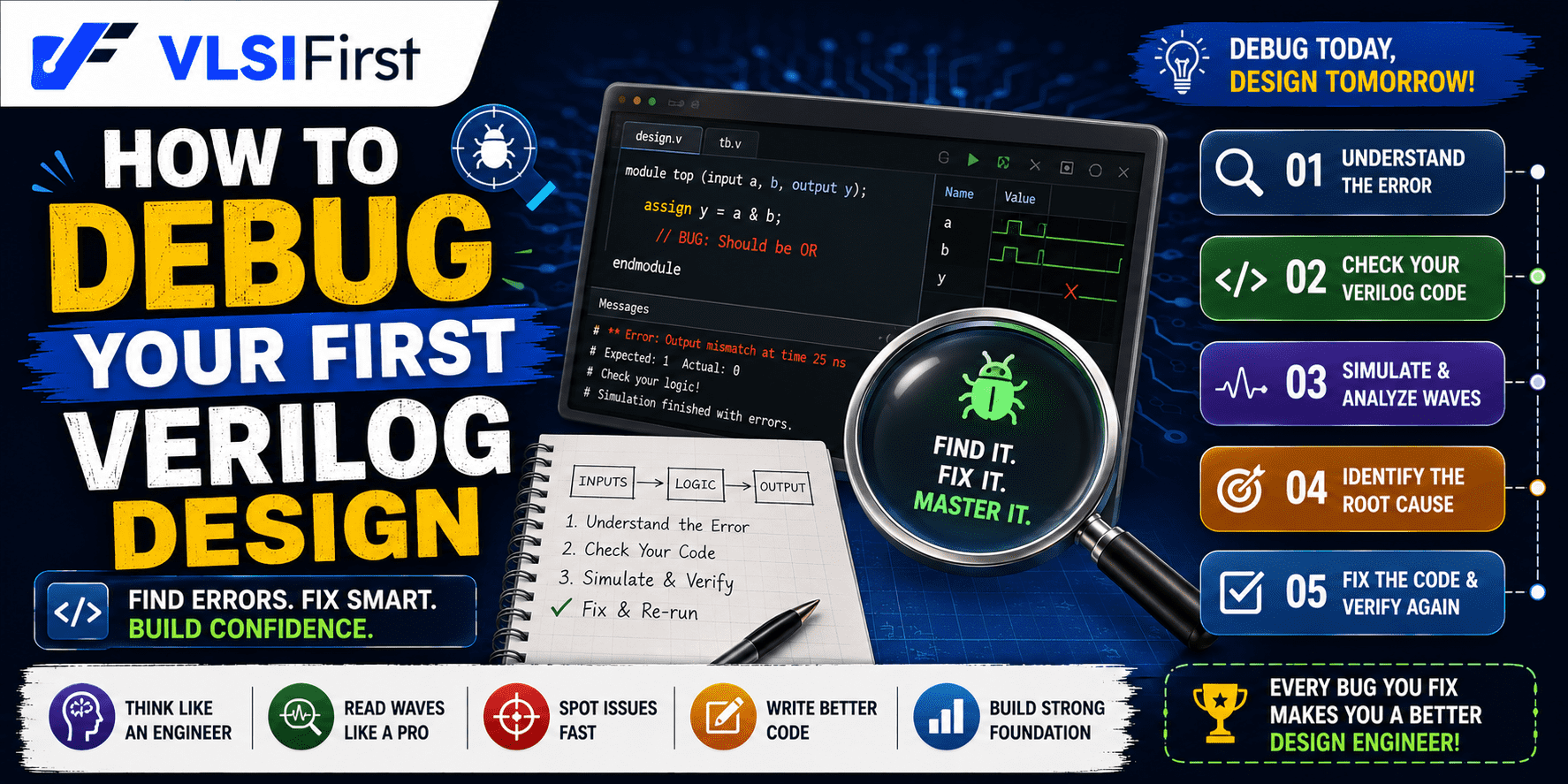
How to Debug Your First Verilog Design
Debugging your first Verilog design with practical RTL debug techniques, waveform analysis, testbench tips, FSM debugging, and common beginner mistakes. Read now!
.


Hours
2-98/1, Gurram Guda Road, Gurram Guda, Hyderabad, Rangareddy, Telangana, 501510
Copyright 2025 © VLSI Technologies Private Limited
Designed and developed by KandraDigitalCopyright 2025 © VLSI Technologies Private Limited
Designed, Developed & Marketing by KandraDigital