
A capstone project is often the most important technical work a VLSI student completes before entering the semiconductor industry. Unlike regular academic assignments, a capstone project is expected to demonstrate your ability to solve engineering problems by applying concepts learned throughout your coursework. It combines digital design, RTL coding, functional verification, debugging, documentation, and presentation into a single comprehensive project.
Unfortunately, many students choose projects that are either too simple to impress recruiters or too ambitious to complete within the available time. Others simply download existing projects from the internet without understanding the implementation, which becomes obvious during technical interviews.
A well-planned capstone project should reflect industry practices, challenge your technical skills, and provide opportunities to discuss design decisions, verification strategies, and debugging experiences. It should also help you build a strong portfolio that supports your first VLSI job application.
This article explores what makes a good VLSI capstone project, shares practical project ideas for different domains, and explains how to select a project that aligns with your career goals.
Why Capstone Projects Matter
Recruiters understand that fresh graduates have limited industry experience. Therefore, they often evaluate candidates based on the quality of their academic and personal projects.
A strong capstone project demonstrates:
- Practical RTL design skills.
- Functional verification knowledge.
- Problem-solving ability.
- Engineering documentation.
- Understanding of digital design principles.
- Ability to complete long-term technical work.
When discussed confidently during interviews, a capstone project can become one of your strongest differentiators.
Characteristics of a Good Capstone Project
Before selecting a project, ensure it meets the following criteria:
- Solves a meaningful engineering problem.
- Requires multiple RTL modules.
- Includes functional verification.
- Can be completed within the available timeline.
- Provides measurable results.
- Allows future enhancements.
- Encourages debugging and optimization.
Avoid choosing projects simply because they appear complex. Depth of understanding matters more than complexity.
RTL Design Capstone Projects
Students interested in RTL Design can consider projects such as:
1. Parameterized FIFO
Develop a configurable FIFO supporting different data widths and depths.
Key learning areas:
- Memory management
- Read/write pointers
- Overflow and underflow handling
- Status flag generation
2. UART Controller
Design a Universal Asynchronous Receiver Transmitter capable of transmitting and receiving serial data.
Skills developed:
- Finite State Machines
- Baud rate generation
- Shift registers
- Error detection
3. SPI Master-Slave Communication
Implement a Serial Peripheral Interface controller supporting multiple communication modes.
Concepts covered:
- Clock synchronization
- Serial communication
- Timing relationships
- Data transfer protocols
4. I²C Controller
Build an I²C master capable of communicating with slave devices.
Learning outcomes include:
- Bidirectional communication
- Addressing
- Arbitration concepts
- Protocol timing
5. Memory Controller
Design a controller responsible for managing memory read and write operations.
This project introduces:
- Address decoding
- Control signals
- Timing coordination
- Data integrity
Functional Verification Projects
Students interested in verification can build projects around validating existing RTL designs.
Examples include:
- FIFO Verification
- UART Verification
- SPI Verification
- Memory Controller Verification
- ALU Verification
Develop:
- Testbenches
- Constrained-random testing
- Assertions
- Functional coverage
- Scoreboards
These projects align well with Functional Verification career paths.
FSM-Based Projects
Finite State Machines are fundamental in digital design.
Good capstone ideas include:
- Traffic Light Controller
- Elevator Controller
- Washing Machine Controller
- Smart Parking System
- Vending Machine
- Digital Lock System
These projects demonstrate sequential logic and control system implementation.
Communication Protocol Projects
Protocol implementation is highly relevant to semiconductor companies.
Projects include:
- UART
- SPI
- I²C
- CAN Controller
- Simple Ethernet MAC
- USB Interface (basic implementation)
These projects improve protocol understanding while strengthening RTL skills.
FPGA-Based Projects
If you have FPGA hardware access, consider implementing:
- Digital Clock
- VGA Controller
- LED Matrix Controller
- Audio Processing System
- Image Display Controller
- Digital Stopwatch
FPGA implementation demonstrates hardware validation experience beyond simulation.
Arithmetic and DSP Projects
Students interested in computational hardware may choose:
- ALU
- Booth Multiplier
- Wallace Tree Multiplier
- MAC Unit
- FIR Filter
- CIC Filter
These projects strengthen arithmetic architecture understanding and optimization skills.
Processor-Oriented Projects
Advanced learners may consider simplified processor designs.
Examples include:
- 8-bit Processor
- RISC Architecture
- Instruction Decoder
- Register File
- Pipeline Demonstration
- Cache Memory Simulation
These projects require stronger architectural planning but offer excellent learning opportunities.
AI-Oriented Hardware Projects
With AI accelerating semiconductor innovation, students can explore hardware implementations related to intelligent computing.
Possible projects include:
- Matrix Multiplication Accelerator
- Neural Network Processing Element
- Activation Function Hardware
- Systolic Array Prototype
- Vector Processing Unit
While simplified versions are sufficient for academic projects, they introduce concepts increasingly relevant to modern chip design.
Physical Design-Oriented Projects
Students interested in backend design can document implementation workflows involving:
- Floorplanning
- Placement
- Clock Tree Synthesis
- Routing
- Static Timing Analysis
- Power Optimization
These projects focus on implementation methodology rather than RTL coding.
Projects Combining Multiple Domains
The strongest capstone projects often integrate several VLSI disciplines.
Example:
UART Communication System
Includes:
- RTL Design
- FSM
- Testbench
- Functional Verification
- FPGA Validation
- Documentation
Such projects provide richer interview discussions than isolated modules.
How to Select the Right Project
Consider the following questions before deciding:
What domain interests you?
- RTL Design
- Functional Verification
- FPGA
- Physical Design
How much time is available?
Choose a project that can realistically be completed with proper verification and documentation.
What tools are available?
Select projects compatible with your development environment.
Does the project allow learning?
Avoid selecting projects that are already fully implemented online.
Document Every Stage
A professional capstone project includes much more than RTL code.
Document:
- Requirements
- Architecture
- Block diagrams
- RTL implementation
- Verification methodology
- Simulation results
- Debugging challenges
- Future improvements
Proper documentation strengthens both project quality and interview preparation.
Common Mistakes While Selecting Capstone Projects
Many students reduce the impact of their projects by making avoidable decisions.
Common mistakes include:
- Choosing overly complex designs.
- Copying projects from GitHub without understanding them.
- Ignoring verification.
- Poor documentation.
- No debugging discussion.
- Incomplete simulation.
- Selecting projects unrelated to career goals.
A smaller project completed thoroughly is often more valuable than a large unfinished project.
Present Your Project Like an Engineer
During interviews, focus on explaining:
- Why the project was selected.
- System architecture.
- RTL implementation.
- Verification strategy.
- Challenges encountered.
- Bugs fixed.
- Performance improvements.
- Lessons learned.
Recruiters appreciate candidates who clearly understand their own work.
Strengthen Your Capstone Through Practical Training
The quality of a capstone project depends not only on the idea but also on the guidance, tools, and practical exposure available during development. Working with experienced mentors helps students understand industry coding standards, project planning, verification methodologies, and design documentation that mirror real semiconductor workflows.
VLSIFirst supports project-based learning through specialized programs including Semiconductor Fundamentals, Digital Electronics for VLSI, RTL Design and Verification, SystemVerilog & UVM, FPGA Design, ASIC Design, Physical Design, Static Timing Analysis (STA), Design for Test (DFT), Custom Layout Design, Low Power VLSI Design, and the Full Chip Design Program. These courses encourage learners to build complete, interview-ready projects while gaining practical experience in RTL development, functional verification, debugging, implementation, and technical documentation.
Final Thoughts
A capstone project is more than an academic requirement; it is an opportunity to demonstrate your readiness for a career in VLSI. The best projects combine thoughtful planning, clean RTL implementation, systematic verification, detailed documentation, and a clear understanding of engineering principles.
Rather than selecting the most complicated topic, choose a project that matches your interests, allows you to apply multiple VLSI concepts, and can be completed with confidence. Focus on understanding every design decision, documenting your work thoroughly, and learning from the challenges you encounter during development.
When you can confidently explain your architecture, verification strategy, debugging process, and future improvements, your capstone project becomes more than a college submission; it becomes compelling evidence of your potential as a future semiconductor engineer.
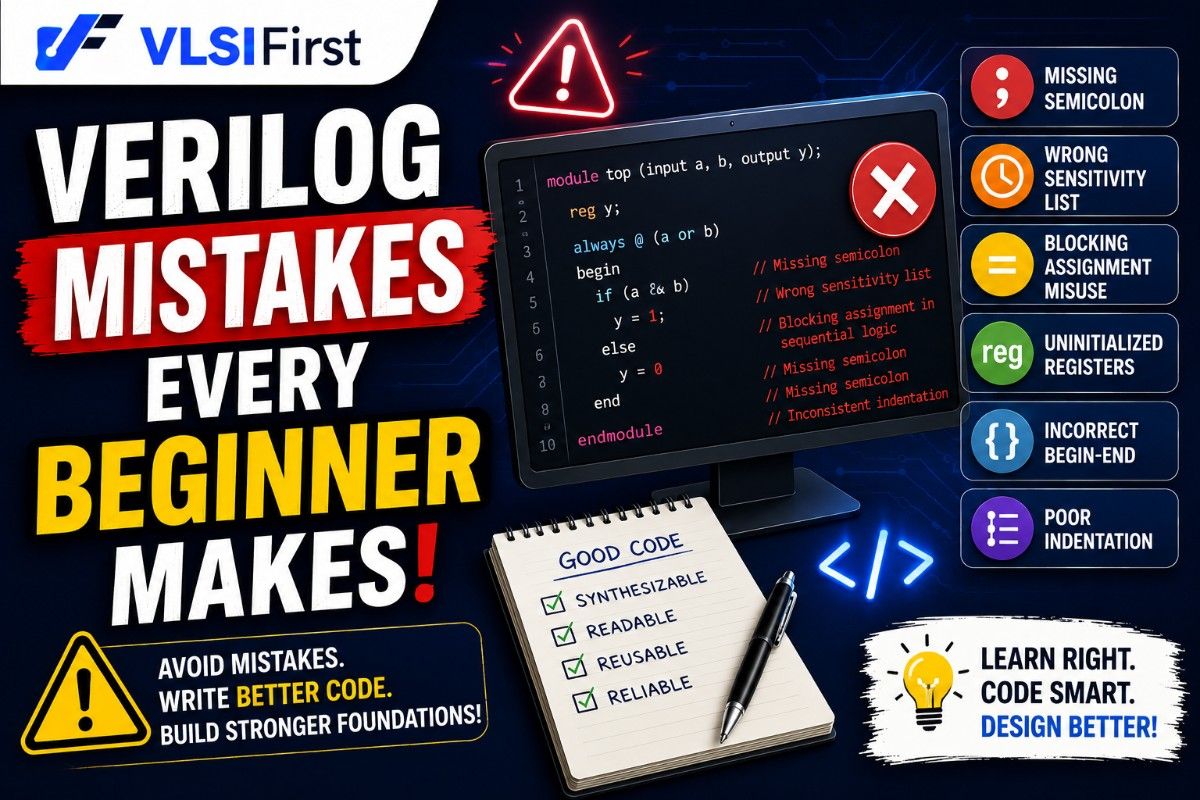
Verilog Mistakes Every Beginner Makes (and How to Avoid Them)
Discover the most common Verilog mistakes beginners make and learn practical tips to improve RTL coding, debugging, simulation, verification, and interview readiness.
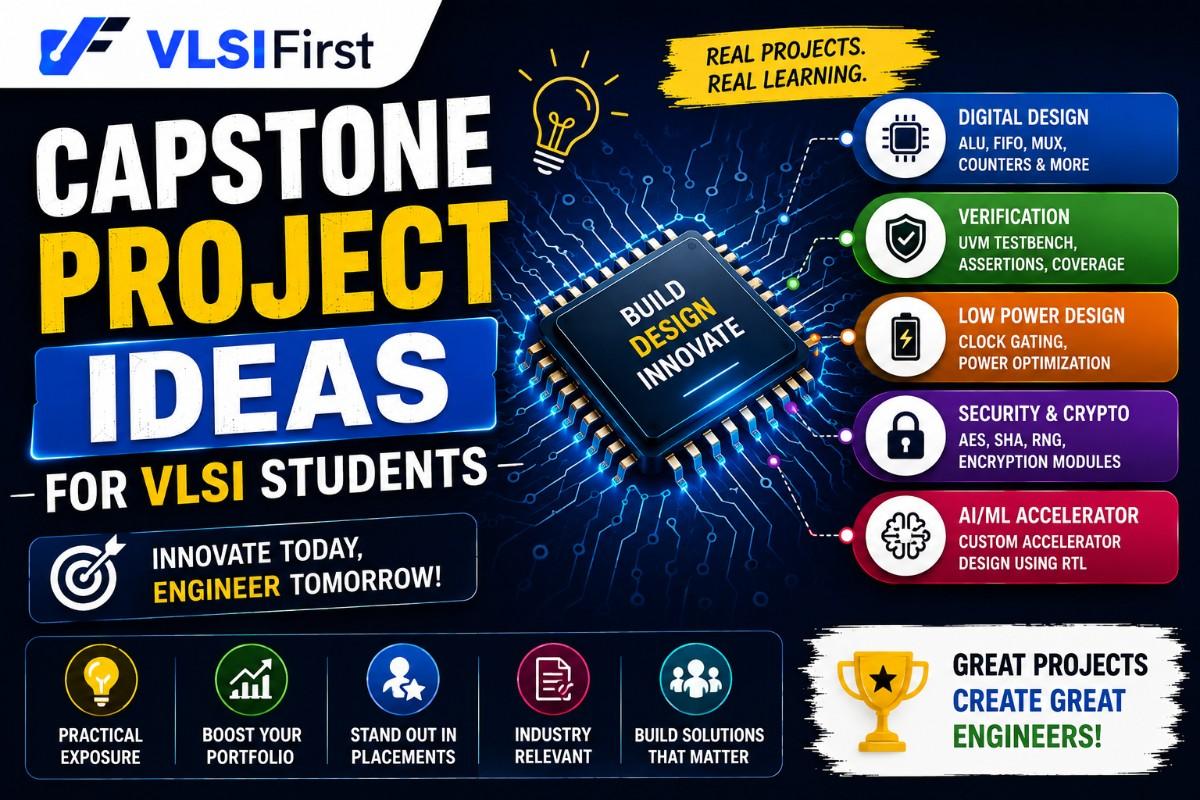
Capstone Project Ideas for VLSI Students
Learn how to write a professional VLSI project report with the right structure, RTL documentation, verification strategy, debugging details, and interview-ready presentation tips.
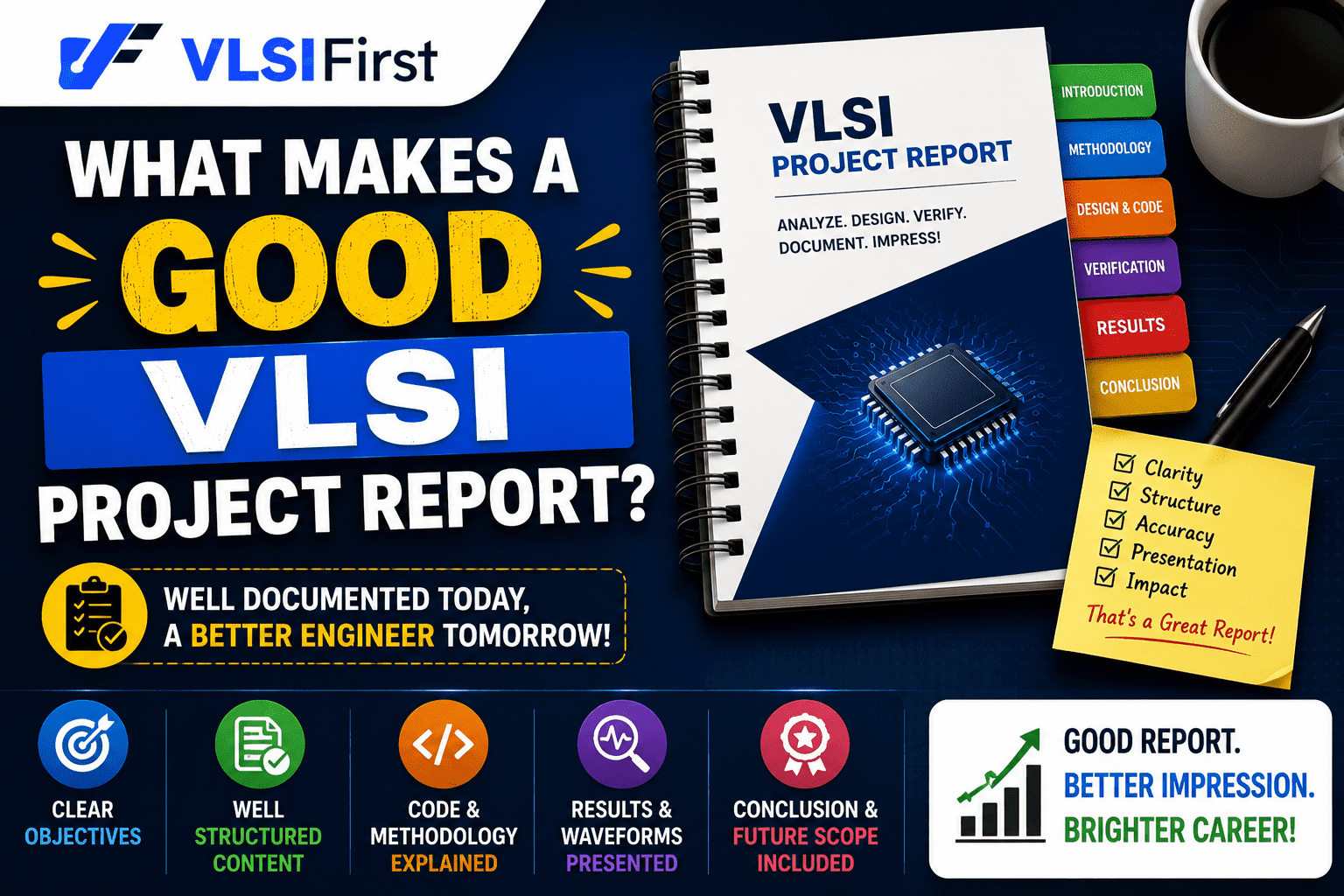
What Makes a Good VLSI Project Report? A Complete Guide for Students and Freshers
Learn how to write a professional VLSI project report with the right structure, RTL documentation, verification strategy, debugging details, and interview-ready presentation tips.
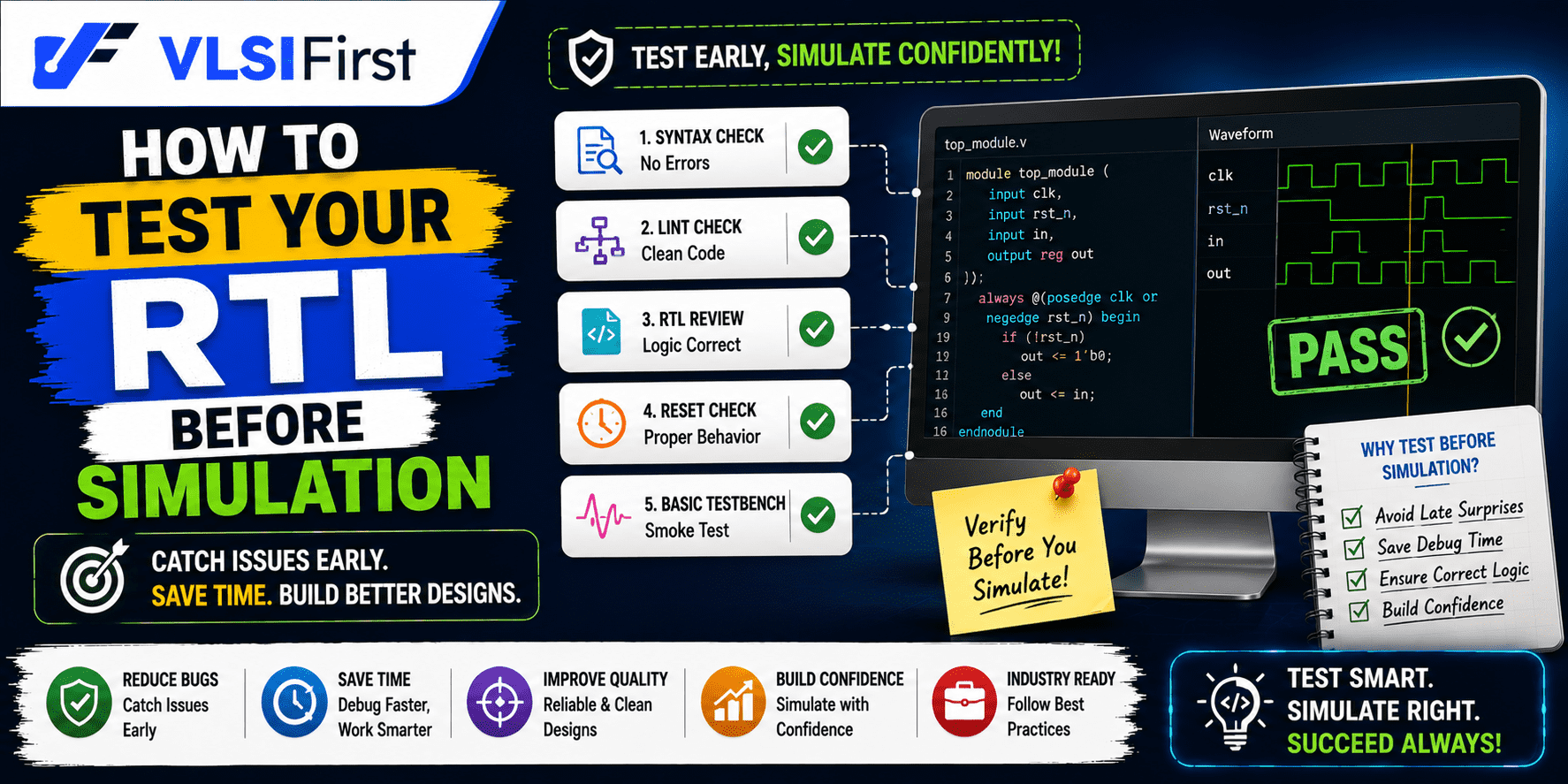
How to Test Your RTL Before Simulation: A Practical Pre-Simulation Checklist for Beginners
Learn how to test your RTL before simulation with a practical pre-simulation checklist. Improve Verilog quality, reduce debugging time, and build industry-ready RTL skills.

From Logic Diagram to Verilog Code – Complete Workflow
Learn the complete workflow from logic diagram to Verilog code, including specifications, RTL architec ture, coding, simulation, debugging, verification, and documentation.


Hours
2-98/1, Gurram Guda Road, Gurram Guda, Hyderabad, Rangareddy, Telangana, 501510
Copyright 2025 © VLSI Technologies Private Limited
Designed and developed by KandraDigitalCopyright 2025 © VLSI Technologies Private Limited
Designed, Developed & Marketing by KandraDigital