
The semiconductor industry is expanding rapidly, with global companies investing heavily in chip design, AI hardware, and advanced computing technologies. As demand for VLSI engineers continues to grow, many students and fresh graduates are enrolling in VLSI training programs to build careers in semiconductor design.
However, not all VLSI courses are created equal. Some programs provide industry-focused training with hands-on projects and tool exposure, while others mainly focus on theoretical concepts.
Choosing the wrong course can result in wasted time, limited practical skills, and difficulty securing job opportunities.
Before enrolling in any training program, it is essential to carefully evaluate the VLSI course curriculum. A well-designed curriculum ensures that students gain the technical skills, practical exposure, and project experience required by semiconductor companies.
This guide explains how to evaluate a VLSI course curriculum step by step, helping you choose the right program for your semiconductor career.
Why Evaluating the Curriculum Is Important
Many students select VLSI institutes based on marketing promises such as “100% placement” or “fast-track training.” However, the real value of any program lies in the quality and structure of its curriculum.
A strong VLSI curriculum should prepare students for real industry workflows including:
- RTL design and simulation
- functional verification
- synthesis and timing analysis
- physical design processes
Without these topics, students may struggle during technical interviews and real project work.
A comprehensive course typically includes semiconductor fundamentals, HDL programming, ASIC design flows, and verification methodologies to ensure students gain industry-ready knowledge.
Therefore, evaluating the curriculum carefully before joining a course is one of the smartest decisions for aspiring VLSI engineers.
1. Check Whether the Course Covers VLSI Fundamentals
The foundation of any VLSI curriculum should start with core semiconductor and digital electronics concepts.
These topics help students understand how integrated circuits are designed and optimized.
Key foundational topics should include:
- semiconductor basics
- CMOS technology
- digital logic design
- combinational and sequential circuits
- timing concepts
These concepts form the basis of VLSI design because engineers must understand how circuits behave before designing complex chip architectures.
If the curriculum skips these fundamentals and jumps directly into advanced topics, students may struggle to understand later modules.
2. Look for Hardware Description Language (HDL) Training
HDL programming is a critical skill in VLSI engineering.
Design engineers use languages such as Verilog and SystemVerilog to describe digital circuits and simulate their behavior.
A strong curriculum should include:
- Verilog basics
- RTL coding techniques
- synthesizable design practices
- simulation and debugging
HDL skills are essential because modern chip design begins at the Register Transfer Level (RTL) stage.
Students who gain strong coding experience become better prepared for roles such as RTL design engineer or verification engineer.
3. Ensure the Course Covers the ASIC Design Flow
One of the most important aspects of VLSI education is understanding the complete ASIC design flow.
This flow explains how a chip moves from concept to silicon manufacturing.
A comprehensive curriculum should include:
- RTL design
- functional verification
- synthesis
- static timing analysis
- physical design
- chip verification and testing
Many professional VLSI training programs include these topics to help students understand real semiconductor development workflows.
Courses that teach only isolated topics without explaining the complete design flow may not prepare students for real industry projects.
4. Verify Industry Tool Exposure
The VLSI industry is heavily dependent on Electronic Design Automation (EDA) tools.
Engineers use specialized software to design, simulate, and verify integrated circuits.
A strong curriculum should include exposure to tools such as:
- Cadence tools
- Synopsys tools
- Mentor Graphics tools
- FPGA development tools
Hands-on tool practice is crucial because semiconductor engineers spend much of their time using these platforms for simulation, debugging, and analysis.
Courses that do not include tool training may leave students unprepared for real engineering tasks.
5. Check Whether the Curriculum Includes Real Projects
Projects are one of the most important elements of VLSI training.
A good course should include both mini projects and major projects.
Examples of useful VLSI projects include:
- traffic light controller using Verilog
- UART communication module
- FIFO memory design
- processor architecture implementation
Projects allow students to apply theoretical concepts and demonstrate practical skills to recruiters.
Training institutes that include FPGA implementation or advanced verification projects help students build strong portfolios.
6. Evaluate Domain Specialization Options
VLSI includes multiple specialized domains.
Students usually focus on one area based on their career goals.
Common domains include:
- RTL design
- functional verification
- physical design
- analog design
- design for testability (DFT)
A strong curriculum should clearly explain which domain the course focuses on and what skills students will develop.
7. Look for Scripting and Automation Skills
Modern chip design teams rely heavily on automation.
Engineers often use scripting languages to automate testing, verification, and design tasks.
Useful scripting languages include:
- Python
- TCL
- Perl
- Shell scripting
Some VLSI training programs include scripting modules because automation skills significantly improve engineering productivity.
8. Check Whether Linux/Unix Environment Is Included
Most semiconductor companies use Linux-based development environments.
Therefore, a good curriculum should include basic Linux commands and workflows.
Students should learn how to:
- navigate file systems
- run simulations through command-line tools
- manage scripts and design files
Linux knowledge is often listed as a prerequisite for advanced VLSI training programs.
9. Evaluate Learning Structure and Duration
VLSI training cannot be completed effectively in a very short time.
A realistic curriculum usually runs for 4–8 months, allowing enough time for concept learning, tool practice, and projects.
Short crash courses may cover theory quickly but often lack sufficient practice.
Look for courses that include:
- weekly assignments
- lab sessions
- project milestones
These features help students build skills progressively.
10. Check Whether the Course Includes Career Preparation
A strong curriculum should go beyond technical concepts.
Many VLSI training programs also include career preparation modules such as:
- resume building
- mock technical interviews
- problem-solving sessions
- industry mentorship
These elements help students transition smoothly into semiconductor job roles.
11. Compare the Curriculum with Real Job Descriptions
One practical method for evaluating a VLSI course is to compare the syllabus with job requirements.
Search for job roles such as:
- RTL design engineer
- verification engineer
- physical design engineer
Then compare the required skills with the topics covered in the course.
If the curriculum matches real job descriptions, the training is more likely to be relevant.
12. Look for Continuous Learning Resources
Good training programs also provide additional learning resources such as:
- recorded lectures
- documentation
- coding exercises
- reference materials
These resources help students revise complex topics and practice outside the classroom.
Final Thoughts
Choosing the right VLSI course is an important step toward building a successful semiconductor career. While many institutes offer VLSI training programs, only a few provide a curriculum that truly matches industry expectations, like vlsifirst.com.
Before enrolling, students should carefully evaluate the course structure, practical exposure, tools, projects, and career support.
A strong VLSI curriculum should include:
- solid semiconductor fundamentals
- HDL programming skills
- ASIC design flow understanding
- industry tool exposure
- real project experience
By analyzing these factors carefully, students can choose a training program that prepares them for real chip design challenges and improves their chances of securing jobs in the semiconductor industry.

How to Test Your RTL Before Simulation: A Practical Pre-Simulation Checklist for Beginners
Learn how to test your RTL before simulation with a practical pre-simulation checklist. Improve Verilog quality, reduce debugging time, and build industry-ready RTL skills.
From Logic Diagram to Verilog Code – Complete Workflow
Learn the complete workflow from logic diagram to Verilog code, including specifications, RTL architec ture, coding, simulation, debugging, verification, and documentation.
Common Mistakes While Writing Verilog Code
Learn the most common Verilog coding mistakes beginners make and how to avoid them. Improve RTL coding, simulation, debugging, verification, and interview readiness.
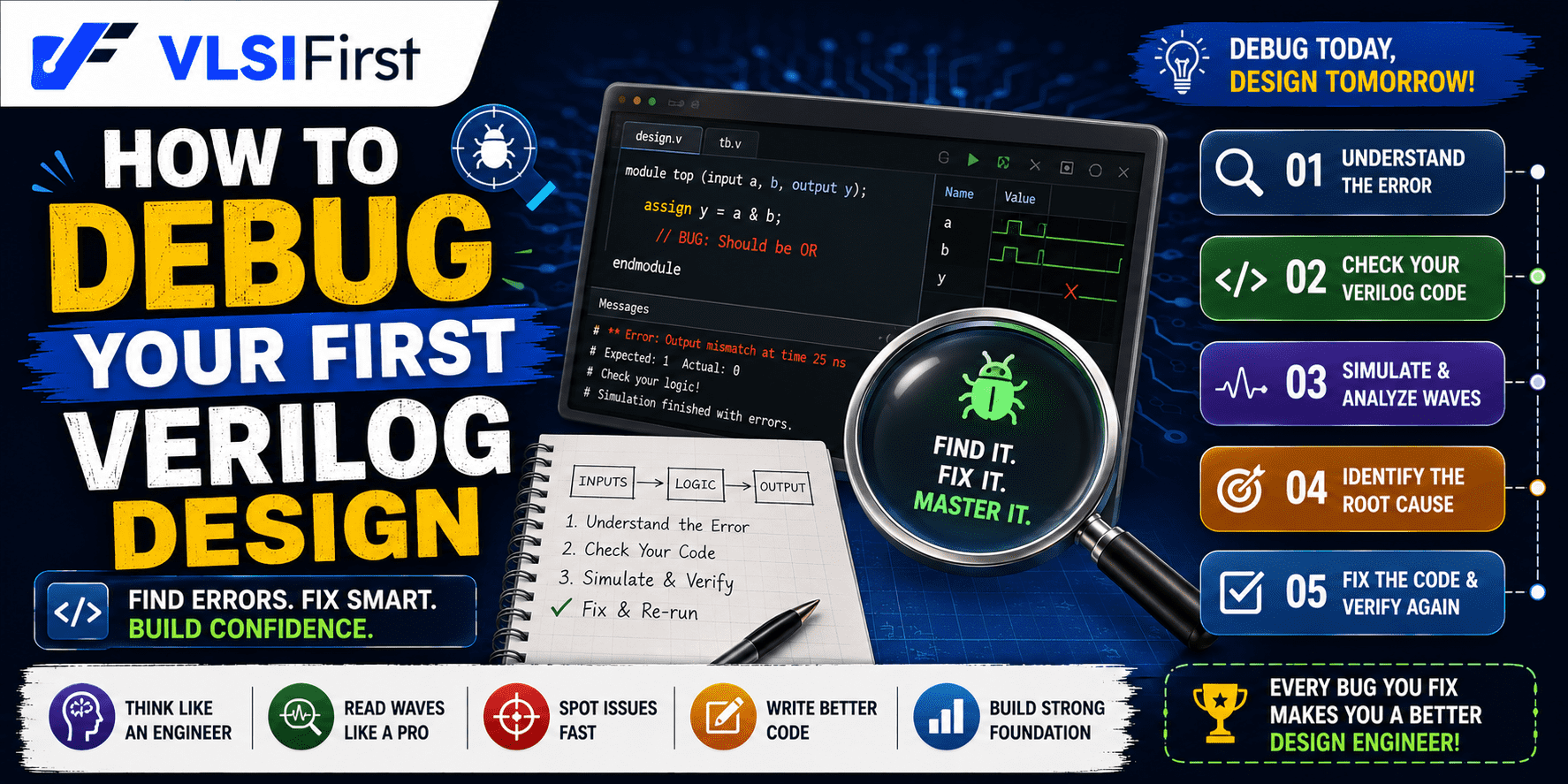
How to Debug Your First Verilog Design
Debugging your first Verilog design with practical RTL debug techniques, waveform analysis, testbench tips, FSM debugging, and common beginner mistakes. Read now!
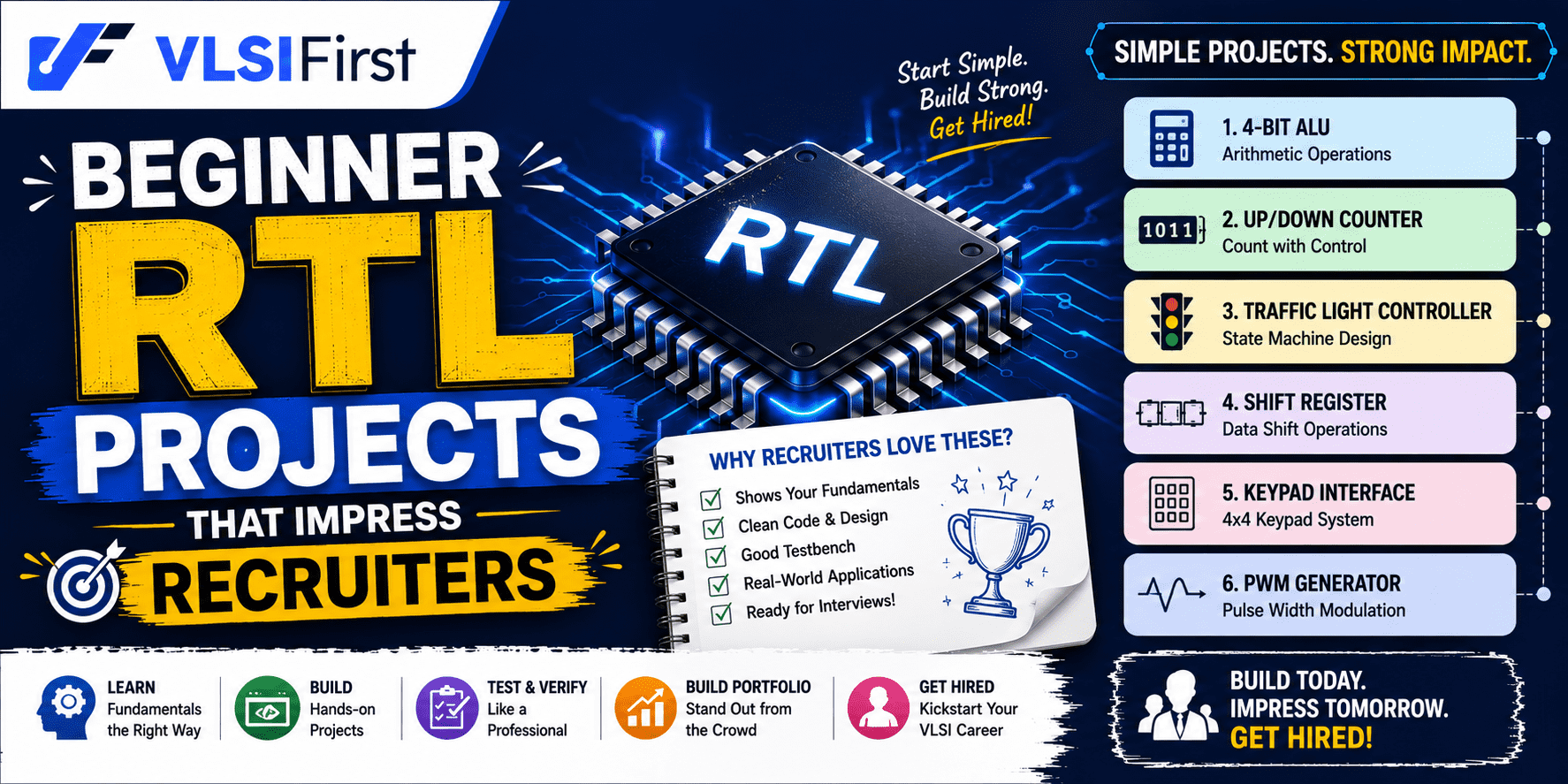
Beginner RTL Projects That Impress Recruiters
Discover beginner RTL projects that impress VLSI recruiters. Learn which Verilog projects build practical skills, strengthen your portfolio, and improve interview success.


Hours
2-98/1, Gurram Guda Road, Gurram Guda, Hyderabad, Rangareddy, Telangana, 501510
Copyright 2025 © VLSI Technologies Private Limited
Designed and developed by KandraDigitalCopyright 2025 © VLSI Technologies Private Limited
Designed, Developed & Marketing by KandraDigital