
One of the biggest challenges faced by VLSI students today is this:
They understand concepts in theory but struggle when exposed to real industry problems.
Many students can:
- define setup and hold time
- explain FSMs
- write basic Verilog syntax
- answer textbook questions
But during interviews or projects, they struggle with:
- debugging failures
- writing scalable RTL
- understanding timing reports
- solving design issues
- analyzing waveforms
This gap exists because academic learning and industry thinking are completely different mindsets.
In college, students are usually trained to:
- memorize concepts
- pass exams
- complete assignments
But in semiconductor companies, engineers are expected to:
- solve problems
- debug efficiently
- optimize designs
- think practically
- understand trade-offs
This blog explains how students can gradually transition from theory-focused learning to real industry thinking in VLSI.
What “Industry Thinking” Actually Means in VLSI
Industry thinking does NOT mean:
- knowing every tool
- memorizing complex commands
- learning advanced topics immediately
Instead, it means developing the ability to:
- analyze problems logically
- understand why failures happen
- connect concepts practically
- debug independently
- think like an engineer instead of a student
This shift is what separates:
- course learners
from - industry-ready engineers.
Recent industry discussions also highlight that many students struggle because they rely too much on theoretical learning without understanding real engineering workflows.
Why Theory Alone Is Not Enough
Theory is important.
Without fundamentals, students cannot survive in VLSI.
But theory alone creates problems because semiconductor engineering is highly practical.
For example:
A student may know:
- what setup time means theoretically
But industry engineers expect them to understand:
- why setup violations happen
- how timing paths behave
- how to debug violations
- how constraints affect STA
This is why many freshers feel lost during:
- internships
- interviews
- project work
- debugging sessions
Modern semiconductor workflows increasingly prioritize debugging and analytical reasoning because chip complexity continues to grow rapidly.
The Biggest Difference Between Academic Learning and Industry Thinking
Academic Learning
Focuses on:
- definitions
- derivations
- marks
- theoretical understanding
Industry Thinking
Focuses on:
- implementation
- debugging
- scalability
- optimization
- reliability
For example:
In academics: “Design a counter.”
In industry: “Why is this counter failing after synthesis under timing pressure?”
That difference is enormous.
Step 1: Stop Learning Only for Interviews
This is the first major mindset shift.
Many students learn VLSI only to:
- answer interview questions
- memorize definitions
- complete courses quickly
But real engineers learn to:
- understand behavior
- solve practical issues
- improve implementation quality
Recent fresher discussions in semiconductor communities repeatedly show that shallow interview-focused preparation creates long-term struggles.
Step 2: Build Strong Digital Fundamentals
Industry thinking starts with fundamentals.
Without strong basics, students cannot debug or analyze effectively.
Focus deeply on:
- combinational logic
- sequential circuits
- FSMs
- timing concepts
- clocking
- reset handling
Even in advanced semiconductor nodes, digital fundamentals remain critical.
Step 3: Learn Through Projects Instead of Passive Theory
Projects force students to think practically.
This is where industry thinking truly begins.
When building projects, students encounter:
- simulation failures
- synthesis issues
- timing mismatches
- design trade-offs
These experiences develop engineering maturity.
ASIC project-based learning is repeatedly recommended because it improves debugging and system-level understanding.
Good beginner projects include:
- UART controller
- FIFO design
- ALU implementation
- SPI protocol
- simple RISC processor
Step 4: Practice Debugging Daily
This is one of the biggest differences between students and industry engineers.
Students try to avoid bugs.
Engineers expect bugs.
In real semiconductor companies: debugging is a daily activity.
Modern verification and physical design workflows heavily depend on debugging expertise because chip complexity is increasing dramatically.
To build debugging skills:
- intentionally create errors
- analyze waveform mismatches
- debug FSM failures
- fix timing issues
This builds real engineering confidence.
Step 5: Understand “Why,” Not Just “How”
This is extremely important.
Many students learn:
- commands
- syntax
- tool flow steps
without understanding:
- why the step exists
- what problem it solves
- what happens if it fails
For example:
Instead of only learning: “Run synthesis.”
Understand:
- why synthesis optimization matters
- how constraints affect results
- why poor RTL impacts timing
This creates deeper engineering thinking.
Step 6: Improve RTL Quality
Industry engineers care heavily about RTL quality.
Good RTL should be:
- readable
- synthesizable
- modular
- timing-aware
Many freshers can write syntax but struggle to create clean RTL suitable for real projects.
Practice:
- FSM coding
- reset synchronization
- parameterized modules
- clean hierarchy design
Step 7: Learn Timing Practically
Timing is one of the biggest areas where theory and industry differ.
In textbooks:
- timing concepts look simple
In real projects:
- timing closure becomes complex
Timing closure is often one of the toughest challenges for freshers because practical timing analysis is far more layered than classroom learning.
Learn to think practically about:
- critical paths
- setup violations
- hold fixing
- clock skew
- timing optimization
Step 8: Understand the Complete ASIC Flow
Students often learn topics separately.
Industry engineers think in flows.
Even beginners should understand:
- RTL → synthesis → STA → physical design → signoff
This helps students connect concepts logically.
A structured roadmap is critical for becoming job-ready in modern VLSI careers.
Step 9: Stop Depending Entirely on Tutorials
Tutorials help initially.
But industry thinking develops only when students:
- experiment independently
- solve unfamiliar problems
- debug without step-by-step guidance
Many students remain stuck in “tutorial learning mode” for too long. Community discussions increasingly warn against this habit.
Step 10: Learn to Handle Ambiguity
Academic problems usually have:
- fixed questions
- clear answers
Industry problems often have:
- incomplete information
- multiple possible solutions
- unclear root causes
Strong engineers become comfortable with uncertainty.
This mindset develops only through:
- projects
- debugging
- repeated practice
Step 11: Think About Trade-Offs
Industry engineering is heavily based on trade-offs.
For example:
- area vs performance
- power vs speed
- verification depth vs schedule
Students transitioning to industry thinking must learn that there is rarely one “perfect” solution.
Step 12: Improve Communication and Documentation
Industry engineers are expected to:
- explain bugs clearly
- document assumptions
- communicate design decisions
Even highly technical engineers need strong communication in collaborative semiconductor teams.
Recent hiring trends increasingly emphasize communication and collaboration skills.
Common Mistakes That Prevent Industry Thinking
1. Memorizing Without Application
Theory without implementation creates weak understanding.
2. Avoiding Difficult Problems
Growth happens during debugging and failure analysis.
3. Learning Too Many Topics Superficially
Students often try:
- RTL
- STA
- UVM
- Physical Design
- DFT
all at once.
Depth matters more initially.
4. Treating Tools as the Main Skill
Tools assist engineering.
They do not replace engineering thinking.
Signs You’re Developing Industry Thinking
You are improving when you start:
- asking “why” frequently
- debugging independently
- understanding trade-offs
- analyzing failures logically
- connecting concepts across domains
- improving RTL quality naturally
Conclusion
So, how do you move from theory-based learning to industry thinking in VLSI?
By shifting from:
- memorization
to - practical engineering understanding.
Focus on:
- projects
- debugging
- RTL quality
- timing analysis
- problem-solving
- workflow understanding
Because semiconductor companies do not hire students simply for knowing definitions.
They hire engineers who can think, analyze, and solve problems practically.

How to Test Your RTL Before Simulation: A Practical Pre-Simulation Checklist for Beginners
Learn how to test your RTL before simulation with a practical pre-simulation checklist. Improve Verilog quality, reduce debugging time, and build industry-ready RTL skills.
From Logic Diagram to Verilog Code – Complete Workflow
Learn the complete workflow from logic diagram to Verilog code, including specifications, RTL architec ture, coding, simulation, debugging, verification, and documentation.
Common Mistakes While Writing Verilog Code
Learn the most common Verilog coding mistakes beginners make and how to avoid them. Improve RTL coding, simulation, debugging, verification, and interview readiness.
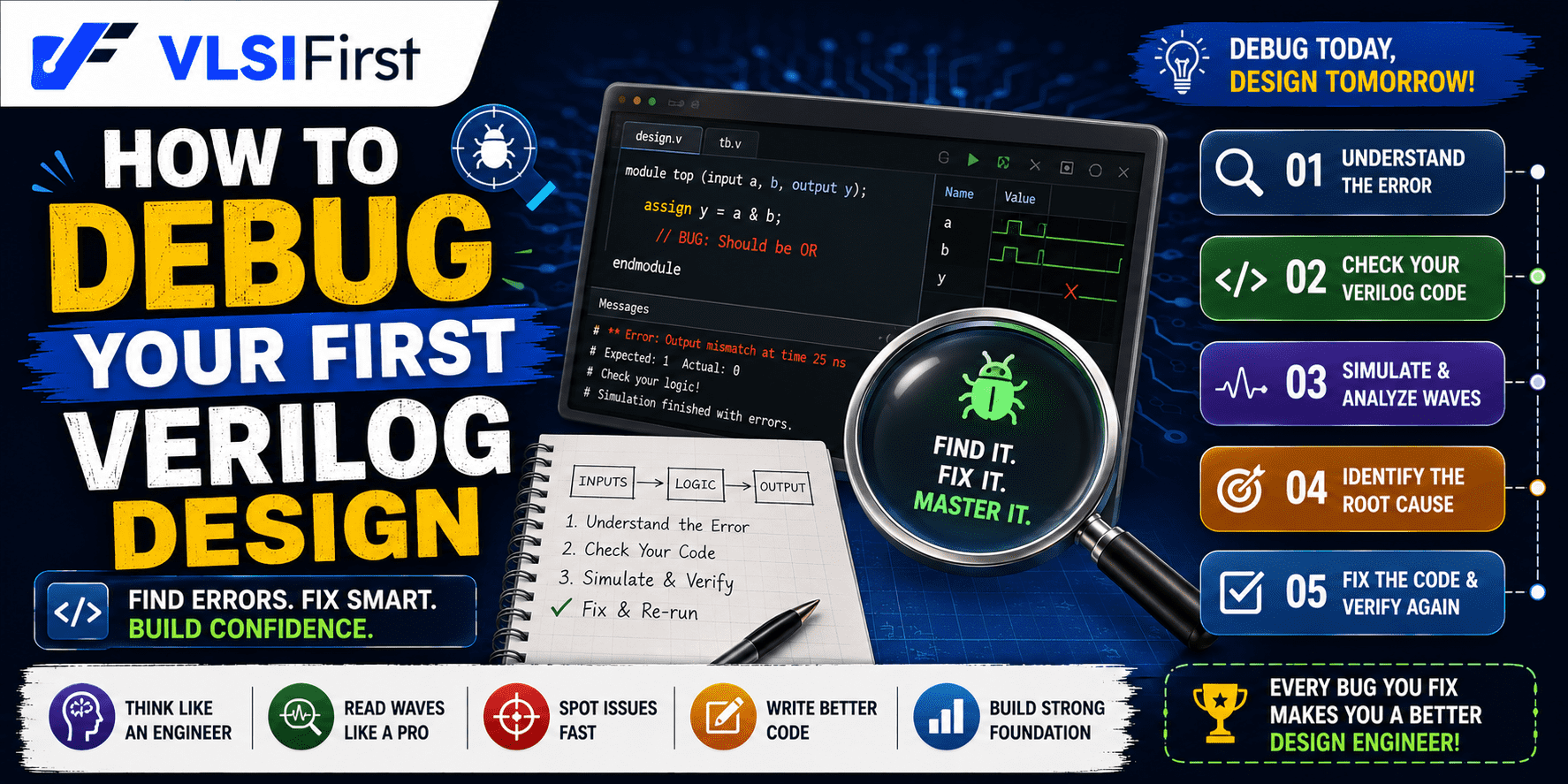
How to Debug Your First Verilog Design
Debugging your first Verilog design with practical RTL debug techniques, waveform analysis, testbench tips, FSM debugging, and common beginner mistakes. Read now!
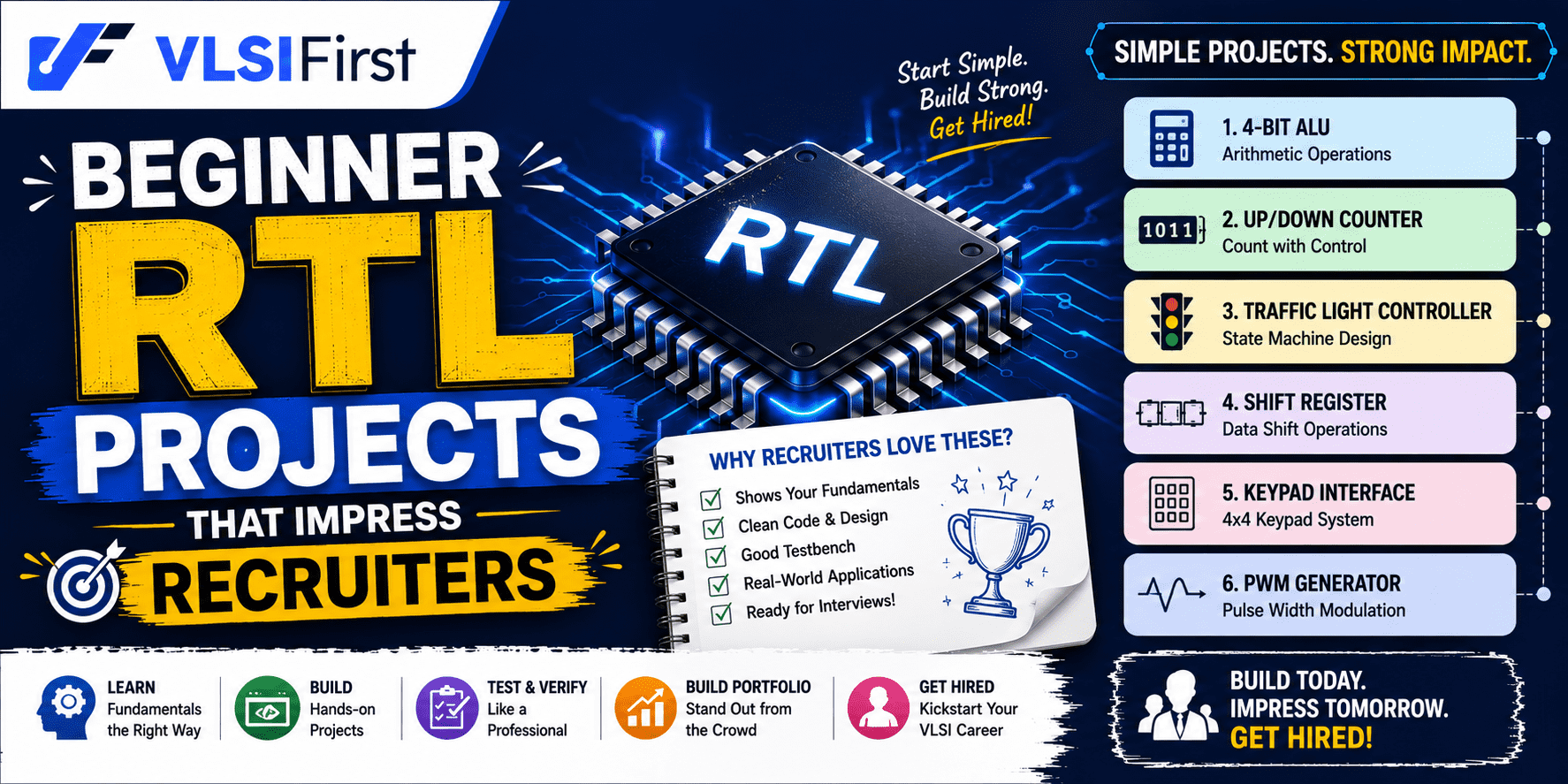
Beginner RTL Projects That Impress Recruiters
Discover beginner RTL projects that impress VLSI recruiters. Learn which Verilog projects build practical skills, strengthen your portfolio, and improve interview success.


Hours
2-98/1, Gurram Guda Road, Gurram Guda, Hyderabad, Rangareddy, Telangana, 501510
Copyright 2025 © VLSI Technologies Private Limited
Designed and developed by KandraDigitalCopyright 2025 © VLSI Technologies Private Limited
Designed, Developed & Marketing by KandraDigital