
Every year, thousands of ECE graduates enter the job market believing they are ready for semiconductor careers.
After all, they have already studied:
- Digital Electronics
- VLSI Design
- Microprocessors
- Communication Systems
- Analog Electronics
So naturally, many students expect: “I already learned VLSI subjects in college, so getting a VLSI job should be straightforward.”
But when they attend interviews or begin industry-level training, many realize something shocking: There is a massive gap between academic ECE learning and actual VLSI industry expectations.
This gap is one of the biggest reasons why:
- many freshers struggle in interviews
- students feel confused during training
- graduates fail to become job-ready quickly
Semiconductor companies expect practical engineering skills that traditional college syllabi often do not fully develop.
This blog explains:
- the biggest skill gaps between ECE education and VLSI jobs
- why these gaps exist
- what companies actually expect
- how students can bridge the gap effectively
Why This Gap Exists
Most university ECE programs are designed to provide:
- broad academic foundations
- theoretical understanding
- examination-oriented learning
Their goal is not always immediate industry readiness.
Meanwhile, semiconductor companies focus heavily on:
- practical implementation
- debugging
- project execution
- tool workflows
- timing closure
- verification quality
As semiconductor design complexity grows rapidly, companies increasingly need engineers who can contribute practically from the beginning.
This naturally creates a skill mismatch.
The Biggest Skill Gap: “Knowing Concepts” vs “Applying Concepts”
This is the core issue.
Most ECE students know concepts theoretically.
But industry engineers are expected to:
- apply concepts practically
- debug failures
- optimize designs
- solve engineering problems
For example:
In College
Students may learn:
- setup time definition
- FSM theory
- Karnaugh maps
- Verilog syntax
In Industry
Engineers are expected to:
- debug timing violations
- design scalable RTL
- analyze waveform mismatches
- optimize logic paths
That transition is much harder than most students expect.
Gap #1: Theory vs Practical Debugging
One of the biggest industry expectations missing in many college environments is debugging.
Students are rarely trained to:
- analyze failing simulations
- trace signal mismatches
- identify root causes
- debug timing failures
But in semiconductor companies, debugging is a daily engineering activity.
Modern chips are becoming increasingly complex, making debugging one of the most valuable VLSI skills today.
Gap #2: Limited RTL Coding Practice
Most ECE students learn:
- basic Verilog syntax
- small academic examples
But real VLSI jobs require:
- synthesizable RTL
- scalable coding
- modular architecture
- timing-aware design
Many freshers struggle because they can write small programs but cannot build clean, reusable RTL suitable for industry projects.
Industry engineers care deeply about:
- code quality
- readability
- reset handling
- FSM implementation
- timing optimization
Gap #3: Lack of Tool Exposure
Many colleges still provide limited access to:
- industry-standard EDA tools
- ASIC flows
- verification environments
As a result, students graduate without understanding:
- synthesis workflows
- STA analysis
- simulation debugging
- place-and-route basics
Meanwhile, companies expect at least basic familiarity with modern VLSI workflows.
This is why industry-focused training becomes important for many graduates.
Gap #4: Weak Problem-Solving Skills
College exams often reward:
- memorization
- formula recall
- theoretical writing
But VLSI jobs demand:
- logical analysis
- root-cause thinking
- debugging strategy
- optimization mindset
Recruiters increasingly test analytical thinking rather than textbook memory.
For example, interviewers may ask:
- “How would you debug this waveform issue?”
- “Why is timing failing?”
- “What happens if reset synchronization fails?”
These require engineering reasoning, not memorization.
Gap #5: Poor Understanding of the Complete ASIC Flow
Most ECE syllabi teach topics separately.
Students learn:
- digital electronics
- VLSI concepts
- microprocessors
as isolated subjects.
But semiconductor companies work in integrated flows:
RTL → Synthesis → STA → Physical Design → Signoff → Verification
Without understanding the complete flow, students struggle to connect concepts practically.
A system-level understanding is becoming increasingly important in modern semiconductor development.
Gap #6: Minimal Industry-Style Projects
Many academic projects are:
- very small
- copied from online sources
- focused only on submission
But industry projects involve:
- debugging cycles
- timing issues
- verification complexity
- integration challenges
Students who lack real project exposure often struggle during interviews.
Project-based learning is now one of the strongest indicators of practical readiness in semiconductor hiring.
Gap #7: Limited Understanding of Timing Analysis
Timing is one of the biggest areas where freshers struggle.
In college:
- timing concepts are often theoretical
In industry:
- timing closure becomes a major engineering challenge
Freshers are often surprised by:
- setup/hold violations
- clock uncertainty
- skew analysis
- critical path optimization
Timing analysis is now central to advanced-node semiconductor workflows.
Gap #8: Communication and Team Collaboration
Most ECE students are evaluated individually.
But semiconductor development is highly collaborative.
Engineers regularly interact with:
- design teams
- verification teams
- physical design engineers
- DFT engineers
- firmware teams
Companies increasingly value:
- communication
- documentation
- teamwork
- technical discussions
even for freshers.
Gap #9: Lack of Industry Thinking
This is perhaps the most important gap.
Students are trained to answer questions correctly.
Industry engineers are expected to solve problems efficiently.
This mindset shift is huge.
Strong engineers constantly think about:
- optimization
- scalability
- corner cases
- reliability
- trade-offs
Gap #10: Overdependence on Academic Marks
Many students assume that “Good CGPA guarantees VLSI jobs.”
But semiconductor hiring increasingly focuses on:
- projects
- debugging ability
- RTL quality
- practical understanding
Many average academic performers become strong VLSI engineers because they build practical skills consistently.
How Students Can Bridge This Skill Gap
1. Build Strong Digital Fundamentals
Focus deeply on:
- FSMs
- timing concepts
- synchronous logic
- clocking
2. Practice RTL Coding Daily
Work on:
- synthesizable Verilog
- clean coding style
- modular design
3. Learn Through Projects
Projects create:
- debugging exposure
- practical understanding
- engineering confidence
4. Develop Debugging Skills
Spend time:
- analyzing waveforms
- fixing bugs
- tracing signals
5. Understand the Full ASIC Flow
Learn how:
- RTL
- synthesis
- STA
- verification
- physical design
connect together.
6. Build Industry Thinking
Stop learning only for exams.
Start asking:
- “Why does this happen?”
- “How would this behave in real silicon?”
What Companies Actually Want
Today’s semiconductor companies primarily look for:
- strong fundamentals
- debugging mindset
- practical projects
- RTL understanding
- timing awareness
- learning attitude
not just academic knowledge.
Recruiters increasingly prefer practical, project-oriented candidates who can adapt quickly to industry workflows.
Final Verdict
The biggest skill gap between college ECE education and VLSI jobs is simple:
- Colleges often teach concepts.
- Industry expects practical engineering application.
That’s why many students feel overwhelmed initially.
But the good news is:
This gap can absolutely be bridged through:
- projects
- debugging
- practical training
- RTL practice
- industry-focused learning
If you are an ECE student planning a VLSI career, don’t depend only on college syllabus.
Use college fundamentals as your base, then build:
- practical skills
- debugging ability
- engineering thinking
- project exposure
Because in semiconductor careers:
The students who grow fastest are not always the toppers, they are the ones who learn how to think like engineers.
For more semiconductor career guidance, VLSI preparation strategies, and industry-focused learning resources, explore detailed content on VLSIFirst.com.

How to Test Your RTL Before Simulation: A Practical Pre-Simulation Checklist for Beginners
Learn how to test your RTL before simulation with a practical pre-simulation checklist. Improve Verilog quality, reduce debugging time, and build industry-ready RTL skills.
From Logic Diagram to Verilog Code – Complete Workflow
Learn the complete workflow from logic diagram to Verilog code, including specifications, RTL architec ture, coding, simulation, debugging, verification, and documentation.
Common Mistakes While Writing Verilog Code
Learn the most common Verilog coding mistakes beginners make and how to avoid them. Improve RTL coding, simulation, debugging, verification, and interview readiness.
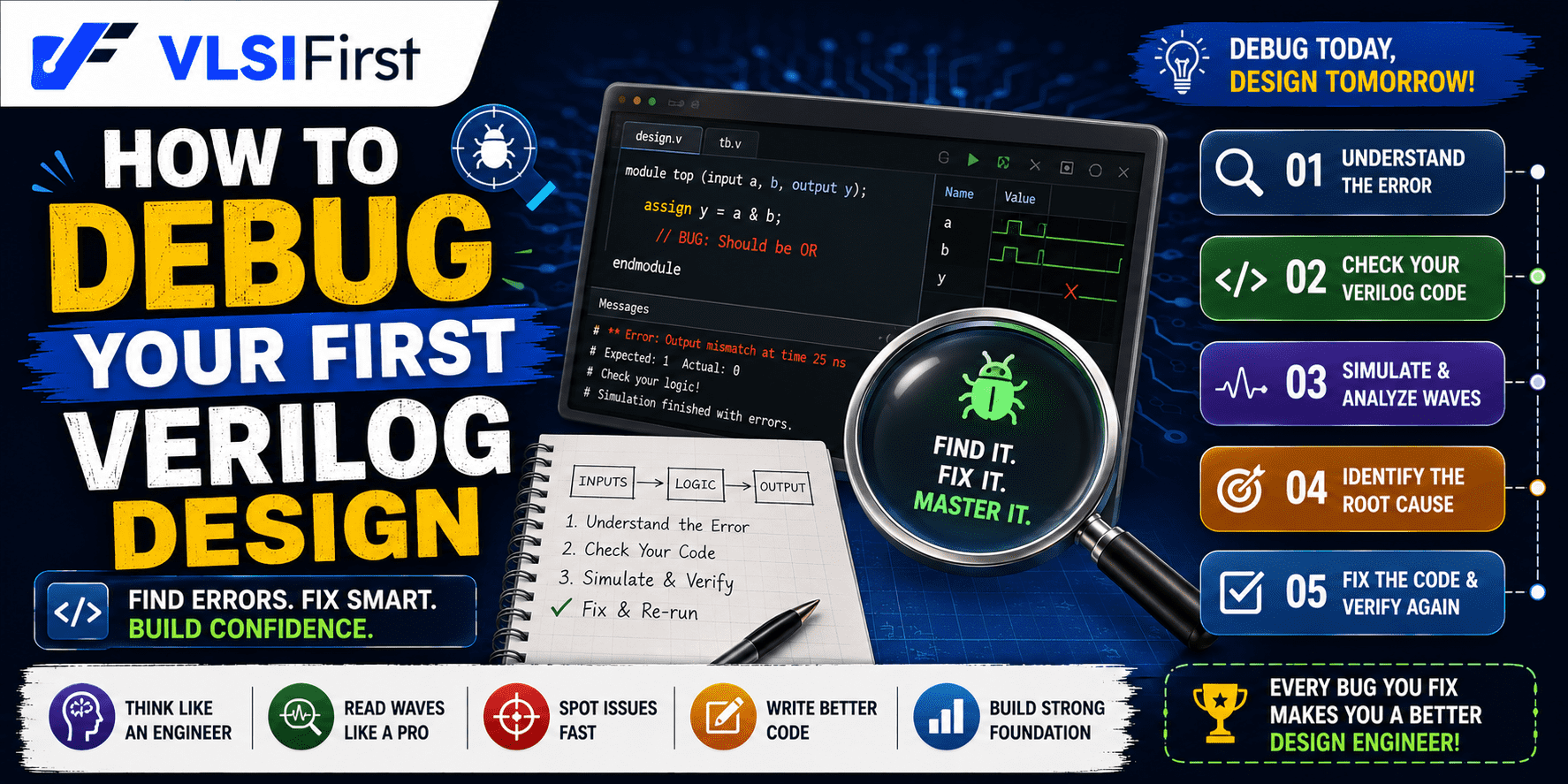
How to Debug Your First Verilog Design
Debugging your first Verilog design with practical RTL debug techniques, waveform analysis, testbench tips, FSM debugging, and common beginner mistakes. Read now!
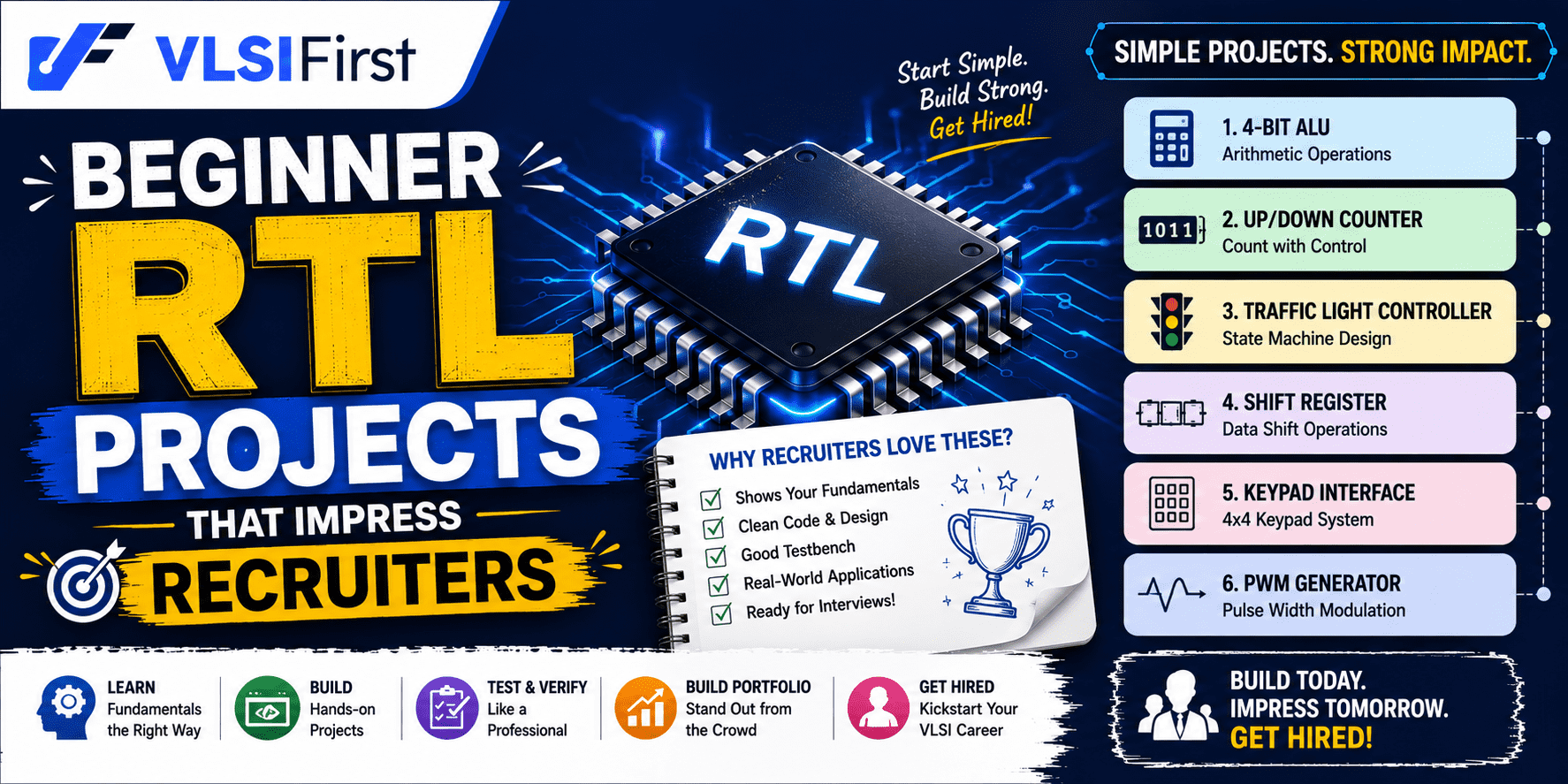
Beginner RTL Projects That Impress Recruiters
Discover beginner RTL projects that impress VLSI recruiters. Learn which Verilog projects build practical skills, strengthen your portfolio, and improve interview success.


Hours
2-98/1, Gurram Guda Road, Gurram Guda, Hyderabad, Rangareddy, Telangana, 501510
Copyright 2025 © VLSI Technologies Private Limited
Designed and developed by KandraDigitalCopyright 2025 © VLSI Technologies Private Limited
Designed, Developed & Marketing by KandraDigital