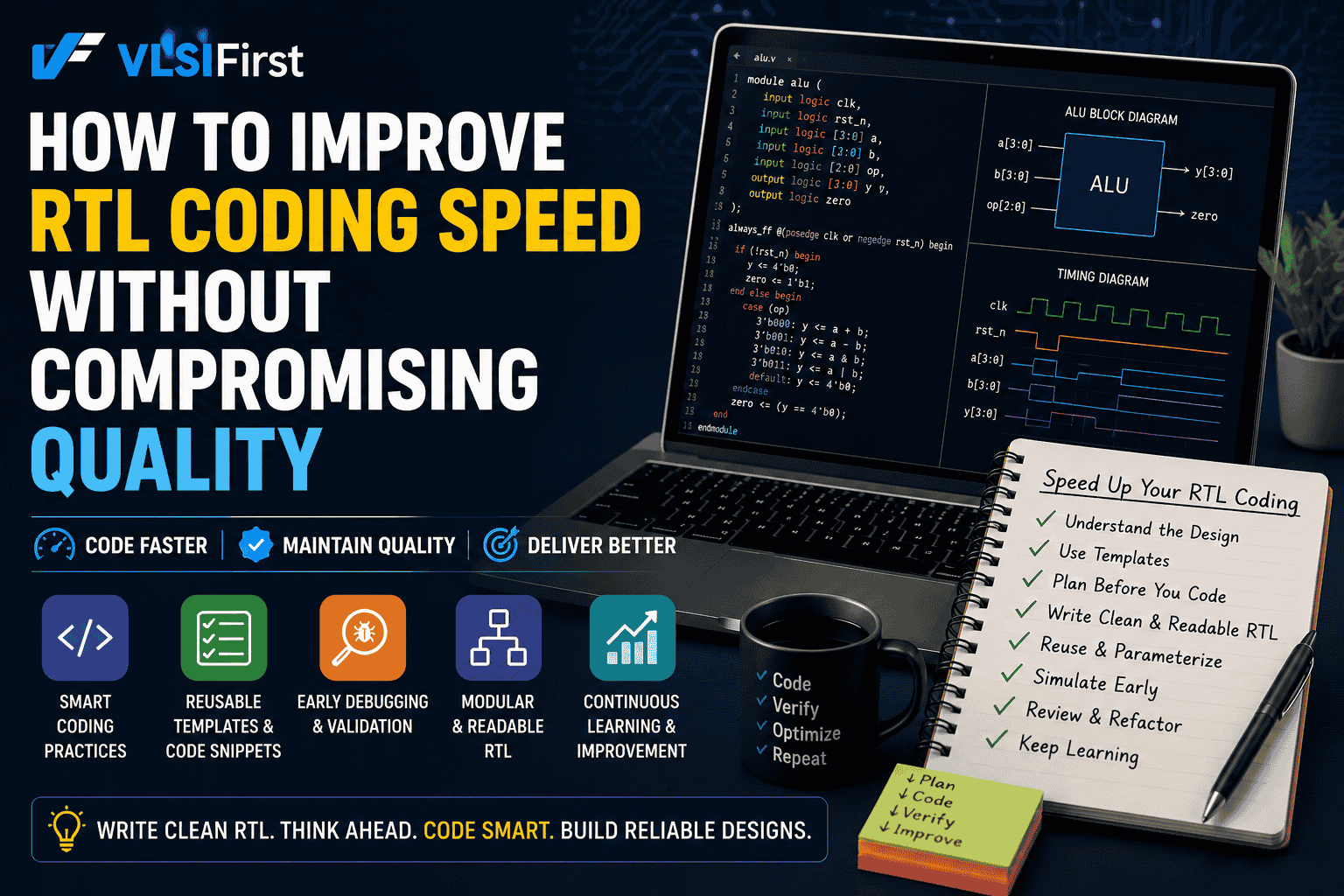
For many VLSI students and fresh graduates, RTL coding initially feels slow and overwhelming. A simple module may take hours to complete, and debugging often consumes more time than writing the code itself. It's natural to compare yourself with experienced engineers who seem to write complex RTL effortlessly, but the reality is that coding speed comes from experience, structured thinking, and repeated practice, not from typing faster.
In the semiconductor industry, companies do not hire engineers simply because they can write Verilog quickly. They value engineers who can understand specifications, design efficient hardware, write synthesizable RTL, verify functionality, and debug issues systematically. Speed becomes a by-product of mastering these skills.
If you are preparing for RTL Design interviews or working on personal VLSI projects, improving your coding speed can significantly increase your productivity and confidence. This article explains practical techniques used by experienced RTL designers to write high-quality RTL faster while maintaining reliability and readability.
Why Beginners Take More Time to Write RTL
Before trying to improve your speed, it's important to understand why coding feels slow.
Most beginners spend time because they:
- Start coding without fully understanding the specification.
- Think about Verilog syntax while designing the hardware.
- Frequently switch between coding and debugging.
- Have limited exposure to common RTL architectures.
- Lack confidence in verification.
These are learning-stage challenges rather than weaknesses. As your understanding improves, your coding naturally becomes faster.
Understand the Problem Before Opening the Editor
One of the biggest productivity mistakes is writing code immediately after reading the problem statement.
Professional RTL engineers first ask questions such as:
- What functionality is required?
- Is the logic combinational or sequential?
- How many inputs and outputs are needed?
- What happens during reset?
- Are there timing or latency requirements?
- Can the design be divided into smaller modules?
Spending 15 minutes planning can save hours of debugging later.
Draw the Hardware Architecture First
Experienced engineers rarely begin with Verilog code.
Instead, they sketch:
- Block diagrams
- Data paths
- Control paths
- Register locations
- State machines
- Signal flow
A simple architecture diagram provides a roadmap for coding and reduces uncertainty during implementation.
Master Digital Design Fundamentals
RTL coding speed is closely linked to your understanding of digital electronics.
If you clearly understand concepts like:
- Multiplexers
- Flip-flops
- Counters
- Registers
- Shift registers
- Finite State Machines
- Arithmetic circuits
you'll spend less time deciding how to implement them.
Strong fundamentals reduce hesitation and improve coding confidence.
Learn Common RTL Design Patterns
Many RTL modules share similar structures.
Examples include:
- Counters
- FIFOs
- UARTs
- Register files
- Memory interfaces
- State machines
- Sequence detectors
As you build more projects, you'll recognize recurring design patterns, allowing you to focus on functionality instead of reinventing the architecture each time.
Strengthen Your Verilog Fundamentals
Many students lose time searching for syntax during coding.
Instead of memorizing every language feature, become comfortable with frequently used constructs such as:
- Module declarations
- Parameters
- Conditional statements
- Case statements
- Loops
- Always blocks
- Continuous assignments
When syntax becomes second nature, you can concentrate on solving design problems.
Think in Hardware, Not in Code
RTL describes hardware, not software.
Before writing any statement, ask yourself:
- Which hardware element am I creating?
- Will this infer a register?
- Is this combinational logic?
- How will synthesis interpret this code?
Thinking about hardware first reduces design errors and accelerates coding.
Write Small Modules Instead of Large Ones
Large modules often become difficult to debug and maintain.
Instead:
- Divide functionality into independent blocks.
- Verify each block separately.
- Combine modules after validation.
Smaller modules are easier to understand and reduce debugging effort.
Develop a Consistent Coding Style
Consistency improves both speed and readability.
Maintain standards for:
- Signal naming
- Indentation
- Module organization
- Comments
- Parameter declarations
When your coding style becomes habitual, you spend less time formatting and more time solving engineering problems.
Avoid Perfection During the First Draft
Many students repeatedly edit small sections while coding.
Professional engineers usually:
- Complete the architecture.
- Finish the RTL.
- Simulate.
- Debug.
- Optimize.
Trying to perfect every line before completing the design often slows overall progress.
Verify Frequently Instead of Waiting Until the End
Long debugging sessions usually result from delayed verification.
Instead:
- Test small modules individually.
- Verify interfaces early.
- Check reset behavior.
- Examine waveforms after each milestone.
Finding errors early is much faster than debugging an entire project later.
Learn to Read Waveforms Efficiently
Waveforms are one of the fastest debugging tools available.
Practice identifying:
- Clock edges
- Register updates
- State transitions
- Data movement
- Reset behavior
- Signal timing
The more comfortable you become with waveform analysis, the faster you'll identify coding issues.
Build Reusable Knowledge Instead of Reusing Code Blindly
Experienced engineers often recognize familiar solutions because they've solved similar problems before, not because they copy old code.
Maintain personal notes on:
- FSM templates
- Counter implementations
- FIFO architectures
- Interface protocols
- Common debugging strategies
This knowledge library accelerates future development while strengthening conceptual understanding.
Practice Timed Coding Exercises
Interview coding rounds usually have time limits.
Set practical challenges such as:
- Implement a 4-bit counter in 20 minutes.
- Design a shift register in 25 minutes.
- Write an FSM within 40 minutes.
- Debug a faulty RTL module in 30 minutes.
Timed practice helps improve decision-making under pressure without sacrificing quality.
Learn from Every Debugging Session
Every bug teaches something valuable.
After fixing an issue, ask yourself:
- Why did this happen?
- Could I have prevented it?
- What design assumption was incorrect?
- How can I avoid repeating this mistake?
Over time, you'll naturally make fewer mistakes, increasing coding speed.
Build More Practical Projects
Coding speed improves dramatically through repetition.
Recommended beginner projects include:
- ALU
- FIFO
- UART
- SPI Controller
- Register File
- Traffic Light Controller
- Sequence Detector
- Memory Controller
- Simple CPU Components
Each project strengthens architecture planning, coding, verification, and debugging skills.
Improve Documentation Habits
Well-documented designs reduce future debugging time.
Document:
- Module purpose
- Interface definitions
- Timing assumptions
- Parameter descriptions
- Design limitations
- Verification results
Good documentation makes modifications faster and improves collaboration with verification and implementation teams.
Prepare Like an Industry Engineer
Companies expect engineers who can deliver reliable RTL within project timelines. Improving coding speed means developing efficient engineering habits rather than simply typing faster. Learn to interpret specifications quickly, think about hardware architecture, write clean synthesizable code, verify continuously, and refine your debugging process.
Students who consistently work on real-world projects, review their own code, and seek constructive feedback generally improve much faster than those who focus only on theoretical learning.
Build Faster RTL Skills Through Practical Training
The fastest way to improve RTL coding is through structured practice guided by industry workflows. Working on progressively challenging projects helps students recognize design patterns, understand hardware behavior, and become comfortable writing synthesizable RTL under realistic timelines.
VLSIFirst offers practical learning through programs including Semiconductor Fundamentals, Digital Electronics for VLSI, RTL Design and Verification, SystemVerilog & UVM, FPGA Design, ASIC Design, Physical Design, Static Timing Analysis (STA), Design for Test (DFT), Custom Layout Design, Low Power VLSI Design, and the Full Chip Design Program. These courses provide hands-on experience with RTL coding, simulation, debugging, synthesis, verification, documentation, and project implementation, helping students build both speed and confidence for real semiconductor roles.
Final Thoughts
Improving RTL coding speed is a gradual process built on strong fundamentals, thoughtful planning, and consistent practice. The goal should never be to write code as quickly as possible; instead, aim to write correct, synthesizable, and maintainable RTL efficiently.
As your understanding of digital design grows, you'll spend less time searching for syntax, fixing preventable mistakes, or redesigning architectures. You'll begin recognizing common design patterns, anticipating hardware behavior, and debugging more systematically, all of which naturally increase your productivity.
Remember that every experienced RTL engineer once faced the same challenges. By focusing on architecture before coding, verifying continuously, learning from each project, and practicing regularly, you can steadily improve both your coding speed and the quality of your designs. In the long run, these habits will not only help you succeed in interviews but also prepare you for the fast-paced environment of professional VLSI development.