A verification engineer does much more than run simulations and check whether an RTL output is correct.
As chip designs become larger and more interconnected, verification engineers must understand the specification, create meaningful stimulus, build reusable verification environments, identify corner cases, analyze failures and provide evidence that important functionality has been adequately tested.
This makes VLSI verification a field that combines digital design knowledge, programming, debugging, automation and analytical thinking.
For students and fresh graduates, the challenge is knowing which skills to learn first. Trying to learn every verification tool and methodology simultaneously can create confusion.
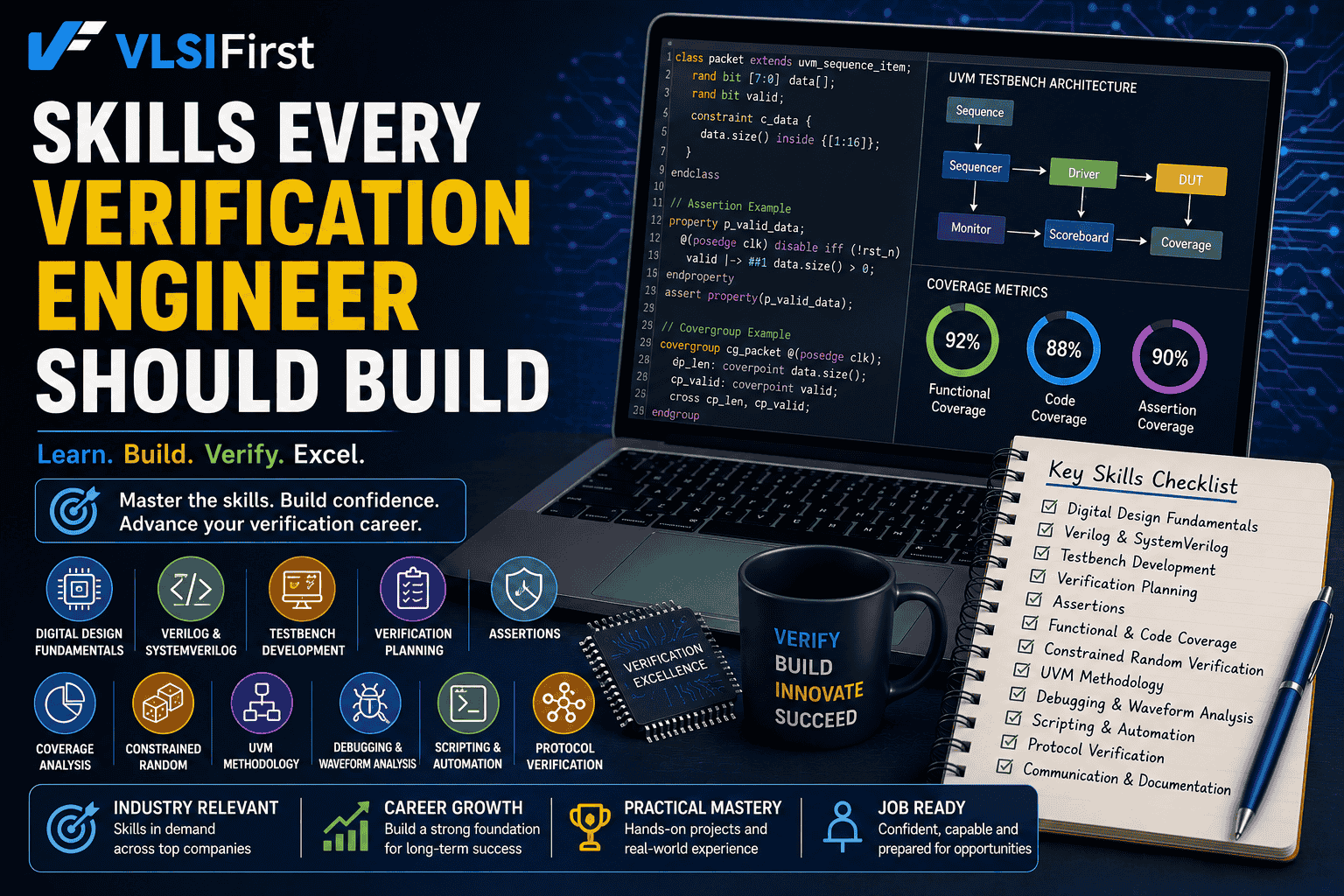
A better approach is to build skills progressively, from digital fundamentals and Verilog to SystemVerilog, testbench development, coverage, UVM and automation.
VLSIFirst's verification roadmap follows a similar progression, starting with digital fundamentals before moving into Verilog, SystemVerilog, assertions, coverage and UVM.
1. Build Strong Digital Design Fundamentals
The first of the essential skills required for VLSI verification is a solid understanding of digital electronics.
A verification engineer cannot effectively verify hardware without understanding how that hardware is supposed to behave.
You should be comfortable with:
- Combinational and sequential circuits
- Flip-flops and registers
- Counters
- Multiplexers and decoders
- FSMs
- Timing diagrams
- Clock and reset behavior
- Setup and hold concepts
- Basic memory structures
- Synchronous and asynchronous behavior
For example, when verifying a FIFO, you should understand what full, empty, read and write operations mean before creating test scenarios.
VLSIFirst also identifies digital electronics, FSMs, timing concepts and clocking as foundational VLSI skills across design and verification roles.
2. Learn Verilog and RTL Properly
Although SystemVerilog is central to modern verification, Verilog remains an important foundation.
You should be able to read RTL and understand:
- Modules and ports
- Combinational logic
- Sequential logic
- always blocks
- Blocking and non-blocking assignments
- Parameters
- Registers and wires
- FSM implementation
- Reset behavior
- Synthesizable RTL
This is important because a verification engineer constantly interacts with the DUT, or Design Under Test.
If you cannot understand the RTL, debugging a failing test becomes much harder.
You do not necessarily need advanced RTL design skills, but you should be able to understand what the hardware is intended to do.
For additional preparation, VLSIFirst's guide on Verilog, SystemVerilog and popular VLSI design languages explains how these languages are used across design and verification.
3. Make SystemVerilog a Core Skill
For modern RTL verification, SystemVerilog is one of the most important technical skills to develop.
It extends Verilog with features specifically useful for verification, including:
- Classes
- Object-oriented programming
- Randomization
- Constraints
- Interfaces
- Assertions
- Functional coverage
- Advanced data types
- Packages
- Clocking blocks
SystemVerilog allows engineers to create sophisticated and reusable verification environments rather than relying only on simple procedural testbenches.
VLSIFirst's RTL Design Verification training curriculum includes advanced SystemVerilog, packages, DPI, verification planning, assertions and SystemVerilog-based FIFO verification.
For beginners, the goal should not be memorizing every SystemVerilog feature. Learn the features that directly support stimulus generation, checking, coverage and reusable testbench architecture.
4. Learn to Build a Good Testbench
A testbench is where verification becomes practical.
A good testbench should generate meaningful stimulus, communicate with the DUT, monitor its behavior and determine whether the observed result is correct.
You should understand the roles of:
- Driver
- Monitor
- Scoreboard
- Reference model
- Test
- Sequence
- Transaction
- Interface
The important skill is understanding how these components work together.
For example:
Sequence → Driver → DUT → Monitor → Scoreboard
The driver applies transactions to the DUT. The monitor observes what happens. The scoreboard compares actual behavior against expected behavior.
This architecture becomes especially important when learning UVM.
5. Develop a Verification Mindset
One of the most important verification engineer skills for freshers is learning to think differently from a designer.
A designer asks:
How do I make this feature work?
A verification engineer asks:
How could this feature fail?
Suppose you are verifying a counter.
Do not test only:
0 → 1 → 2 → 3
Think about:
- Reset during operation
- Enable disabled
- Maximum count
- Minimum count
- Reset and enable together
- Unexpected input conditions
- Consecutive resets
- Long-duration operation
This mindset helps you discover corner cases rather than simply proving that the obvious scenario works.
VLSIFirst's career comparison similarly identifies debugging mindset and logical analysis as important characteristics for verification professionals.
6. Learn Verification Planning
Good verification does not begin with writing random tests.
It begins with understanding the specification and creating a verification plan.
A verification plan should identify:
- Features to verify
- Expected behavior
- Test scenarios
- Corner cases
- Coverage goals
- Assertions
- Error conditions
- Pass/fail criteria
This forces you to convert a specification into measurable verification objectives.
VLSIFirst's current course curriculum includes feature extraction, test-plan creation, coverage planning, assertion planning and verification architecture.
For students, practicing a verification plan for a FIFO, UART or APB block can be extremely valuable.
7. Understand Functional and Code Coverage
A verification engineer must eventually answer:
How much of the intended behavior have we actually tested?
This is where functional coverage and code coverage become important.
Code coverage helps identify which portions of RTL have been exercised.
Functional coverage evaluates whether important scenarios and behaviors defined by the verification plan have been exercised.
You should also understand:
- Covergroups
- Coverpoints
- Cross coverage
- Coverage holes
- Coverage closure
However, achieving high coverage does not automatically prove that a design is bug-free. Coverage must be meaningful and connected to the actual verification objectives.
VLSIFirst's verification resources emphasize code, functional and assertion coverage as important mechanisms for identifying verification gaps.
8. Learn Assertion-Based Verification
Assertion-based verification helps engineers automatically check whether specific properties hold during simulation or formal analysis.
For example, you may want to ensure:
- A request eventually receives an acknowledgment.
- A FIFO cannot read when empty.
- A protocol signal follows a required sequence.
- A reset places a register into its expected state.
SystemVerilog Assertions, or SVA, provide a way to express these properties.
Assertions are valuable because they can detect violations close to the point where they occur, reducing the amount of manual checking required.
VLSIFirst identifies assertions as a core SystemVerilog verification capability and includes assertion planning in its verification curriculum.
9. Learn Constrained Random Verification
Testing every possible input combination manually is usually impossible for complex designs.
Constrained random verification provides a way to generate many different scenarios while keeping stimulus within meaningful boundaries.
The skill is not simply knowing how to randomize variables.
You should understand:
- Why randomization is useful
- How constraints control stimulus
- How to avoid over-constraining
- How to reproduce failures
- How random tests complement directed tests
A good verification engineer combines directed scenarios with randomized testing rather than depending entirely on either approach.
10. Master UVM Gradually
UVM is an important verification methodology for scalable SystemVerilog-based environments.
Beginners often make the mistake of memorizing UVM classes without understanding why they exist.
Instead, understand the architecture:
- Sequence item
- Sequence
- Sequencer
- Driver
- Monitor
- Agent
- Scoreboard
- Environment
- Test
- TLM
- Factory
- Configuration
- Phases
Then build a small environment yourself.
VLSIFirst's UVM curriculum covers testbench architecture, sequence items, sequences, drivers, monitors, agents, scoreboards, phases, TLM, configuration, factory and callbacks.
For practical learning, VLSIFirst also recommends projects involving protocols and memories rather than learning UVM entirely through theory.
11. Develop Strong Debugging Skills
Among all VLSI verification skills for beginners, debugging deserves special attention.
A failed test does not automatically mean the RTL is wrong.
The problem could be in:
- RTL
- Test
- Driver
- Monitor
- Scoreboard
- Reference model
- Constraint
- Configuration
- Testbench timing
You need to trace the failure systematically.
Learn to use:
- Simulation logs
- Error messages
- Waveform viewers
- Transaction-level information
- Assertions
- Scoreboard output
Good waveform debugging means identifying the first point where actual behavior diverged from expected behavior, not merely looking at the final incorrect output.
VLSIFirst specifically identifies simulation failure analysis and debugging as core verification skills.
12. Learn Regression Testing and Automation
As the number of tests grows, manually running every test becomes inefficient.
That is where regression testing and automation become essential.
A verification engineer should gradually learn scripting, particularly Python for verification, along with basic shell scripting.
Automation can help with:
- Launching simulations
- Running multiple tests
- Parsing logs
- Identifying failures
- Generating reports
- Managing regressions
- Repeating experiments
VLSIFirst's verification tools guide specifically highlights Python, Perl and shell scripting for regression automation, log parsing, report generation and build/run automation.
You don't need to become a software engineer. You need enough scripting ability to eliminate repetitive manual work.
13. Understand Protocol Verification
As you progress, learn at least one industry-relevant interface or protocol.
Examples include:
- APB
- AXI
- AHB
- SPI
- I2C
- UART
- PCIe
Protocol knowledge teaches you how to verify interactions rather than isolated signals.
For example, an AXI verification engineer must understand transactions, handshaking, ordering and protocol rules, not just whether individual signals toggle.
VLSIFirst's course curriculum includes APB development and verification using UVM and projects involving APB, AHB, AXI, SPI, UART, I2C, PCIe and other interfaces.
14. Learn the EDA Tools Used in Verification
Knowing verification concepts without knowing how to execute them in an actual environment can leave a major practical gap.
You should become familiar with the general workflow of simulation and debugging tools.
Depending on the organization, engineers may encounter tools such as:
- Synopsys VCS
- Siemens Questa
- Cadence Xcelium
- Waveform/debug tools
- Coverage tools
The exact tool is less important initially than understanding the workflow:
Compile → Elaborate → Simulate → Analyze → Debug → Re-run
VLSIFirst's roadmap includes VCS, Questa and Vivado exposure as examples of tools students can encounter while developing verification skills.
15. Improve Documentation and Communication
Verification is not an isolated activity.
Verification engineers interact with:
- RTL designers
- Architects
- Firmware engineers
- Validation teams
- Project leads
Therefore, verification skills required for semiconductor jobs include communication and documentation.
Learn to write clear:
- Test plans
- Test cases
- Bug reports
- Coverage reports
- Debug summaries
A good bug report should explain what failed, how it was reproduced, what was expected, what actually happened and what evidence supports the conclusion.
VLSIFirst also highlights documentation and communication as important parts of professional verification work.
16. Build Skills Beyond UVM
UVM should not be treated as the final destination.
As you gain experience, explore:
- Formal verification
- Portable Stimulus
- Python-based verification
- Hardware security verification
- AI-assisted verification
- Cloud-based verification
- System-level verification
These are complementary skills rather than replacements for fundamental verification knowledge.
VLSIFirst's discussion of verification methodologies beyond UVM identifies formal methods, Portable Stimulus, AI-driven approaches and Python-based flows as areas engineers can explore as verification evolves.
How to Know If You Are Becoming Job-Ready
Before applying for a verification position, ask yourself:
- Can I understand basic RTL?
- Can I write SystemVerilog testbench code?
- Can I create meaningful test scenarios?
- Can I explain a verification plan?
- Can I write basic assertions?
- Do I understand functional and code coverage?
- Can I explain UVM architecture?
- Can I debug a failed simulation?
- Can I analyze waveforms?
- Can I write basic Python or shell scripts?
- Can I verify a simple protocol?
- Can I explain one complete verification project?
If the answer is yes to most of these questions, you are developing the right foundation.
The objective is not to know every tool or methodology before applying.
It is to demonstrate that you can understand a specification, create verification scenarios, automate stimulus, check results and debug failures systematically.
Conclusion
The skills every verification engineer should build go far beyond SystemVerilog and UVM.
A strong verification engineer combines digital design fundamentals, Verilog, SystemVerilog, testbench architecture, verification planning, functional coverage, code coverage, assertions, constrained random verification, UVM, debugging, scripting, protocol knowledge and communication.
For freshers, the most important lesson is to build these capabilities in layers.
Do not start by memorizing hundreds of UVM classes. Start with digital logic. Understand RTL. Learn SystemVerilog. Build a testbench. Learn how to check results. Add assertions and coverage. Then move into UVM and automation.
Most importantly, build projects where you have to find actual problems.
That is where theoretical VLSI verification skills turn into practical engineering ability.
The industry does not need engineers who can merely explain what a monitor or scoreboard is. It needs engineers who can look at a specification, anticipate failure scenarios, build an effective verification environment, investigate failures and confidently communicate whether the design meets its requirements.
Learn the concepts. Build the environment. Find the bugs. Explain the evidence. That is how you grow into a verification engineer.