Writing Verilog code that functions correctly is only one part of becoming a successful RTL designer. In professional semiconductor companies, engineers are expected to write code that is clean, readable, synthesizable, maintainable, and easy for others to understand. This is where Verilog coding standards play a crucial role.
Imagine joining a semiconductor project with millions of lines of RTL code developed by hundreds of engineers across different teams and countries. Without standardized coding practices, maintaining such a design would be nearly impossible. Coding standards ensure consistency, reduce misunderstandings, simplify debugging, and improve collaboration throughout the chip design lifecycle.
For students preparing for RTL Design careers, understanding industry coding standards is just as important as learning Verilog syntax. Recruiters often evaluate whether candidates follow professional coding practices while implementing RTL during interviews or technical assessments.
This article explores the most common Verilog coding standards used in the semiconductor industry, explains why they matter, and provides practical guidance for writing RTL that reflects real engineering practices.
Why Coding Standards Matter
Coding standards are not created simply to make code look neat. They solve real engineering challenges.
Following consistent coding practices helps:
- Improve readability.
- Simplify debugging.
- Reduce functional bugs.
- Make code reusable.
- Support teamwork.
- Improve code reviews.
- Enable easier maintenance.
- Reduce project risks.
In large VLSI projects, engineers often work on modules written by someone else. Well-structured RTL makes collaboration much more efficient.
Begin with a Clear Understanding of the Specification
Professional RTL development always begins with understanding the design requirements.
Before writing any Verilog code, identify:
- Functional behavior
- Inputs and outputs
- Clocking scheme
- Reset strategy
- Timing expectations
- Parameter requirements
- Interface definitions
A well-understood specification reduces unnecessary code changes later in the project.
Use Meaningful Module Names
Module names should describe functionality clearly.
Instead of generic names like:
- module1
- test_design
- abc
Prefer descriptive names such as:
- uart_receiver
- spi_controller
- fifo_memory
- packet_decoder
Meaningful module names make large projects easier to navigate.
Follow Consistent Signal Naming
Signal names should immediately communicate their purpose.
Examples include:
- clk
- rst_n
- data_valid
- write_enable
- read_pointer
- packet_ready
- error_flag
Avoid short or ambiguous names that require additional explanation.
Consistent naming significantly improves readability during debugging and code reviews.
Organize Module Structure Logically
Professional RTL modules generally follow a predictable structure.
Typical organization includes:
- Module declaration
- Parameters
- Port definitions
- Internal signal declarations
- Combinational logic
- Sequential logic
- Output assignments
A consistent structure allows engineers to understand unfamiliar modules more quickly.
Maintain Proper Code Formatting
Readable formatting is one of the simplest yet most valuable coding practices.
Maintain consistency in:
- Indentation
- Alignment
- Blank lines
- Statement grouping
- Comment placement
Poor formatting may not affect synthesis, but it significantly impacts maintainability.
Keep Modules Small and Reusable
Rather than creating one large module that performs multiple unrelated tasks, divide functionality into smaller blocks.
Benefits include:
- Easier verification
- Faster debugging
- Improved reuse
- Better scalability
- Simpler maintenance
Modular RTL is a hallmark of professional design teams.
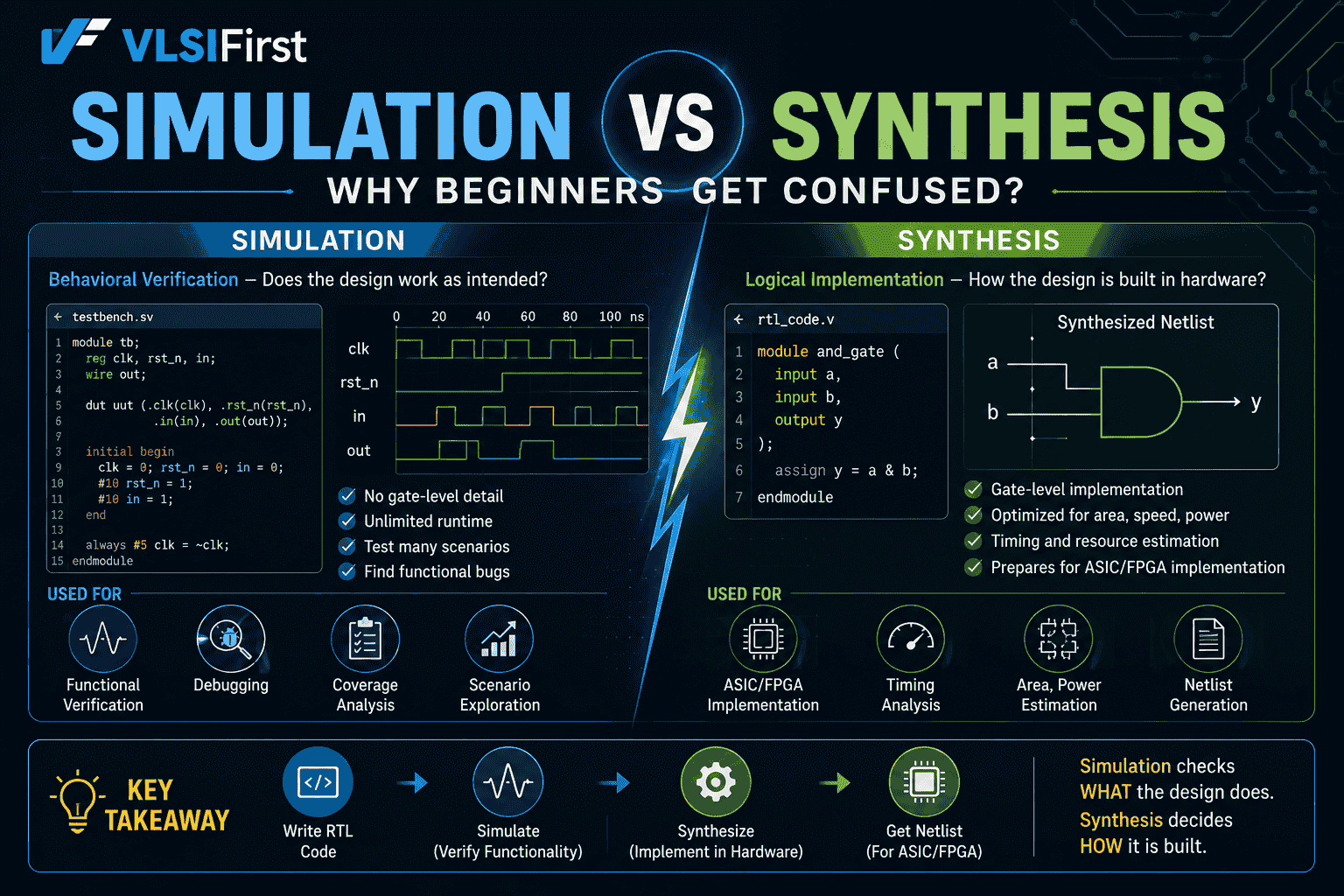
Write Synthesizable RTL
Industry coding standards prioritize synthesizable constructs that consistently infer the intended hardware.
Good synthesizable RTL should:
- Represent real hardware.
- Produce predictable synthesis results.
- Avoid ambiguous behavior.
- Support multiple synthesis tools.
Understanding how RTL maps to hardware is more important than memorizing language features.
Use Blocking and Non-Blocking Assignments Correctly
One of the most fundamental coding standards concerns assignment operators.
General industry practice recommends:
- Blocking assignments for combinational logic.
- Non-blocking assignments for sequential logic.
Using appropriate assignment operators improves simulation accuracy and hardware modeling.
Implement Reliable Reset Logic
Reset behavior should be clearly defined for every sequential module.
Professional engineers ensure:
- Known startup conditions.
- Deterministic initialization.
- Consistent reset handling.
- Proper verification of reset scenarios.
Reliable reset implementation simplifies debugging and integration.
Avoid Unintended Latch Inference
Incomplete combinational logic can unintentionally create latches.
Industry coding standards encourage:
- Complete conditional coverage.
- Default assignments where appropriate.
- Careful review of combinational logic.
Preventing accidental latch inference improves design predictability.
Parameterize Reusable Modules
Parameterized designs increase flexibility and reduce code duplication.
Parameters can configure:
- Data width
- FIFO depth
- Counter size
- Memory capacity
- Address width
Parameterized modules are easier to reuse across multiple projects.
Separate Combinational and Sequential Logic
Maintaining clear separation between combinational and sequential logic improves:
- Readability
- Verification
- Debugging
- Code reviews
- Maintenance
This practice also makes hardware behavior easier to understand.
Add Useful Comments
Comments should explain why something is implemented rather than simply describing what the code already states.
Good comments clarify:
- Design assumptions
- Interface behavior
- Timing considerations
- State machine operation
- Parameter usage
Excessive or redundant comments should be avoided.
Verify Every RTL Module
Coding standards extend beyond writing RTL.
Every module should undergo verification through:
- Functional simulation
- Directed testing
- Corner-case testing
- Reset validation
- Waveform analysis
Verification is an essential part of professional RTL development.
Review Waveforms Carefully
Simulation waveforms reveal whether hardware behaves as intended.
Review:
- Clock transitions
- Register updates
- Reset behavior
- Signal timing
- FSM transitions
- Output responses
Waveform analysis is a daily activity for many RTL engineers.
Document Design Decisions
Professional teams document more than just code.
Useful documentation includes:
- Module descriptions
- Interface definitions
- Parameter explanations
- Design assumptions
- Known limitations
- Verification status
Clear documentation improves long-term maintainability.
Perform Peer Code Reviews
Most semiconductor organizations require RTL code reviews before integration.
Code reviews help identify:
- Functional mistakes
- Coding inconsistencies
- Maintainability issues
- Optimization opportunities
- Verification concerns
Learning to review your own code before submitting it is an excellent professional habit.
Build Practical Experience Through Projects
Coding standards become second nature through hands-on implementation.
Projects that strengthen RTL coding discipline include:
- ALU
- FIFO
- UART
- SPI Controller
- Register File
- Sequence Detector
- Traffic Light Controller
- Memory Controller
Each project reinforces clean coding, modular design, verification, and documentation.
Learn Industry Practices Through Structured Training
Coding standards are most effectively learned by working on real RTL projects under experienced guidance. Practical training exposes students to professional workflows, coding reviews, debugging methodologies, synthesis considerations, and verification processes commonly followed in semiconductor companies.
VLSIFirst offers industry-oriented learning through programs including Semiconductor Fundamentals, Digital Electronics for VLSI, RTL Design and Verification, SystemVerilog & UVM, FPGA Design, ASIC Design, Physical Design, Static Timing Analysis (STA), Design for Test (DFT), Custom Layout Design, Low Power VLSI Design, and the Full Chip Design Program. These programs provide hands-on experience with synthesizable RTL development, coding best practices, functional verification, debugging, documentation, and complete ASIC design workflows.
Final Thoughts
Verilog coding standards are far more than formatting rules, they represent a disciplined engineering approach that enables large teams to build reliable, maintainable, and high-quality semiconductor products. Clean code improves collaboration, simplifies debugging, supports efficient verification, and reduces costly mistakes throughout the design cycle.
As a student or aspiring RTL engineer, developing these habits early will set you apart during interviews and prepare you for professional VLSI development environments. Focus on writing RTL that is not only functionally correct but also easy to understand, verify, and maintain.
Remember that great RTL designers are recognized not just for solving design problems, but for creating solutions that other engineers can confidently build upon. By consistently following industry coding standards, you'll strengthen your technical foundation and move one step closer to becoming an industry-ready RTL engineer.