
Many engineering graduates enroll in VLSI training programs with the hope of entering the semiconductor industry. They complete the course, receive certificates, and start applying for jobs. However, some students face a frustrating reality: months pass without receiving interview calls.
This situation leads many students to question whether VLSI is still a good career or whether the job market is too competitive.
In most cases, the issue is not the lack of opportunities but a gap between industry expectations and candidate readiness. Semiconductor companies look for specific skills, project experience, and problem-solving ability before inviting candidates for interviews.
Understanding why some VLSI course graduates struggle to get interview calls can help students prepare more effectively and improve their chances of entering the industry.
The VLSI Job Market Reality
India’s semiconductor ecosystem is expanding rapidly. The country hires thousands of VLSI engineers each year, with freshers entering design, verification, and embedded hardware roles.
However, companies are becoming more selective in their hiring process. Instead of recruiting large numbers of graduates based on degrees alone, recruiters increasingly focus on skills, internships, and practical experience to ensure candidates are ready to contribute from day one.
This shift explains why some graduates struggle to get interviews even after completing training programs.
1. Weak Fundamentals in Core Electronics
One of the biggest reasons students do not receive interview calls is weak fundamentals.
Many candidates complete VLSI courses but still struggle with basic concepts such as:
- combinational and sequential logic
- setup and hold timing
- clock domain crossing
- finite state machines
- CMOS fundamentals
Recruiters often screen resumes based on these foundational skills. If candidates appear weak in fundamentals, companies may hesitate to schedule interviews.
Strong basics remain essential because tools and technologies change frequently, but core electronics concepts remain constant.
Students who want to strengthen their foundation can explore structured learning approaches such as:
https://vlsifirst.com/blog/vlsi-fundamentals-roadmap-for-beginners/
2. Lack of Hands-On Tool Experience
VLSI is a highly practical engineering domain. Recruiters prefer candidates who have experience working with industry tools rather than just theoretical knowledge.
Common tools used in semiconductor design include:
- Synopsys tools for synthesis and timing analysis
- Cadence tools for physical design
- Mentor Graphics tools for verification and testing
Students who only understand theory without tool exposure may struggle to demonstrate industry readiness.
Practical exposure to tools such as simulation, synthesis, or waveform debugging significantly increases the chances of receiving interview calls.
A deeper understanding of design workflows is also important. Candidates should understand where each tool fits into the chip design process.
3. Limited Project Experience
Projects play a major role in VLSI hiring decisions.
Many graduates rely only on a single academic project or basic assignments from training programs. Unfortunately, this may not be enough to stand out in a competitive job market.
Recruiters want to see candidates who have worked on meaningful technical projects such as:
- UART controller verification
- FIFO design implementation
- cache controller design
- protocol verification environments
These projects demonstrate that the candidate understands design flows, debugging processes, and real engineering challenges.
Students should also document their work and showcase their projects online to build a strong technical portfolio.
This guide explains how to build a portfolio that attracts recruiters:
https://vlsifirst.com/blog/how-to-build-a-github-portfolio-that-attracts-vlsi-recruiters/
4. Overdependence on Training Institutes
Another common issue is excessive reliance on training institutes.
Some students assume that completing a course automatically guarantees interview opportunities. However, training programs are meant to provide foundational knowledge and guidance, not instant placement.
Students must take initiative by:
- exploring additional projects
- practicing coding and debugging
- reading technical documentation
- studying industry design flows
Candidates who actively explore beyond the classroom often develop stronger technical profiles.
5. Unclear Career Direction
VLSI includes several specialized domains, and recruiters expect candidates to demonstrate clear focus.
Major domains include:
- RTL design
- functional verification
- physical design
- design for test (DFT)
- analog and mixed-signal design
Students who apply for multiple unrelated roles without a clear specialization may appear unfocused to recruiters.
Instead, candidates should choose a domain early and build deeper expertise in that area.
6. Poor Resume Quality
Sometimes the problem is not technical skills but how those skills are presented.
Recruiters often spend less than a minute reviewing each resume before deciding whether to proceed with a candidate.
If the resume is poorly structured, important skills and projects may go unnoticed.
Common resume mistakes include:
- listing tools without explaining usage
- vague project descriptions
- excessive theoretical details
- lack of measurable achievements
A strong VLSI resume should clearly highlight:
- domain specialization
- tools used
- project details
- debugging experience
- programming or scripting knowledge
7. Lack of Internships or Industry Exposure
Internships have become one of the most effective pathways into semiconductor careers.
Many companies now prefer hiring candidates who have already gained practical exposure through internships or collaborative projects.
Industry hiring trends show that internships are increasingly used to identify and train future employees, as they provide hands-on experience with real chip design workflows.
Students who complete internships often gain valuable experience with tools, debugging techniques, and real project environments.
8. Weak Debugging and Problem-Solving Skills
Debugging is one of the most valuable skills in VLSI engineering.
During interviews, recruiters often evaluate how candidates approach problems rather than expecting perfect answers.
Engineers regularly debug issues such as:
- simulation failures
- timing violations
- incorrect signal behavior
- verification coverage gaps
Students who develop systematic debugging strategies demonstrate strong engineering potential.
Scripting languages such as Python or TCL can also improve debugging efficiency in chip design workflows.
9. Not Following Industry Trends
The semiconductor industry evolves rapidly with technologies such as:
- AI accelerators
- RISC-V architecture
- chiplet-based design
- advanced semiconductor nodes
Students who remain unaware of these developments may appear less motivated or outdated during technical discussions.
Keeping up with industry trends demonstrates curiosity and long-term commitment to the field.
For example, this article explores how emerging technologies rely on VLSI innovation:
https://vlsifirst.com/blog/edge-ai-and-the-role-of-vlsi-in-enabling-it/
How Students Can Improve Their Chances
Students who want to increase their chances of receiving interview calls should focus on building a strong technical profile.
Here are some practical steps:
Strengthen your fundamentals
Revisit digital electronics and timing concepts regularly.
Build multiple hands-on projects
Projects demonstrate real engineering capability.
Gain exposure to EDA tools
Practical experience with tools makes your profile more attractive.
Improve your resume and portfolio
Highlight projects, tools, and achievements clearly.
Practice debugging regularly
Develop logical thinking and systematic problem-solving skills.
Stay updated with semiconductor trends
Understanding industry developments shows curiosity and initiative.
Final Thoughts
Not getting interview calls after completing a VLSI course can be discouraging, but it does not mean the field lacks opportunities.
The semiconductor industry is growing rapidly and continues to hire engineers with strong technical skills. However, recruiters are becoming more selective and expect candidates to demonstrate practical experience, problem-solving ability, and industry readiness.
Students who focus on building real engineering skills rather than relying solely on certificates will significantly improve their chances of entering the VLSI industry.
With consistent learning, hands-on practice, and the right preparation strategy, the path to a semiconductor career becomes much clearer.

How to Test Your RTL Before Simulation: A Practical Pre-Simulation Checklist for Beginners
Learn how to test your RTL before simulation with a practical pre-simulation checklist. Improve Verilog quality, reduce debugging time, and build industry-ready RTL skills.
From Logic Diagram to Verilog Code – Complete Workflow
Learn the complete workflow from logic diagram to Verilog code, including specifications, RTL architec ture, coding, simulation, debugging, verification, and documentation.
Common Mistakes While Writing Verilog Code
Learn the most common Verilog coding mistakes beginners make and how to avoid them. Improve RTL coding, simulation, debugging, verification, and interview readiness.

How to Debug Your First Verilog Design
Debugging your first Verilog design with practical RTL debug techniques, waveform analysis, testbench tips, FSM debugging, and common beginner mistakes. Read now!
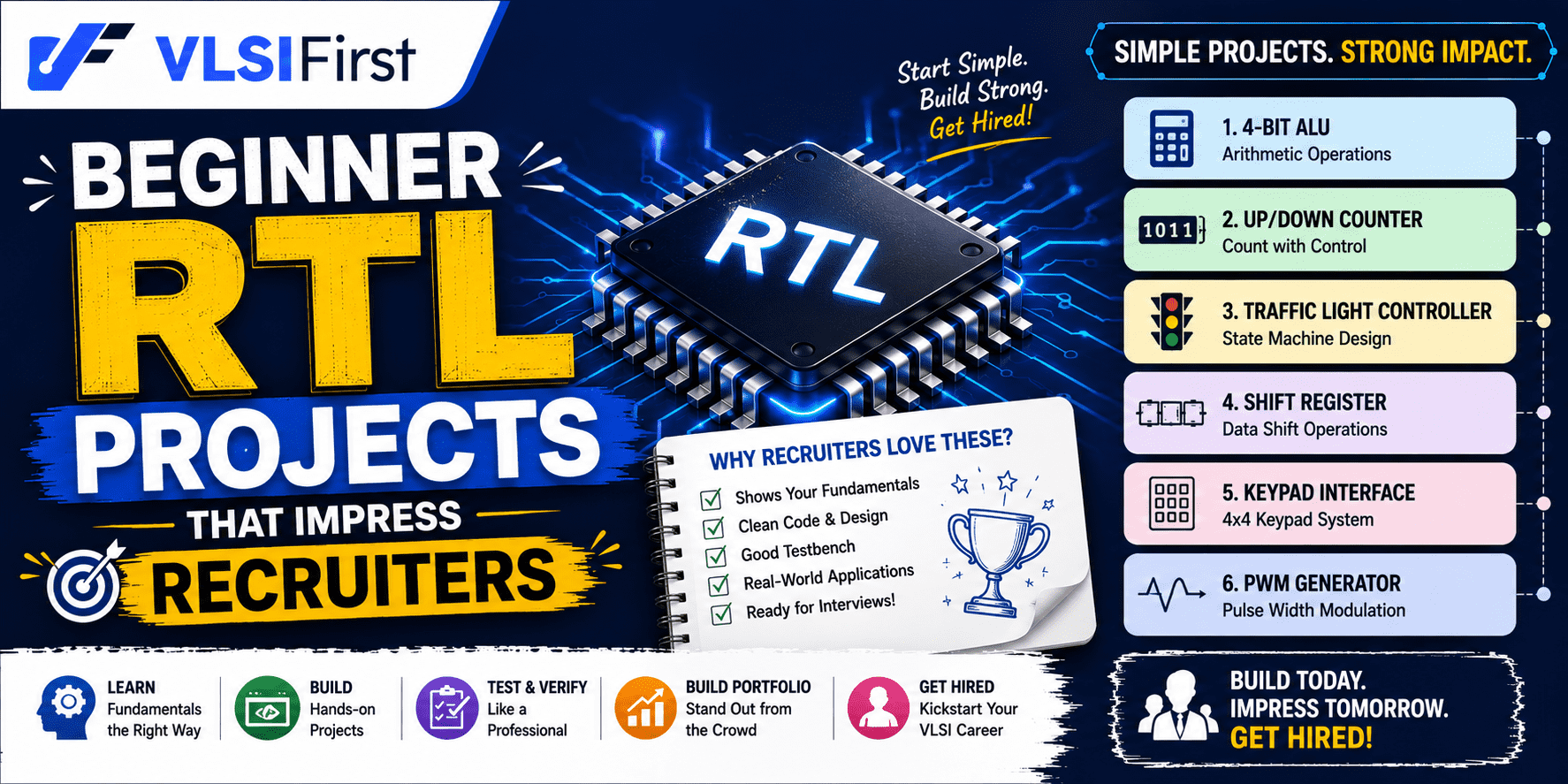
Beginner RTL Projects That Impress Recruiters
Discover beginner RTL projects that impress VLSI recruiters. Learn which Verilog projects build practical skills, strengthen your portfolio, and improve interview success.


Hours
2-98/1, Gurram Guda Road, Gurram Guda, Hyderabad, Rangareddy, Telangana, 501510
Copyright 2025 © VLSI Technologies Private Limited
Designed and developed by KandraDigitalCopyright 2025 © VLSI Technologies Private Limited
Designed, Developed & Marketing by KandraDigital