
When students explore VLSI training programs, one of the first questions they ask is:
“How long is the course?”
Some institutes advertise short-term crash courses (4–8 weeks), while others offer comprehensive programs lasting 4–8 months or more. At first glance, shorter courses may seem attractive, they promise faster completion and quicker entry into the job market.
But in a complex field like VLSI, the real question is not just how long the course is, but what you actually learn during that time.
So, does course duration really matter in VLSI training?
The answer is yes, but not in the way most students think.
This article explores how course duration impacts learning, skill development, and job readiness in VLSI, helping you choose the right training program for your semiconductor career.
Why Course Duration Is an Important Factor
VLSI is a specialized engineering domain that involves:
- digital circuit design
- hardware description languages (HDL)
- simulation and verification
- timing analysis
- physical design workflows
Learning these topics requires time, practice, and repetition.
Unlike general IT skills, VLSI training is not just about understanding concepts, it is about applying them through tools, projects, and debugging.
This is why course duration plays a role in:
- depth of learning
- hands-on experience
- project completion
- interview preparation
The Myth of Short-Term VLSI Courses
Many institutes promote fast-track VLSI programs with claims like:
- “Become job-ready in 30 days”
- “Crash course for quick placement”
While these programs may cover basic concepts, they often lack:
- detailed explanation of topics
- practical tool exposure
- real project experience
- debugging practice
In reality, mastering VLSI fundamentals and workflows cannot be rushed.
Students who enroll in very short courses often face challenges such as:
- difficulty in interviews
- lack of confidence in projects
- incomplete understanding of design flows
What a Proper VLSI Learning Timeline Looks Like
A well-structured VLSI training program typically follows multiple stages.
Stage 1: Fundamentals (3–6 weeks)
Students learn:
- digital electronics
- CMOS basics
- logic design
- timing concepts
Strong fundamentals are essential for understanding advanced topics.
Stage 2: HDL Coding and Simulation (4–6 weeks)
Students focus on:
- Verilog/SystemVerilog
- RTL coding
- simulation and debugging
This stage builds the foundation for design and verification roles.
Stage 3: Tool-Based Learning (4–8 weeks)
Students gain hands-on experience with:
- simulation tools
- synthesis tools
- waveform debugging
Tool exposure is critical because real VLSI work is highly tool-driven.
Stage 4: Project Development (4–6 weeks)
Students work on:
- real RTL design projects
- verification environments
- debugging tasks
Projects help bridge theory and practical application.
Stage 5: Interview Preparation (2–4 weeks)
Students prepare for:
- technical interviews
- problem-solving questions
- resume building
This stage ensures job readiness.
Ideal Course Duration for VLSI Training
Based on industry expectations, a typical VLSI training program should last:
- 4 to 6 months (minimum) for freshers
- 6 to 8 months (comprehensive training) for deeper specialization
This duration allows sufficient time for:
- concept clarity
- tool practice
- project work
- interview preparation
Courses shorter than this may compromise depth, while longer programs can provide more specialization.
Does Longer Duration Always Mean Better Quality?
Not necessarily.
Some long-duration courses may still lack:
- proper structure
- hands-on training
- experienced trainers
A longer course without quality content can waste time.
What Matters More Than Duration
While duration is important, several other factors have a greater impact on learning.
1. Course Content Quality
A strong curriculum should include:
- complete ASIC design flow
- HDL programming
- verification methodologies
- physical design basics
Without these topics, even a long course may not be effective.
2. Trainer Experience
Experienced trainers help students:
- understand complex concepts
- solve real-world problems
- prepare for interviews
3. Hands-On Practice
Practical exposure is essential for:
- debugging skills
- tool usage
- real project experience
Courses without hands-on learning are incomplete.
4. Project-Based Learning
Projects help students:
- apply concepts
- build portfolios
- demonstrate skills to recruiters
5. Consistency and Student Effort
Even the best course will not help if students do not:
- practice regularly
- revise concepts
- work on projects
Learning speed varies from student to student.
Short vs Long Duration Courses: Comparison
|
Factor |
Short-Term Course |
Long-Term Course |
|
Depth of Learning |
Limited |
High |
|
Practical Exposure |
Low |
Strong |
|
Project Work |
Minimal |
Extensive |
|
Job Readiness |
Low |
High |
|
Flexibility |
High |
Moderate |
This comparison shows that longer courses generally provide better learning opportunities, but only if they are well-structured.
Who Can Choose Short-Term Courses?
Short-term VLSI courses may be suitable for:
- professionals with prior experience
- students revising concepts
- engineers switching domains with strong fundamentals
However, beginners should avoid relying solely on short programs.
Who Should Choose Long-Term Courses?
Longer VLSI training programs are ideal for:
- fresh graduates
- final-year students
- career switchers without VLSI background
These students need:
- structured learning
- guided mentorship
- extensive practice
Common Mistakes Students Make
Many students make decisions based on:
- shortest course duration
- lowest fees
- fastest placement promises
This often leads to:
- incomplete learning
- poor interview performance
- delayed career growth
Choosing the right course requires evaluating quality, structure, and outcomes, not just duration.
Final Thoughts
So, does course duration matter in VLSI training?
Yes, but only when combined with quality learning.
A course that is too short may not provide enough depth, while a longer course without proper structure may waste time.
The ideal VLSI training program balances:
- sufficient duration (4–6 months)
- strong curriculum
- hands-on tool exposure
- real project experience
- expert mentorship
Students who focus on these factors, not just duration, are more likely to succeed in semiconductor careers.
Ultimately, VLSI is a field where skills, practice, and consistency matter far more than how quickly you complete a course.
For more insights on VLSI careers, training strategies, and industry trends, explore additional guides on VLSIFirst.com.

How to Test Your RTL Before Simulation: A Practical Pre-Simulation Checklist for Beginners
Learn how to test your RTL before simulation with a practical pre-simulation checklist. Improve Verilog quality, reduce debugging time, and build industry-ready RTL skills.
From Logic Diagram to Verilog Code – Complete Workflow
Learn the complete workflow from logic diagram to Verilog code, including specifications, RTL architec ture, coding, simulation, debugging, verification, and documentation.
Common Mistakes While Writing Verilog Code
Learn the most common Verilog coding mistakes beginners make and how to avoid them. Improve RTL coding, simulation, debugging, verification, and interview readiness.
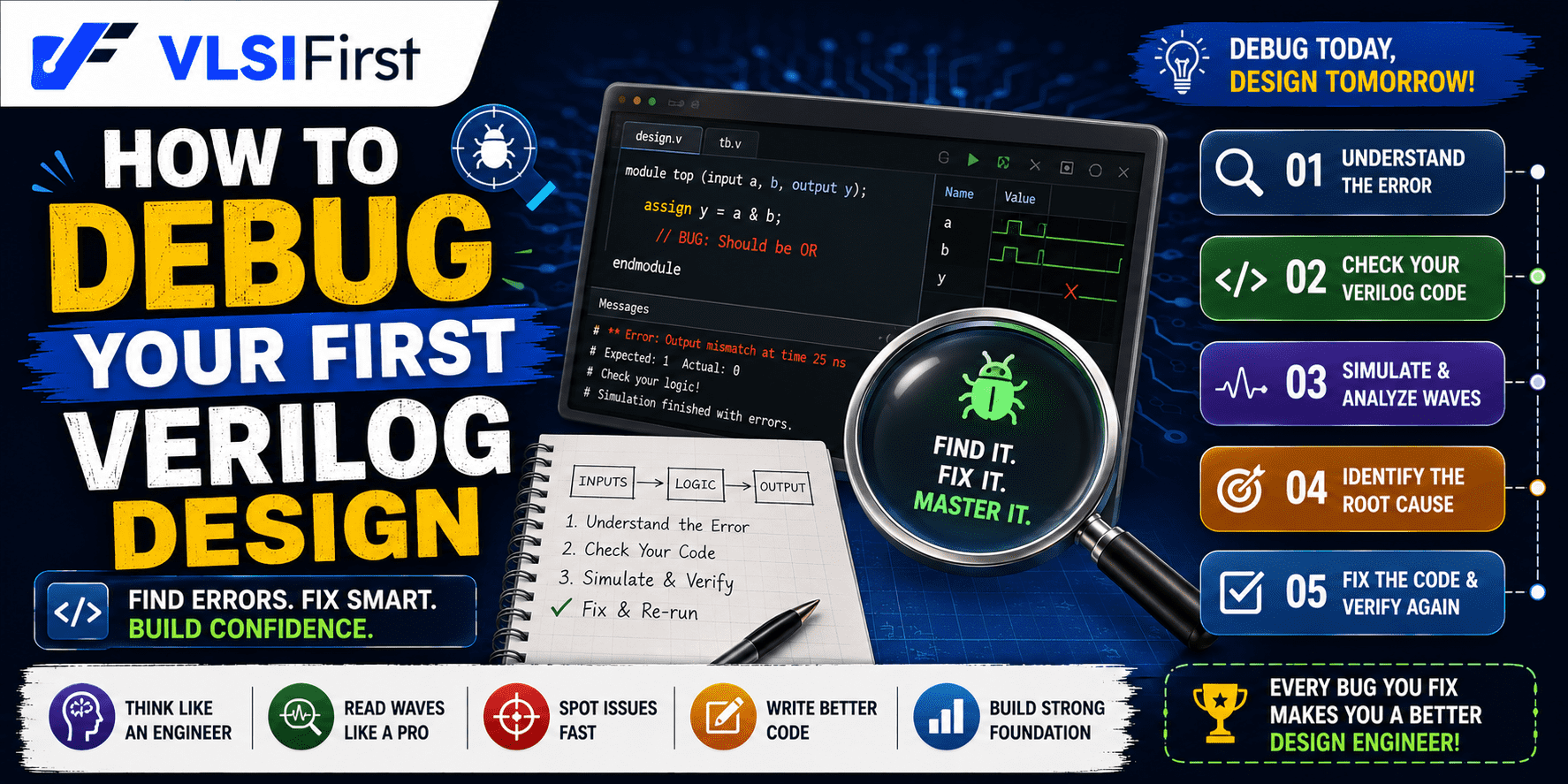
How to Debug Your First Verilog Design
Debugging your first Verilog design with practical RTL debug techniques, waveform analysis, testbench tips, FSM debugging, and common beginner mistakes. Read now!
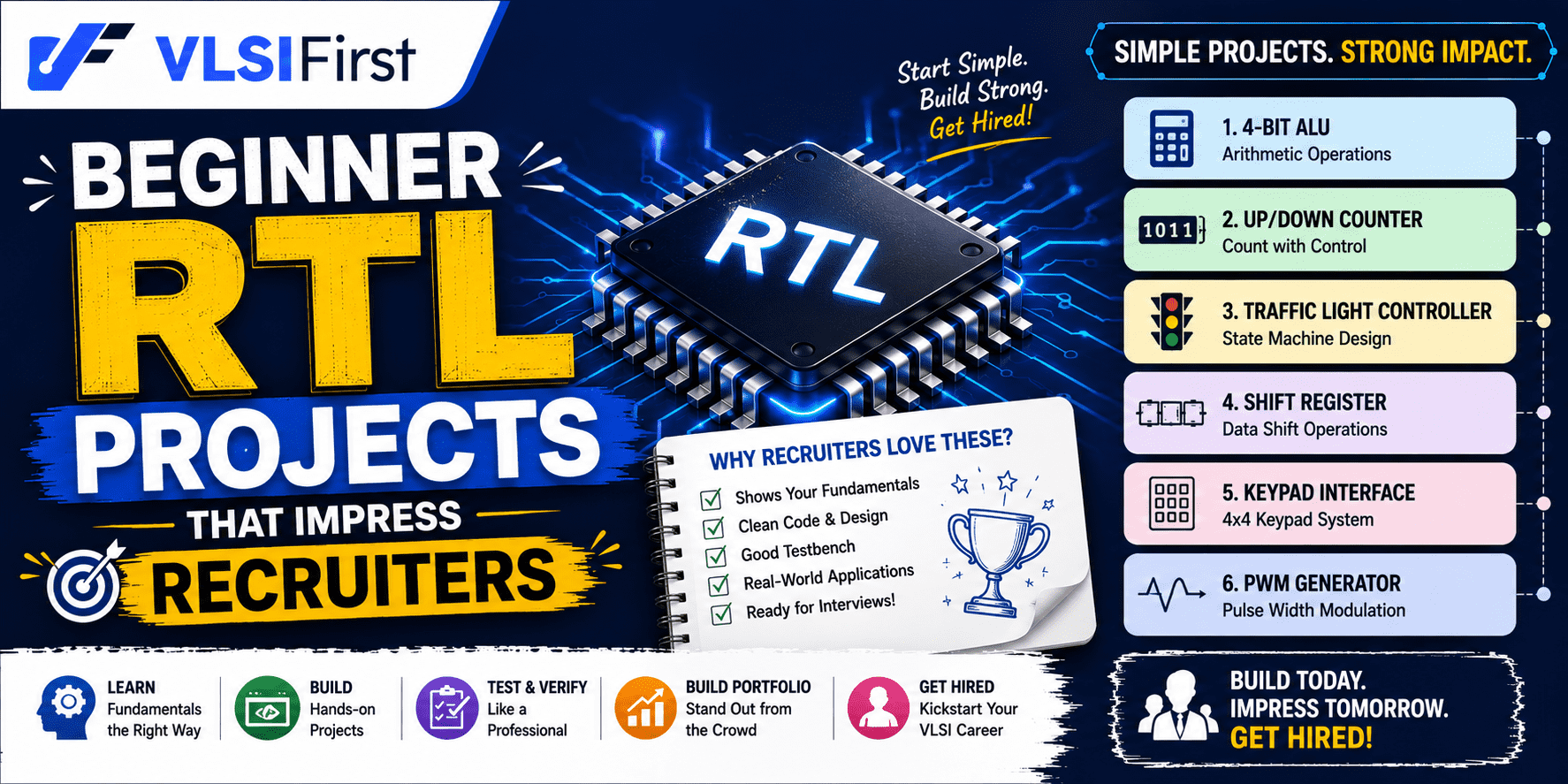
Beginner RTL Projects That Impress Recruiters
Discover beginner RTL projects that impress VLSI recruiters. Learn which Verilog projects build practical skills, strengthen your portfolio, and improve interview success.


Hours
2-98/1, Gurram Guda Road, Gurram Guda, Hyderabad, Rangareddy, Telangana, 501510
Copyright 2025 © VLSI Technologies Private Limited
Designed and developed by KandraDigitalCopyright 2025 © VLSI Technologies Private Limited
Designed, Developed & Marketing by KandraDigital