
When choosing a VLSI training program, students often focus on two major factors:
- Trainer experience
- Course curriculum (content)
Some believe that a strong syllabus is enough to build skills. Others argue that an experienced trainer can make even an average curriculum effective.
So which one truly matters more?
The reality is that both trainer experience and course content play critical roles, but their impact is different. Understanding how each influences learning can help students make smarter decisions when selecting a VLSI course.
This article explores the real difference between trainer experience and course content, how each affects learning outcomes, and what matters more for building a successful semiconductor career.
Why This Question Matters in VLSI Training
VLSI is not a typical theoretical subject. It is a practical engineering domain where students must:
- write RTL code
- debug simulations
- analyze timing reports
- work with EDA tools
Because of this, learning depends not only on what is taught (curriculum) but also on how it is taught (trainer delivery).
A strong VLSI institute must bridge the gap between academic knowledge and real industry expectations, which requires both a relevant syllabus and effective mentorship.
Understanding Course Content in VLSI Training
Course content refers to the topics, modules, and structure of the training program.
A well-designed VLSI curriculum typically includes:
- digital electronics and CMOS fundamentals
- Verilog/SystemVerilog
- ASIC design flow
- functional verification (UVM)
- physical design concepts
- timing analysis
The curriculum acts as the foundation of learning. Without the right content, students may miss critical skills required by semiconductor companies.
Modern industry-oriented programs also align content with specific job roles such as RTL design, verification, and physical design.
Why Course Content Matters
1. Defines What You Learn
The curriculum determines whether you gain:
- basic knowledge or advanced skills
- theoretical understanding or practical exposure
- outdated concepts or industry-relevant techniques
If the syllabus is incomplete or outdated, even the best trainer cannot fully compensate for missing topics.
2. Aligns with Industry Requirements
Semiconductor companies expect engineers to understand:
- complete design flows
- verification methodologies
- tool-based workflows
Courses that align with real job roles help students become job-ready faster.
3. Provides Structured Learning Path
A good curriculum ensures:
- step-by-step progression
- logical topic sequencing
- balanced theory and practice
Without structure, students may feel confused or overwhelmed.
Limitations of Course Content Alone
While curriculum is important, it has limitations.
A syllabus is just a blueprint. It does not guarantee learning.
Students often face problems such as:
- difficulty understanding complex topics
- inability to apply concepts
- lack of real-world context
This is where trainer experience becomes critical.
Understanding Trainer Experience in VLSI
Trainer experience refers to the practical industry exposure and teaching ability of the instructor.
An experienced VLSI trainer typically has:
- worked on real chip design projects
- used industry EDA tools
- handled debugging and design challenges
- participated in ASIC/SoC development
Such trainers bring real-world insights into the classroom.
Why Trainer Experience Matters
1. Simplifies Complex Concepts
VLSI topics such as:
- timing closure
- clock domain crossing
- verification methodologies
can be difficult to understand through theory alone.
Experienced trainers explain these concepts using:
- real examples
- practical scenarios
- debugging cases
This makes learning easier and more relatable.
2. Bridges Theory and Practice
One of the biggest challenges in VLSI learning is applying theory to real design problems.
Hands-on learning and real-world examples help bridge this gap and improve understanding.
Experienced trainers guide students through:
- real debugging scenarios
- tool usage
- design workflows
This transforms theoretical knowledge into practical skills.
3. Teaches Industry Thinking
VLSI engineering is not just about knowledge, it’s about how you approach problems.
Experienced trainers teach:
- how to debug efficiently
- how to analyze design trade-offs
- how to think like an engineer
These skills are rarely found in textbooks.
4. Improves Interview Readiness
Trainers with industry experience understand:
- what companies ask in interviews
- how candidates are evaluated
- common mistakes students make
They can guide students with:
- mock interviews
- real interview questions
- practical problem-solving techniques
Limitations of Trainer Experience Alone
Even the best trainer cannot overcome a weak curriculum.
If the course lacks:
- tool exposure
- project work
- advanced topics
students may still miss important skills.
Also, trainer quality can vary between batches or sessions.
Trainer vs Course Content – Key Comparison
|
Factor |
Course Content |
Trainer Experience |
|
Role |
Defines what you learn |
Defines how you learn |
|
Importance |
Foundation of training |
Application of learning |
|
Impact on Skills |
Moderate |
High |
|
Industry Readiness |
Depends on implementation |
Strong impact |
|
Learning Clarity |
Limited |
High |
What Matters More These Days?
In today’s semiconductor industry, trainer experience has a slightly higher impact than course content.
Here’s why:
- VLSI is practical, not theoretical
- real-world problem-solving is critical
- debugging and tool usage require guidance
- industry expectations are constantly evolving
A strong trainer can:
- make complex topics easy
- add real-world examples beyond syllabus
- guide students in projects and debugging
However, this does not mean curriculum is less important.
The best results come from a combination of both.
The Ideal VLSI Training Model
The most effective VLSI training programs combine:
1. Industry-Relevant Curriculum
- updated syllabus
- role-based training
- tool exposure
2. Experienced Trainers
- real chip design experience
- strong teaching ability
- mentorship mindset
3. Hands-On Learning
- projects
- debugging sessions
- practical assignments
Hands-on training is essential because theory alone cannot prepare students for real chip design challenges.
How to Evaluate Both Before Joining
Before enrolling in any VLSI course, students should evaluate both factors carefully.
Questions to Ask About Curriculum
- Does it cover the complete ASIC flow?
- Are tools included?
- Are projects part of the course?
Questions to Ask About Trainers
- Do they have industry experience?
- Have they worked on real projects?
- Do they provide practical examples?
Common Mistakes Students Make
Many students choose courses based only on:
- syllabus PDF
- course duration
- marketing claims
But they ignore:
- trainer quality
- mentorship support
- practical exposure
This often leads to poor learning outcomes.
Final Verdict
So, trainer experience vs course content – which matters more?
- Course content is the foundation.
- Trainer experience is the multiplier.
Without good content, learning lacks direction.
Without a good trainer, learning lacks depth.
In the current era, where semiconductor companies expect engineers to be job-ready from day one, trainer experience often becomes the deciding factor.
However, the best VLSI training programs combine:
- strong curriculum
- experienced trainers
- hands-on projects
- tool exposure
Students who choose such programs gain both knowledge and practical skills, making them highly competitive in the semiconductor job market.

How to Test Your RTL Before Simulation: A Practical Pre-Simulation Checklist for Beginners
Learn how to test your RTL before simulation with a practical pre-simulation checklist. Improve Verilog quality, reduce debugging time, and build industry-ready RTL skills.
From Logic Diagram to Verilog Code – Complete Workflow
Learn the complete workflow from logic diagram to Verilog code, including specifications, RTL architec ture, coding, simulation, debugging, verification, and documentation.
Common Mistakes While Writing Verilog Code
Learn the most common Verilog coding mistakes beginners make and how to avoid them. Improve RTL coding, simulation, debugging, verification, and interview readiness.
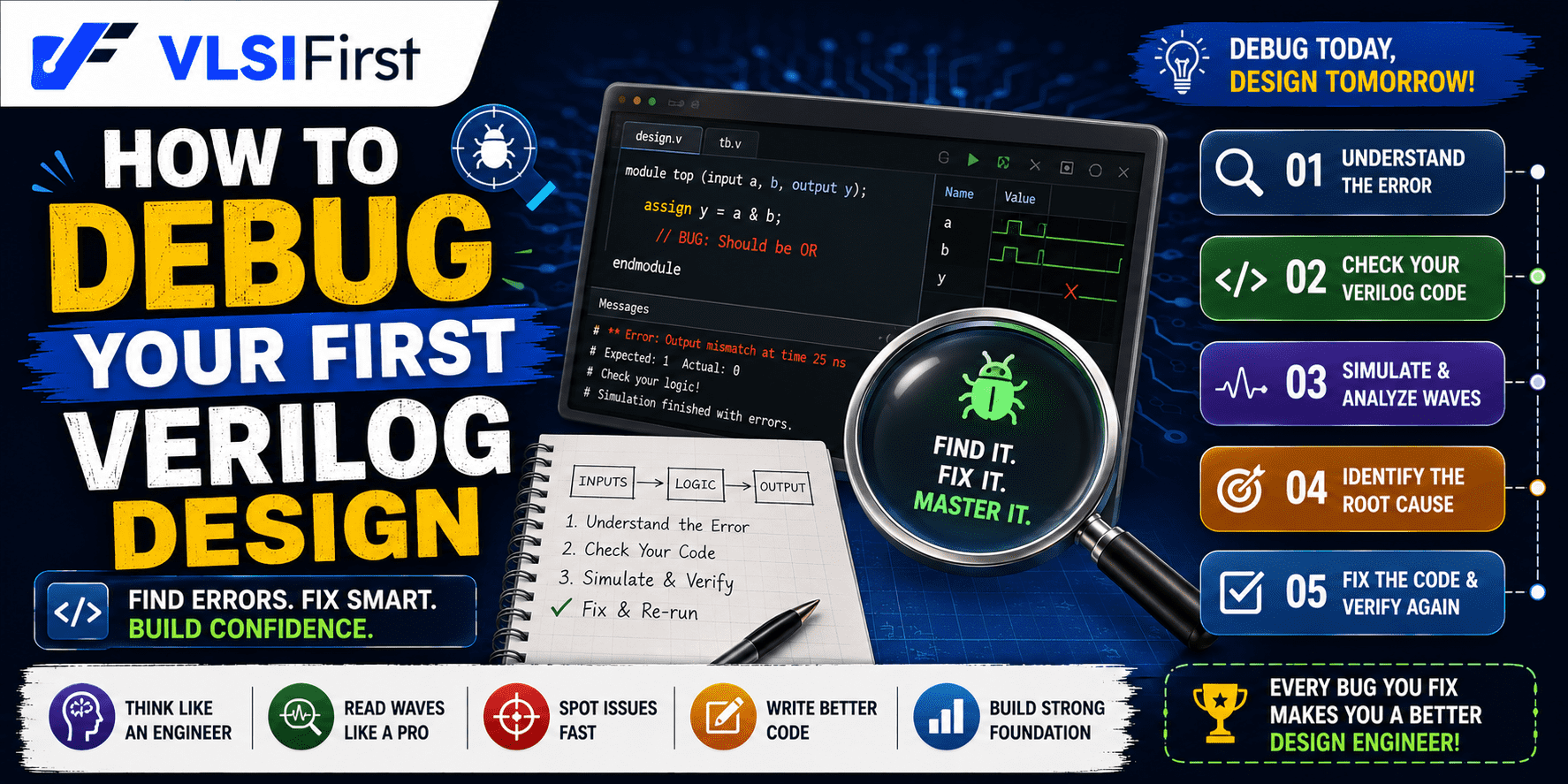
How to Debug Your First Verilog Design
Debugging your first Verilog design with practical RTL debug techniques, waveform analysis, testbench tips, FSM debugging, and common beginner mistakes. Read now!
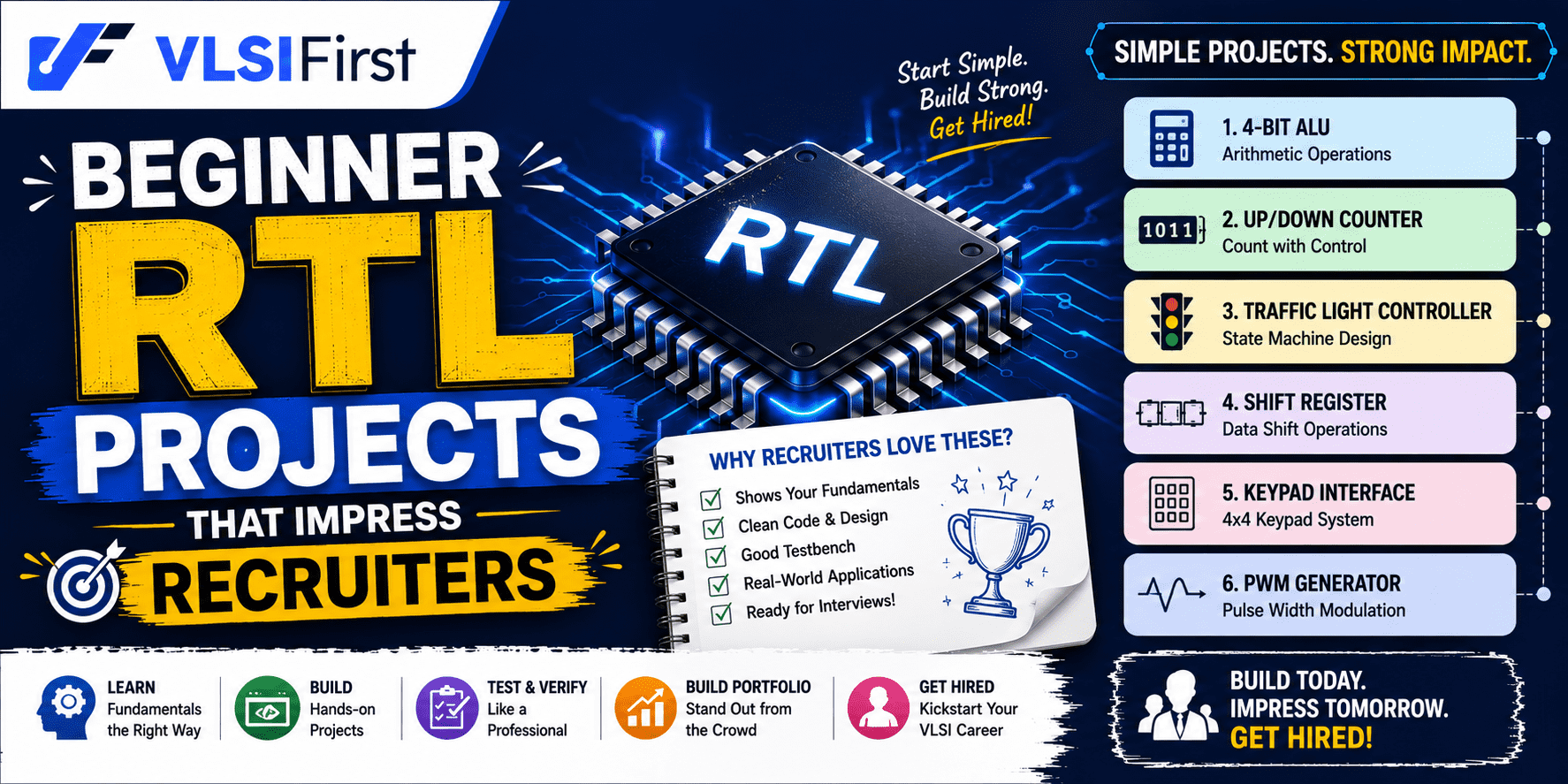
Beginner RTL Projects That Impress Recruiters
Discover beginner RTL projects that impress VLSI recruiters. Learn which Verilog projects build practical skills, strengthen your portfolio, and improve interview success.


Hours
2-98/1, Gurram Guda Road, Gurram Guda, Hyderabad, Rangareddy, Telangana, 501510
Copyright 2025 © VLSI Technologies Private Limited
Designed and developed by KandraDigitalCopyright 2025 © VLSI Technologies Private Limited
Designed, Developed & Marketing by KandraDigital