
One of the biggest reasons students delay entering VLSI is fear.
They think:
- “I need expert programming skills first.”
- “I should master electronics completely before starting.”
- “I need advanced mathematics.”
- “Only toppers can learn VLSI.”
As a result, many students spend months, or even years, waiting for the “perfect time” to start.
But here’s the reality:
You do NOT need to know everything before starting VLSI.
In fact, most successful VLSI engineers began with only a few core basics and learned the rest gradually.
This blog explains the minimum skills you actually need to start learning VLSI, without unnecessary confusion or over-preparation.
Why Students Overcomplicate VLSI Learning
The internet is filled with:
- huge roadmaps
- endless tool lists
- advanced concepts
- complex jargon
This creates the impression that VLSI requires:
- 10 programming languages
- advanced chip architecture knowledge
- years of preparation before starting
But industry reality is different.
Companies expect freshers to have:
- strong basics
- learning ability
- practical mindset
Not expert-level mastery from day one.
The Truth: You Need Foundations, Not Perfection
To begin learning VLSI, you only need a few core skills:
- basic digital electronics
- logical thinking
- willingness to practice
- beginner-level coding mindset
That’s it. Everything else can be learned step-by-step.
Minimum Skills Required to Start VLSI
Let’s break this down clearly.
1. Basic Digital Electronics Knowledge (Most Important)
This is the single most important prerequisite.
You should understand:
- logic gates
- flip-flops
- multiplexers
- counters
- combinational vs sequential circuits
These concepts form the foundation of almost every VLSI domain.
Without digital electronics, even simple Verilog coding becomes difficult.
What Level Is Enough?
You do NOT need advanced expertise.
If you can:
- understand basic logic
- solve simple circuit problems
- understand FSM basics
you are ready to start learning VLSI.
2. Basic Logical Thinking
VLSI is fundamentally about designing logic and solving problems.
You should be comfortable with:
- step-by-step thinking
- analyzing outputs
- understanding conditions
This matters more than academic marks.
3. Beginner-Level Programming Mindset
A major myth is: “You must be an expert programmer to learn VLSI.”
Not true.
For beginners, you only need:
- basic coding understanding
- ability to follow syntax
- patience to debug errors
In VLSI, HDL languages like Verilog are more about describing hardware behavior than traditional software programming.
4. Willingness to Practice Consistently
This is more important than intelligence.
Students who improve in VLSI usually:
- practice regularly
- debug patiently
- work on small projects consistently
Even industry discussions highlight that consistency matters more than starting with advanced skills.
5. Basic Computer Usage Skills
You should know how to:
- use a laptop comfortably
- install software
- manage files and folders
- run simulations
That’s enough for beginners.
Skills You DO NOT Need Initially
This is where students waste time unnecessarily.
1. Advanced Programming
You do NOT need:
- competitive coding
- advanced algorithms
- expert-level C++
before starting VLSI.
2. Deep Semiconductor Physics
Understanding transistor-level physics is useful later, but not required to begin.
Start with digital basics first.
3. Complex Mathematics
You do NOT need:
- advanced calculus
- machine learning math
- research-level mathematics
to start learning RTL design or verification.
4. Full ASIC Flow Knowledge
Beginners often try to learn:
- RTL
- STA
- DFT
- Physical Design
- UVM
all together. This creates confusion. Start small and grow gradually.
The Best Beginner Skill Combination
If you have these 4 things, you are ready:
- Basic digital electronics
- Logical thinking
- Beginner coding mindset
- Consistency
That’s enough to begin.
What Should You Learn First?
A simple beginner sequence:
Step 1: Digital Electronics
Focus on:
- combinational circuits
- sequential circuits
- FSMs
Step 2: Verilog Basics
Start with:
- modules
- always blocks
- if/case statements
- sequential logic
Industry roadmaps consistently recommend Verilog immediately after digital fundamentals.
Step 3: Simple Projects
Examples:
- counters
- ALU
- traffic light controller
Projects build confidence quickly. Understand project importance.
Step 4: Tool Exposure
Learn simulation basics using beginner tools.
Tool familiarity becomes increasingly important in VLSI careers.
Common Beginner Mistakes
1. Trying to Learn Everything at Once
Students jump into:
- UVM
- advanced protocols
- physical design
before understanding basics.
This slows learning.
2. Watching Tutorials Without Practice
Passive learning does not work in VLSI.
You must:
- write code
- debug errors
- simulate designs
3. Comparing Yourself to Experts
Many beginners feel discouraged after seeing advanced engineers online.
Remember, every expert started with logic gates and simple Verilog.
4. Delaying Start Due to Fear
This is the biggest mistake. You do NOT need perfect preparation.
Start learning with basic skills and improve gradually.
How Long Does It Take to Become Comfortable?
For most students:
- 2–4 weeks → digital basics
- 4–8 weeks → beginner Verilog
- 2–3 months → mini projects + simulations
What Recruiters Expect from Beginners
Recruiters do NOT expect freshers to know everything.
They mainly evaluate:
- fundamentals
- logical thinking
- willingness to learn
- project understanding
The Most Important Skill of All
If there is one skill that matters most in VLSI, it is the ability to learn continuously.
Technology changes rapidly.
Even experienced engineers constantly update their knowledge.
So don’t focus on: “How much do I know today?”
Focus on: “Can I keep learning consistently?”
Conclusion
So, what are the minimum skills required to start learning VLSI?
You only need:
- basic digital electronics
- logical thinking
- beginner coding mindset
- willingness to practice
You do NOT need:
- advanced programming
- deep semiconductor expertise
- perfect academic scores
If you are waiting to become “fully prepared” before starting VLSI:
Start with the basics. Build small projects. Learn gradually.
Because in VLSI, Consistency beats over-preparation.
For more beginner-friendly VLSI guidance, career roadmaps, and industry insights, explore detailed resources on VLSIFirst.com.

How to Test Your RTL Before Simulation: A Practical Pre-Simulation Checklist for Beginners
Learn how to test your RTL before simulation with a practical pre-simulation checklist. Improve Verilog quality, reduce debugging time, and build industry-ready RTL skills.
From Logic Diagram to Verilog Code – Complete Workflow
Learn the complete workflow from logic diagram to Verilog code, including specifications, RTL architec ture, coding, simulation, debugging, verification, and documentation.
Common Mistakes While Writing Verilog Code
Learn the most common Verilog coding mistakes beginners make and how to avoid them. Improve RTL coding, simulation, debugging, verification, and interview readiness.
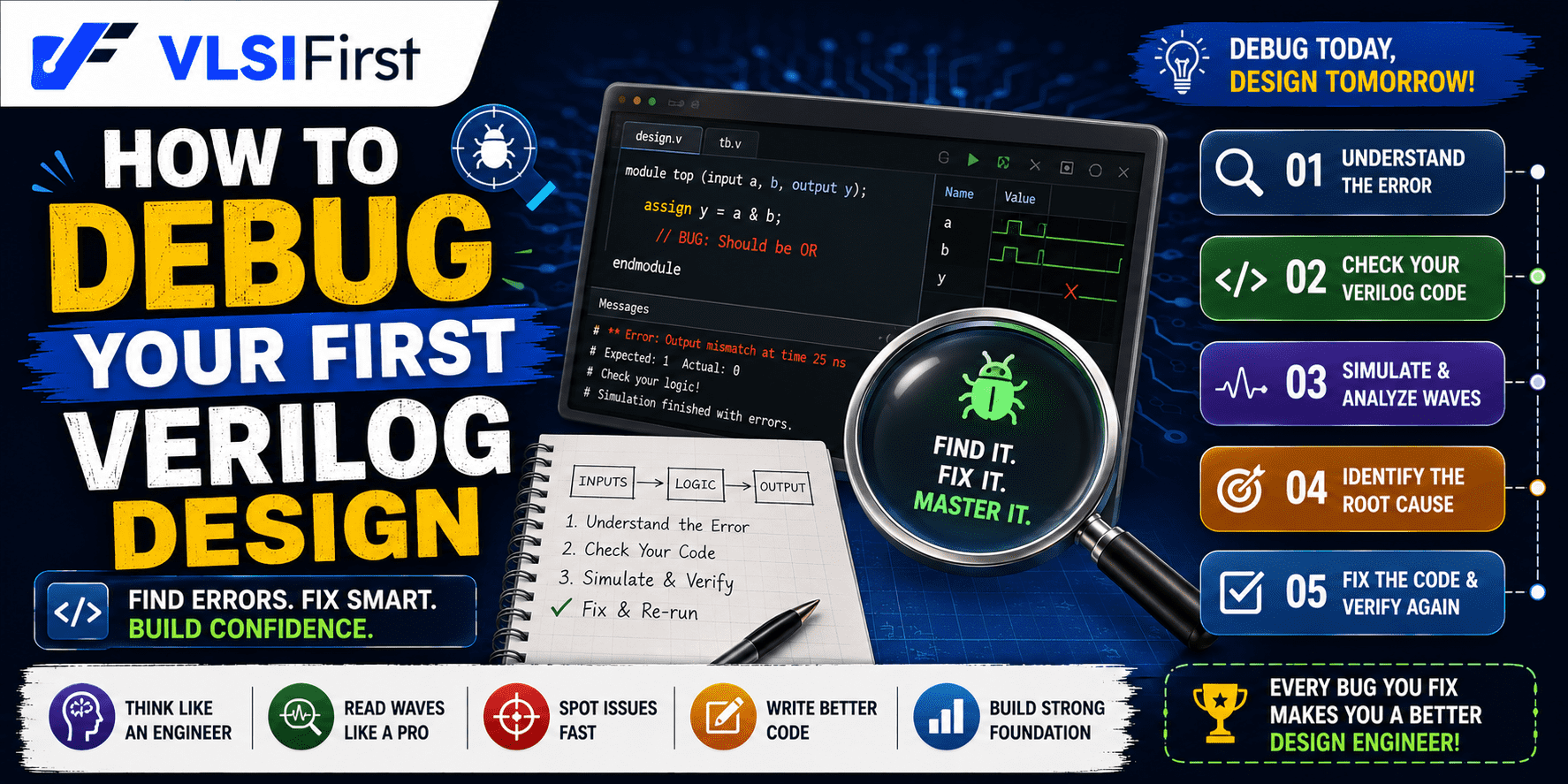
How to Debug Your First Verilog Design
Debugging your first Verilog design with practical RTL debug techniques, waveform analysis, testbench tips, FSM debugging, and common beginner mistakes. Read now!
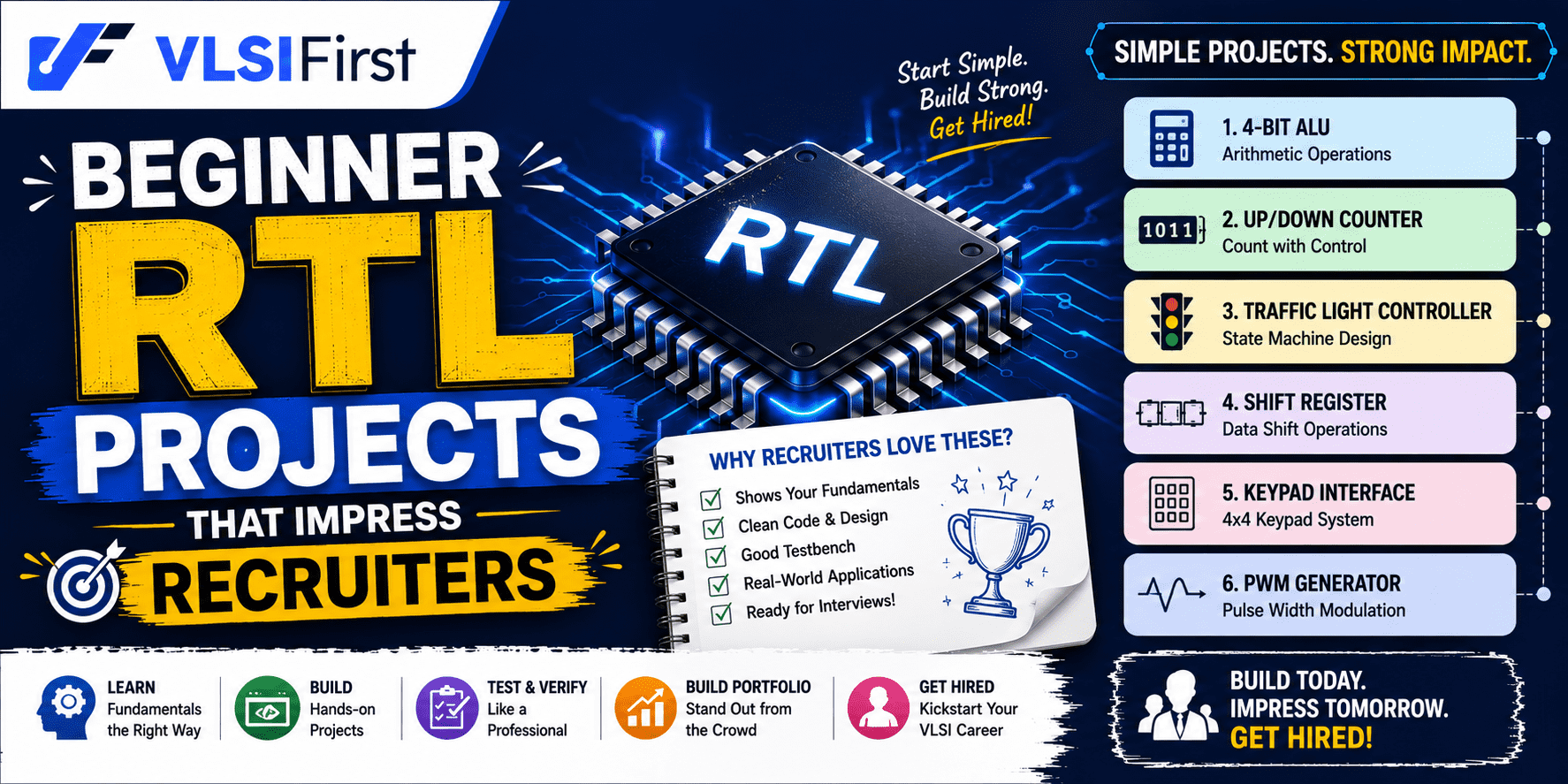
Beginner RTL Projects That Impress Recruiters
Discover beginner RTL projects that impress VLSI recruiters. Learn which Verilog projects build practical skills, strengthen your portfolio, and improve interview success.


Hours
2-98/1, Gurram Guda Road, Gurram Guda, Hyderabad, Rangareddy, Telangana, 501510
Copyright 2025 © VLSI Technologies Private Limited
Designed and developed by KandraDigitalCopyright 2025 © VLSI Technologies Private Limited
Designed, Developed & Marketing by KandraDigital