
If you are a final-year ECE/EEE student aiming for a VLSI career but haven’t done an internship, you’re probably thinking:
“Did I miss my chance?”
“Will companies reject me?”
Let’s clear this upfront:
Not having an internship is a disadvantage, but NOT a dead end.
In fact, many successful VLSI engineers enter the industry without internships by focusing on skills, projects, and strategic preparation.
This blog will give you a clear, practical roadmap to recover, rebuild, and move forward—even at the final stage of your degree.
Why Internships Matter (And What You Missed)
Internships are valuable because they:
- provide hands-on experience
- expose you to real VLSI workflows
- give access to industry tools
They help bridge the gap between theory and practical work.
Also, the VLSI industry increasingly uses internships as a hiring pipeline, making them a strong advantage for freshers.
But Here’s the Important Truth
Internship is just ONE way to gain experience, not the only way.
You can compensate for it through:
- strong projects
- tool exposure
- structured learning
- smart job strategy
The Real Problem: Skill Gap (Not Internship Gap)
Most final-year students struggle not because they lack internships, but because they lack:
- practical skills
- tool knowledge
- real project experience
In fact, the biggest challenge freshers face is, gap between academic knowledge and industry expectations
So your focus should shift from:
- “I don’t have internship” to “How do I build industry-ready skills quickly?”
Step-by-Step VLSI Career Plan (Without Internship)
Let’s break it into a clear action plan.
Step 1: Accept Your Current Position (No Panic Mode)
First, stop comparing yourself with others.
Many students waste months thinking:
- “Others have internships”
- “I am already behind”
This mindset delays progress.
Instead:
Focus on what you can control right now.
Step 2: Choose Your VLSI Domain Quickly
You don’t have time to explore everything.
Pick one domain:
- RTL Design
- Verification
- Physical Design
This helps you focus deeply instead of spreading effort.
Learn how to decide: https://vlsifirst.com/blog/how-to-decide-between-verification-design-and-physical-design
Step 3: Strengthen Core Fundamentals
Even without internship, strong fundamentals can save you.
Focus on:
- digital electronics
- FSM design
- timing concepts
- logic building
Understand what to study: https://vlsifirst.com/blog/what-ece-students-should-focus-on-academically-for-vlsi-roles
Step 4: Learn HDL and Core Skills
Start with:
- Verilog
- SystemVerilog
These are essential for:
- design roles
- verification roles
If coding feels difficult: https://vlsifirst.com/blog/should-you-learn-vlsi-if-youre-weak-in-programming
Step 5: Replace Internship with Strong Projects
This is the MOST IMPORTANT step.
Your projects must act as your “virtual internship.”
Build:
- ALU design
- FIFO
- FSM controllers
- protocol-based designs
Projects demonstrate:
- real understanding
- problem-solving
- debugging ability
Learn more: https://vlsifirst.com/blog/should-a-vlsi-course-include-projects-or-internships
Step 6: Gain Tool Exposure (Critical Step)
Companies expect familiarity with:
- simulation tools
- synthesis tools
- debugging flows
Tools are often more important than theory.
Understand why: https://vlsifirst.com/blog/why-tool-exposure-matters-more-than-theory-in-vlsi-training
Step 7: Build a Portfolio (Your Replacement for Internship)
Your portfolio should include:
- project descriptions
- GitHub links
- simulation outputs
- design explanations
Recruiters use this to judge your skills.
Step 8: Apply Off-Campus Strategically
Without internship or campus placement:
Off-campus becomes your primary path.
Use:
- LinkedIn networking
- referrals
- job portals
- direct company applications
Step 9: Prepare for Interviews Smartly
Focus on:
- fundamentals
- project explanation
- debugging scenarios
Recruiters care more about:
“What you can do” than “what you studied”
Step 10: Consider Training + Internship Comb
If you still feel behind:
Join a VLSI course that includes:
- projects
- tool access
- internship (real or simulated)
This combination is proven to bridge the skill gap effectively.
Timeline to Recover
If you start now:
- 1–2 months → fundamentals + HDL
- 2–4 months → projects + tools
- 4–6 months → job-ready
You can still enter VLSI within a year of graduation.
Common Mistakes Final-Year Students Make
1. Waiting Until Graduation
Many students delay preparation.
Start NOW, even before exams end.
2. Overthinking Internship Gap
Spending time worrying instead of building skills.
3. Learning Without Projects
Theory alone won’t help in interviews.
4. Believing “Internship is Mandatory”
It helps, but it’s not compulsory.
Alternative Entry Paths (If Immediate VLSI Job Is Difficult)
If you don’t get immediate VLSI roles:
You can:
- start in embedded systems
- work in electronics roles
- take IT job and transition later
Many engineers follow this route successfully.
Industry Opportunity Still Exists
Despite competition:
- VLSI demand remains strong
- semiconductor industry is expanding rapidly
- multiple roles are opening across domains
Opportunity is still there, you just need to prepare correctly.
Conclusion
So, can you build a VLSI career without an internship in final year?
Yes, but only with focused effort.
You must:
- build strong projects
- gain tool experience
- prepare strategically
- apply off-campus
If you are in your final year without an internship:
- Don’t panic
- Don’t compare
- Don’t delay
Instead:
- Start building skills immediately
- Replace internship with projects
- Focus on becoming job-ready
Because in VLSI:
Skills + Projects = Opportunities

How to Test Your RTL Before Simulation: A Practical Pre-Simulation Checklist for Beginners
Learn how to test your RTL before simulation with a practical pre-simulation checklist. Improve Verilog quality, reduce debugging time, and build industry-ready RTL skills.
From Logic Diagram to Verilog Code – Complete Workflow
Learn the complete workflow from logic diagram to Verilog code, including specifications, RTL architec ture, coding, simulation, debugging, verification, and documentation.
Common Mistakes While Writing Verilog Code
Learn the most common Verilog coding mistakes beginners make and how to avoid them. Improve RTL coding, simulation, debugging, verification, and interview readiness.
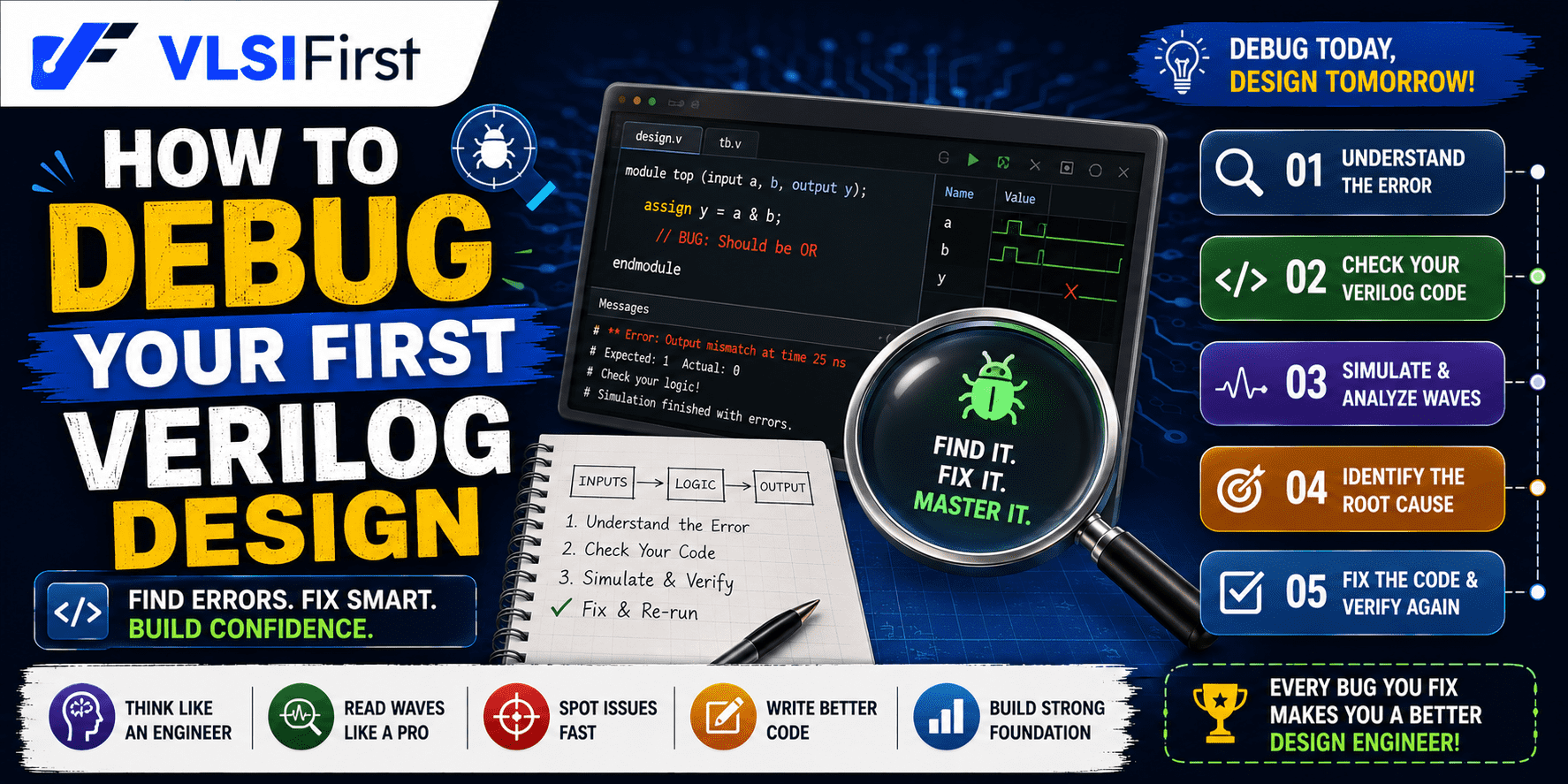
How to Debug Your First Verilog Design
Debugging your first Verilog design with practical RTL debug techniques, waveform analysis, testbench tips, FSM debugging, and common beginner mistakes. Read now!
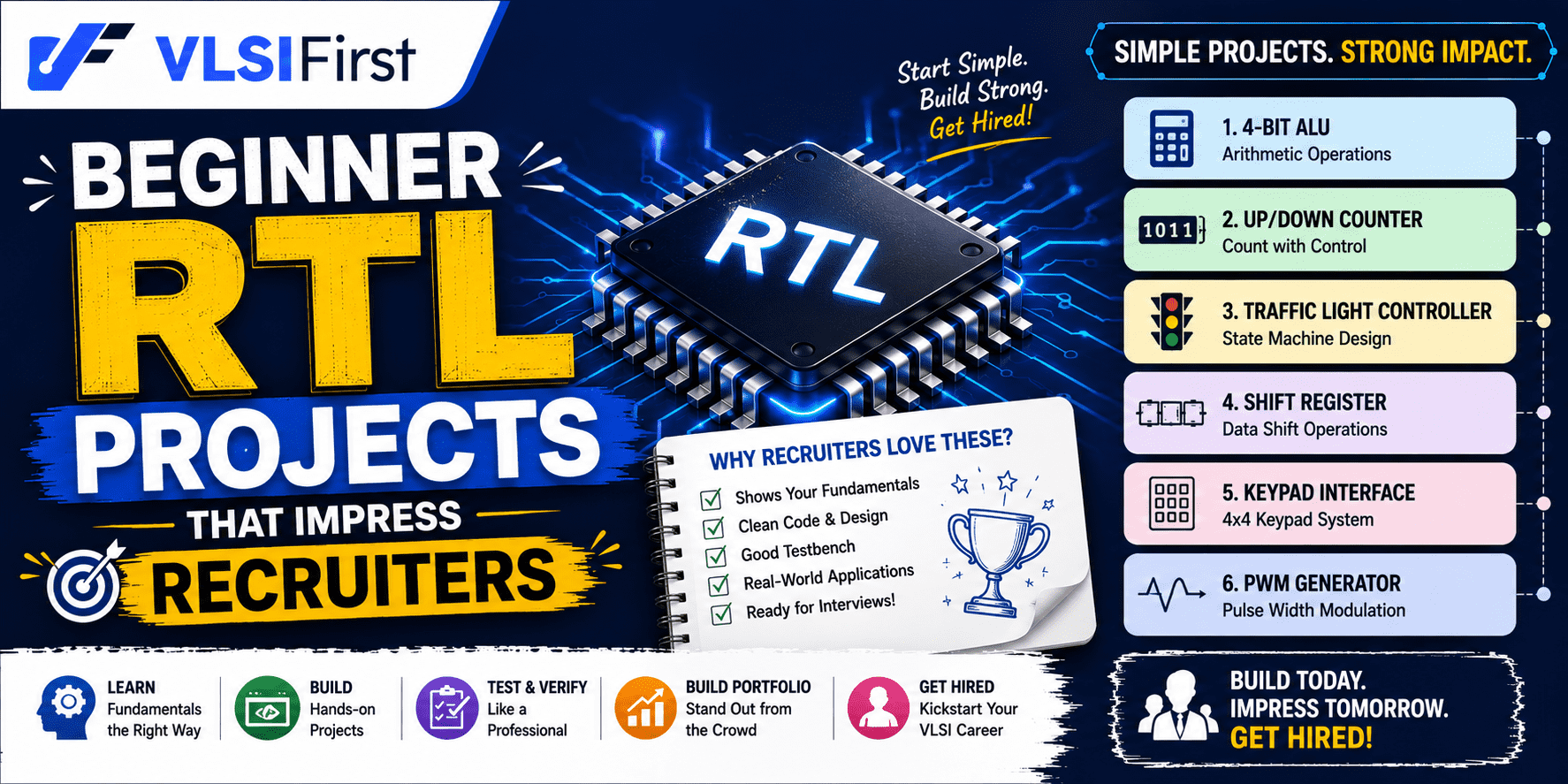
Beginner RTL Projects That Impress Recruiters
Discover beginner RTL projects that impress VLSI recruiters. Learn which Verilog projects build practical skills, strengthen your portfolio, and improve interview success.


Hours
2-98/1, Gurram Guda Road, Gurram Guda, Hyderabad, Rangareddy, Telangana, 501510
Copyright 2025 © VLSI Technologies Private Limited
Designed and developed by KandraDigitalCopyright 2025 © VLSI Technologies Private Limited
Designed, Developed & Marketing by KandraDigital