
One of the most common fears among students entering VLSI is mathematics.
Many ECE/EEE students hesitate to start learning VLSI because they believe:
- “VLSI requires extremely advanced math.”
- “I’m weak in mathematics, so I can’t enter semiconductor careers.”
- “Only students who are excellent at calculus can succeed in VLSI.”
These assumptions stop many capable students from even trying.
But here’s the reality:
Most VLSI roles do NOT require extremely advanced mathematics on a daily basis.
Yes, math plays an important role in semiconductor engineering, but the level and type of math depend heavily on the role you choose.
This blog will explain:
- what math is actually required in VLSI
- what you don’t need initially
- how much math different VLSI domains use
- how beginners should prepare
Why Students Fear Math in VLSI
When students search online, they often see topics like:
- semiconductor equations
- transistor modeling
- signal analysis
- timing calculations
This creates the impression that VLSI is entirely math-heavy.
But the industry reality is different.
Most beginner-level VLSI roles focus more on:
- logic
- debugging
- design thinking
- tool usage
than complex mathematics.
The Truth: VLSI Uses Applied Math, Not Competitive Math
You do not need:
- Olympiad-level mathematics
- advanced theorem proofs
- research-level equations
for most VLSI jobs.
Instead, VLSI mainly uses practical and application-oriented mathematics.
What Math Is Actually Required in VLSI?
Let’s break it down clearly.
1. Basic Algebra (Very Important)
This is the most commonly used math skill.
You should be comfortable with:
- equations
- simplification
- ratios
- logarithms
- exponents
These are useful in:
- timing calculations
- power estimation
- understanding formulas
2. Binary Number System
This is essential.
You must understand:
- binary conversions
- hexadecimal numbers
- arithmetic operations
- signed and unsigned numbers
Because digital systems operate entirely using binary logic.
Without this, VLSI becomes difficult.
3. Boolean Algebra (Critical for VLSI)
This is more important than traditional mathematics in many VLSI roles.
You should know:
- logic simplification
- Karnaugh maps
- Boolean expressions
- DeMorgan’s laws
These concepts directly impact:
- RTL design
- logic optimization
- verification
In fact, Boolean logic forms the foundation of digital circuit design.
4. Basic Probability (Helpful in Verification)
For verification roles, probability helps in:
- constrained random testing
- coverage concepts
- debugging analysis
But beginners only need basic understanding.
5. Basic Timing Calculations
You should understand:
- setup time
- hold time
- clock frequency
- delays
This involves simple calculations, not advanced mathematics.
Math Requirements by VLSI Domain
Different VLSI roles require different levels of math.
RTL Design
Math Requirement: Low to Moderate
Mostly involves:
- Boolean algebra
- logic analysis
- binary systems
Strong logical thinking matters more than advanced math.
Learn how to choose domains here: https://vlsifirst.com/blog/how-to-decide-between-verification-design-and-physical-design
Verification
Math Requirement: Moderate
Verification uses:
- probability basics
- logical analysis
- debugging mindset
But again, coding and problem-solving are more important than advanced mathematics.
Physical Design
Math Requirement: Moderate
Physical design involves:
- timing analysis
- optimization
- calculations related to area/power/performance
Still, tools handle most complex calculations automatically.
Analog/Mixed-Signal Design
Math Requirement: High
This is where stronger mathematics becomes important.
You may need:
- calculus
- differential equations
- signal analysis
Analog design is generally more math-intensive compared to digital VLSI.
What You DON’T Need Initially
This is where students overcomplicate learning.
1. Advanced Calculus
You do NOT need advanced calculus to start learning:
- RTL design
- verification
- basic digital VLSI
2. Research-Level Mathematics
Most freshers never use highly theoretical mathematics in daily work.
3. Machine Learning Mathematics
Some students think AI-level math is required.
Not true for most VLSI beginner roles.
4. Competitive Exam-Level Problem Solving
You are not preparing for mathematics olympiads.
VLSI values:
- logic
- consistency
- debugging ability
more than solving difficult math puzzles.
Why Logical Thinking Matters More Than Heavy Math
This is an important industry reality.
VLSI work often involves:
- debugging
- analyzing waveforms
- fixing logic issues
- understanding behavior
These require logical reasoning more than complex mathematics.
Common Myth: “Weak in Math = Cannot Learn VLSI”
This is completely false.
Many successful VLSI engineers are:
- average in mathematics
- strong in logic and practice
If you can:
- understand digital concepts
- think step-by-step
- debug patiently
you can succeed in VLSI.
Best Way to Prepare Mathematically for VLSI
Step 1: Strengthen Digital Logic
Focus on:
- Boolean algebra
- binary arithmetic
- logic simplification
This is far more useful than advanced math.
Learn academic priorities here: https://vlsifirst.com/blog/what-ece-students-should-focus-on-academically-for-vlsi-roles
Step 2: Understand Timing Concepts
Learn basics of:
- propagation delay
- setup/hold timing
- clock cycles
These are fundamental for real-world VLSI understanding.
Step 3: Practice Problem Solving
Solve:
- logic exercises
- FSM problems
- circuit analysis questions
Practical thinking matters more than memorization.
Role of Tools in Reducing Math Complexity
Modern EDA tools automate many calculations.
For example:
- timing analysis
- synthesis optimization
- placement calculations
are heavily tool-driven.
This is why tool exposure matters greatly in modern VLSI training.
Read more: https://vlsifirst.com/blog/why-tool-exposure-matters-more-than-theory-in-vlsi-training
Common Student Mistakes
1. Delaying VLSI Due to Fear of Math
Many students waste months thinking they need stronger math first.
Start with digital logic instead.
2. Focusing on Irrelevant Math Topics
Not all engineering mathematics subjects are equally useful for VLSI.
Prioritize:
- logic
- timing
- binary systems
3. Comparing with Analog Designers
Analog VLSI requires more mathematics.
Digital VLSI roles are very different.
Real Industry Perspective
Today’s semiconductor companies primarily evaluate freshers on:
- fundamentals
- projects
- problem-solving
- practical understanding
not advanced mathematical expertise.
Recruiters care more about:
“Can you design and debug?” than “Can you solve advanced equations?”
Conclusion
So, how much math is actually required for VLSI?
For most beginner digital VLSI roles:
- basic algebra
- Boolean logic
- binary systems
- timing concepts
are enough.
You do NOT need:
- advanced calculus
- research-level mathematics
- expert mathematical skills
to start your VLSI journey.
If mathematics is stopping you from learning VLSI:
Don’t overestimate the math requirement.
Focus on:
- logic building
- digital electronics
- practical projects
- consistent learning
Because in VLSI:
Strong logic beats advanced mathematics for most beginner roles.
For more beginner-friendly VLSI career guidance, training roadmaps, and industry insights, explore detailed resources on VLSIFirst.com.

How to Test Your RTL Before Simulation: A Practical Pre-Simulation Checklist for Beginners
Learn how to test your RTL before simulation with a practical pre-simulation checklist. Improve Verilog quality, reduce debugging time, and build industry-ready RTL skills.
From Logic Diagram to Verilog Code – Complete Workflow
Learn the complete workflow from logic diagram to Verilog code, including specifications, RTL architec ture, coding, simulation, debugging, verification, and documentation.
Common Mistakes While Writing Verilog Code
Learn the most common Verilog coding mistakes beginners make and how to avoid them. Improve RTL coding, simulation, debugging, verification, and interview readiness.
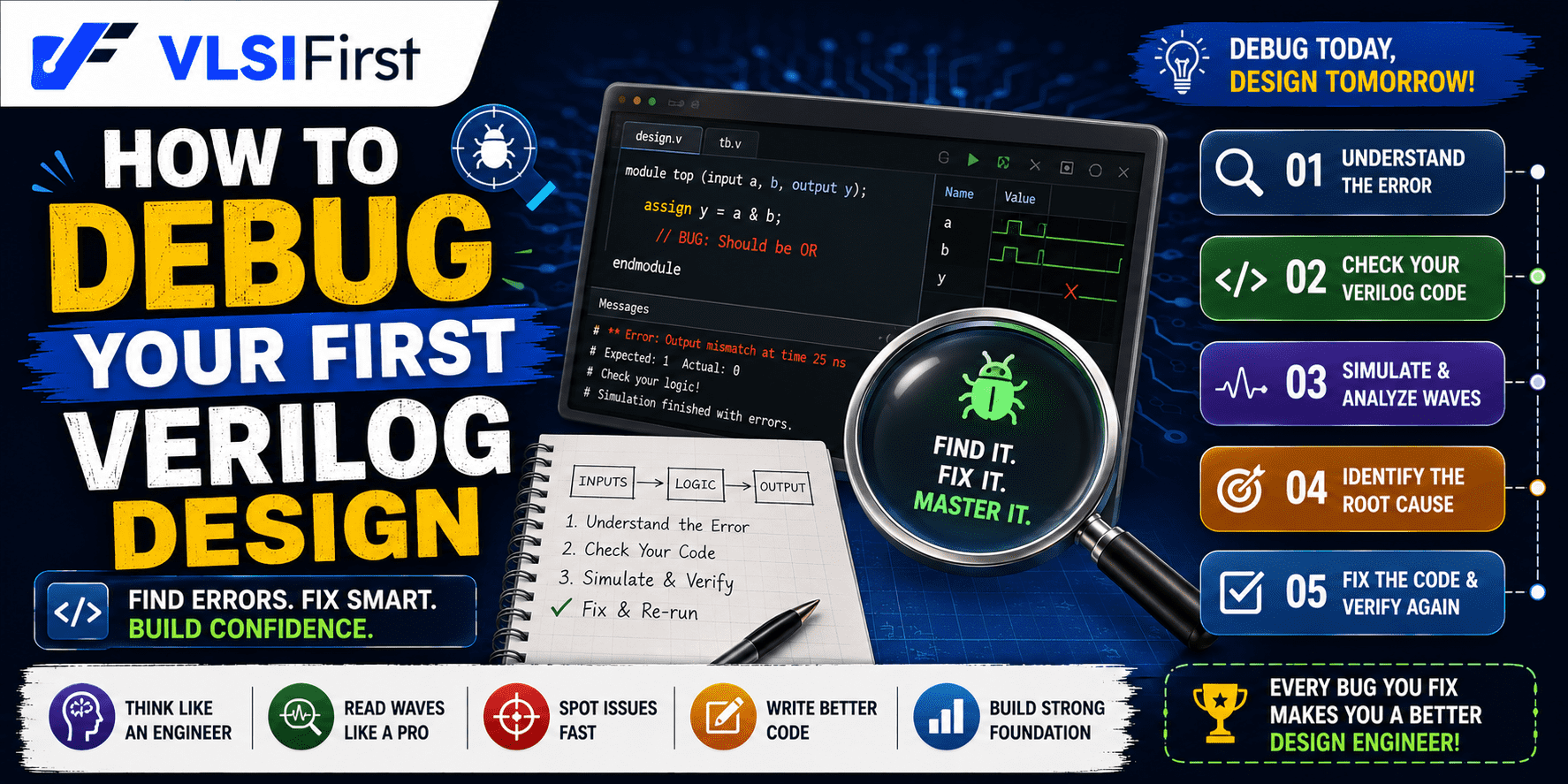
How to Debug Your First Verilog Design
Debugging your first Verilog design with practical RTL debug techniques, waveform analysis, testbench tips, FSM debugging, and common beginner mistakes. Read now!
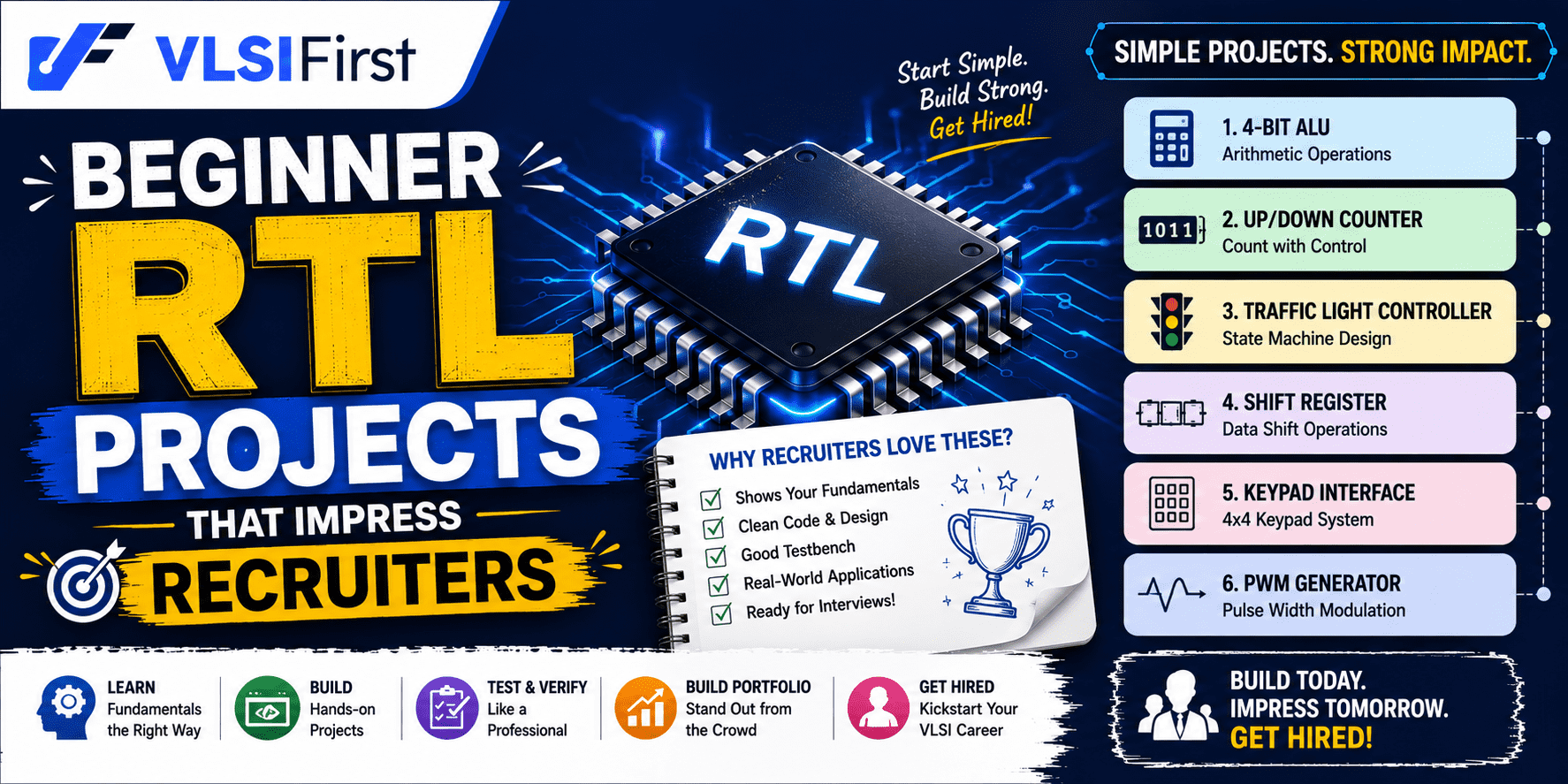
Beginner RTL Projects That Impress Recruiters
Discover beginner RTL projects that impress VLSI recruiters. Learn which Verilog projects build practical skills, strengthen your portfolio, and improve interview success.


Hours
2-98/1, Gurram Guda Road, Gurram Guda, Hyderabad, Rangareddy, Telangana, 501510
Copyright 2025 © VLSI Technologies Private Limited
Designed and developed by KandraDigitalCopyright 2025 © VLSI Technologies Private Limited
Designed, Developed & Marketing by KandraDigital