
For Electronics and Communication Engineering (ECE) students, entering the VLSI (Very Large Scale Integration) domain is a popular and promising career goal. However, many students make a critical mistake:
They complete their degree without aligning their academics with industry requirements.
The result?
- confusion during training
- difficulty in interviews
- lack of confidence in projects
So the real question is:
What should ECE students focus on academically to succeed in VLSI roles?
This blog provides a clear academic roadmap, helping students prioritize the right subjects, build strong fundamentals, and prepare effectively for VLSI careers.
Why Academic Focus Matters in VLSI
VLSI is not a field where you can rely only on short-term training.
It requires:
- strong conceptual understanding
- analytical thinking
- problem-solving skills
Your academic subjects form the foundation for:
- RTL design
- verification
- physical design
Students who ignore core subjects often struggle later, even after completing VLSI courses.
Core Subjects Every ECE Student Must Focus On
Let’s break down the most important academic areas.
1. Digital Electronics
This is the backbone of VLSI.
You must master:
- logic gates
- combinational circuits
- sequential circuits
- flip-flops
- finite state machines (FSMs)
Why it matters:
VLSI design is essentially building complex digital systems using these basic concepts.
Students weak in digital electronics struggle with:
- Verilog coding
- design logic
- debugging
2. CMOS and VLSI Design Basics
Subjects like:
- CMOS technology
- MOSFET operation
- basic VLSI design concepts
help you understand:
- how circuits are physically implemented
- power and performance trade-offs
This is especially important for:
- physical design roles
- low-power design understanding
3. Data Structures & Programming Basics
While VLSI is not pure software, programming plays a role.
Focus on:
- basic C/C++
- data structures (arrays, stacks, queues)
- problem-solving logic
This helps in:
- writing testbenches
- scripting
- debugging
If you're concerned about coding, read: https://vlsifirst.com/blog/should-you-learn-vlsi-if-youre-weak-in-programming
4. Signals and Systems
This subject builds analytical thinking.
Key areas:
- signal representation
- system behavior
- time and frequency analysis
It helps in understanding:
- communication systems
- timing behavior in circuits
5. Electronic Devices & Circuits
Focus on:
- diodes
- transistors
- amplifiers
This subject is crucial for understanding:
- how digital circuits are physically built
- switching behavior
6. Computer Organization & Architecture
This subject connects hardware and system design.
You will learn:
- processor architecture
- memory systems
- instruction execution
This is useful for:
- RTL design
- system-level understanding
7. Control Systems
While not directly core to VLSI, it helps develop:
- system-level thinking
- analytical skills
Subjects You Should Not Ignore
Many students skip certain subjects thinking they are not important.
However, subjects like:
- mathematics (especially discrete math)
- probability
- basic electronics
play a supporting role in VLSI learning.
How to Study These Subjects Effectively
Just attending classes is not enough.
1. Focus on Concept Clarity
Don’t memorize.
Instead:
- understand “why” behind concepts
- solve problems step-by-step
2. Practice Regularly
Solve:
- previous year questions
- design problems
- logic exercises
Practice improves:
- speed
- accuracy
- confidence
3. Connect Theory with Applications
Ask yourself:
“How is this concept used in VLSI?”
This helps in:
- better retention
- practical understanding
Bridging Academics with VLSI Skills
Academic learning alone is not enough.
You must connect it with industry skills.
1. Learn HDL (Verilog/SystemVerilog)
Once you understand digital electronics, start coding designs in Verilog
This helps you apply theoretical concepts practically.
2. Work on Mini Projects
Examples:
- counters
- ALU design
- FSM-based controllers
Projects help convert academic knowledge into real skills.
Learn more here: https://vlsifirst.com/blog/should-a-vlsi-course-include-projects-or-internships
3. Gain Tool Exposure
EDA tools are essential in VLSI.
You must learn:
- simulation tools
- synthesis tools
Understand why tools matter: https://vlsifirst.com/blog/why-tool-exposure-matters-more-than-theory-in-vlsi-training
Common Mistakes ECE Students Make
1. Ignoring Core Subjects
Students focus only on:
- passing exams
- memorizing notes
This leads to weak fundamentals.
2. Starting VLSI Training Too Late
Many students delay learning until final year.
You can plan better here: https://vlsifirst.com/blog/when-is-the-right-time-to-start-vlsi-training
3. Over-Reliance on Certificates
Certificates alone do not guarantee jobs.
Learn what matters: https://vlsifirst.com/blog/what-recruiters-look-for-beyond-vlsi-course-certificates
4. Lack of Practical Exposure
Without projects and tools:
- concepts remain theoretical
- interviews become difficult
Ideal Academic Roadmap for ECE Students
Here’s a simple roadmap:
1st Year
- focus on basic electronics
- build strong math foundation
2nd Year
- master digital electronics
- start learning programming basics
3rd Year
- learn Verilog/SystemVerilog
- start mini projects
- explore VLSI domains
Final Year
- work on major projects
- gain tool experience
- prepare for interviews
How Academics Impact Placements
Strong academic knowledge helps you:
- answer interview questions confidently
- explain concepts clearly
- solve problems effectively
Even off-campus opportunities depend heavily on fundamentals.
Final Thoughts
So, what should ECE students focus on academically for VLSI roles?
Strong fundamentals in digital electronics and core subjects
Programming basics and problem-solving skills
Connecting theory with practical applications
Companies are looking for:
- engineers who understand concepts
- engineers who can apply them
- engineers who can solve real problems
Your academic preparation plays a crucial role in achieving this.
If you are an ECE student aiming for VLSI:
- Don’t study just for exams
- Study for understanding
- Start early and stay consistent
- Combine academics with practical learning
With the right academic focus, you can build a strong foundation for a successful VLSI career.
For more insights on VLSI careers, training strategies, and industry expectations, explore detailed guides on VLSIFirst.com.
How to Test Your RTL Before Simulation: A Practical Pre-Simulation Checklist for Beginners
Learn how to test your RTL before simulation with a practical pre-simulation checklist. Improve Verilog quality, reduce debugging time, and build industry-ready RTL skills.
From Logic Diagram to Verilog Code – Complete Workflow
Learn the complete workflow from logic diagram to Verilog code, including specifications, RTL architec ture, coding, simulation, debugging, verification, and documentation.
Common Mistakes While Writing Verilog Code
Learn the most common Verilog coding mistakes beginners make and how to avoid them. Improve RTL coding, simulation, debugging, verification, and interview readiness.
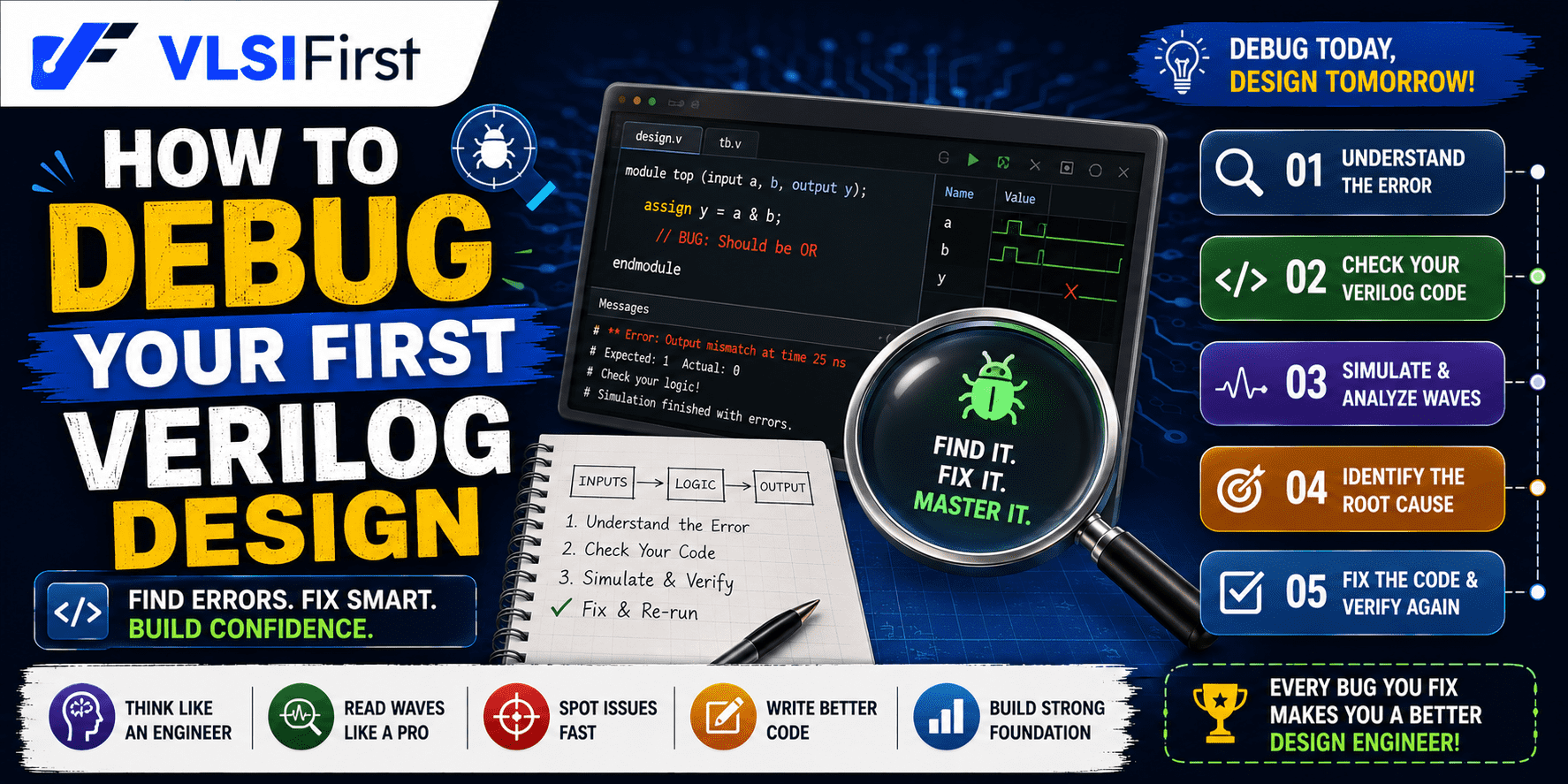
How to Debug Your First Verilog Design
Debugging your first Verilog design with practical RTL debug techniques, waveform analysis, testbench tips, FSM debugging, and common beginner mistakes. Read now!
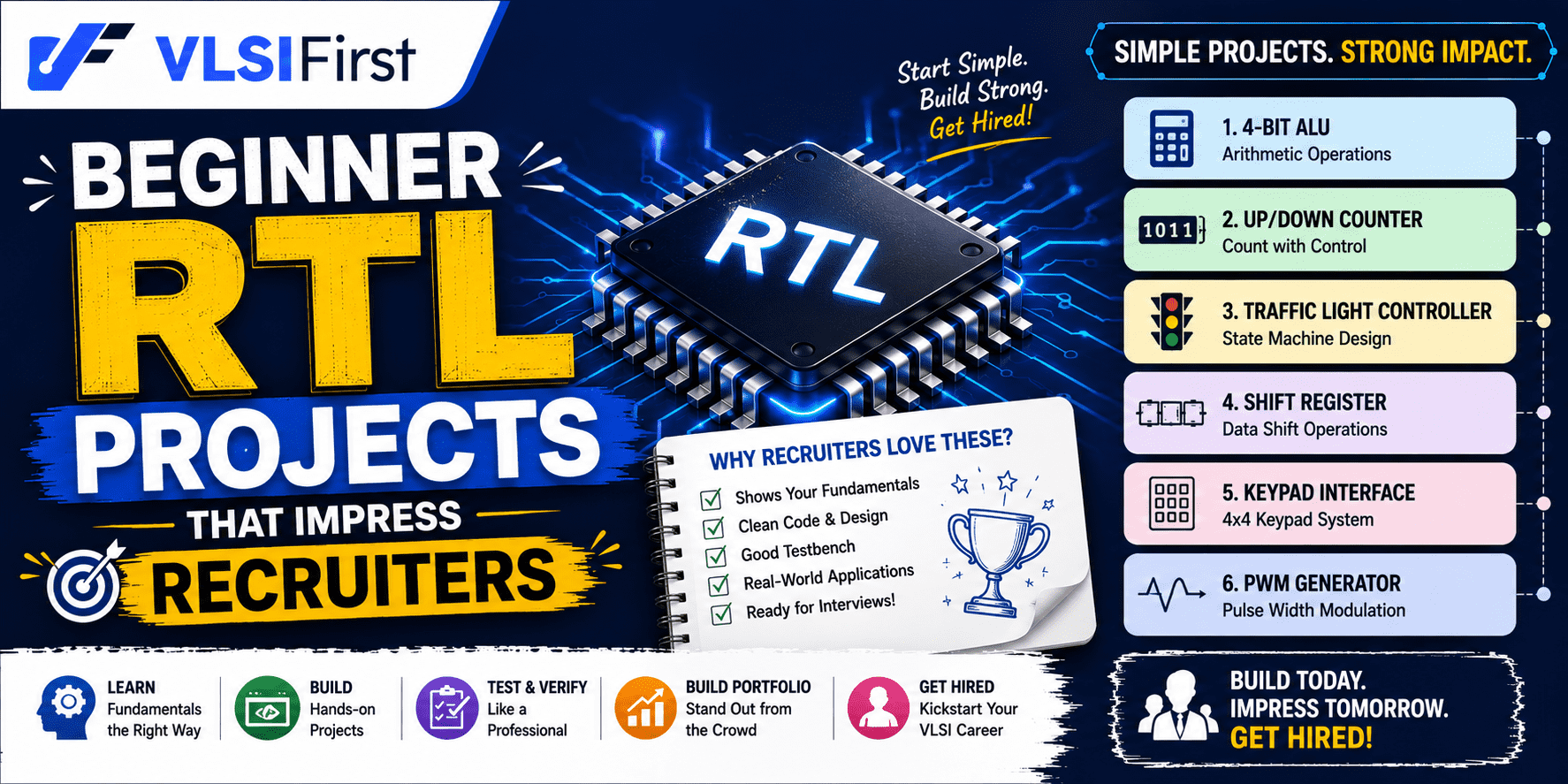
Beginner RTL Projects That Impress Recruiters
Discover beginner RTL projects that impress VLSI recruiters. Learn which Verilog projects build practical skills, strengthen your portfolio, and improve interview success.


Hours
2-98/1, Gurram Guda Road, Gurram Guda, Hyderabad, Rangareddy, Telangana, 501510
Copyright 2025 © VLSI Technologies Private Limited
Designed and developed by KandraDigitalCopyright 2025 © VLSI Technologies Private Limited
Designed, Developed & Marketing by KandraDigital