
Many students entering VLSI training today believe one thing:
“If I learn Cadence or Synopsys tools, I’ll become industry-ready.”
This mindset has become extremely common because many institutes heavily advertise:
- tool access
- lab environments
- EDA software exposure
- workflow demonstrations
As a result, students often assume semiconductor jobs are mostly about operating tools.
But when real interviews and projects begin, they discover something important:
Tool familiarity alone does NOT make someone a strong VLSI engineer.
In fact, many recruiters and industry engineers now openly say that students often know tool names and commands but struggle with:
- debugging
- timing analysis
- RTL quality
- design thinking
- root-cause analysis
Recent discussions from experienced VLSI professionals highlight that many students fail not because of lack of knowledge, but because they are not prepared for real engineering workflows.
This blog explains:
- why tool exposure is important but insufficient
- what skills actually matter in semiconductor careers
- why fundamentals and debugging dominate real projects
- how students should prepare properly for VLSI jobs
Why Students Overestimate EDA Tools
EDA tools look powerful and complex.
Students see:
- waveform viewers
- synthesis reports
- physical design layouts
- timing analysis dashboards
and naturally assume:
“The person who knows the tool best will become the best engineer.”
But the semiconductor industry works differently.
EDA tools are engineering assistants, not replacements for engineering thinking.
Even modern AI-assisted EDA workflows still depend heavily on engineers who understand:
- timing
- logic
- architecture
- verification
- debugging
deeply.
What EDA Tools Actually Do
EDA tools help automate semiconductor workflows such as:
- RTL simulation
- logic synthesis
- place and route
- static timing analysis
- verification
- physical signoff
Examples include:
- Synopsys VCS
- Cadence Xcelium
- PrimeTime
- Innovus
- ICC2
- QuestaSim
These tools are essential in the industry.
But tools only:
- execute workflows
- generate reports
- simulate behavior
They do NOT automatically:
- understand design intent
- debug logic problems
- optimize architecture intelligently
That responsibility still belongs to engineers.
The Biggest Industry Problem Today
Many students can:
- launch tools
- run scripts
- execute flows
- follow tutorials
But struggle badly when interviewers ask:
- “Why did timing fail?”
- “Why is this RTL not synthesizable?”
- “How would you debug this waveform mismatch?”
- “Why is this FSM stuck?”
Industry professionals repeatedly mention this “theory + tool familiarity but weak debugging” gap.
Example: Static Timing Analysis (STA)
Suppose PrimeTime reports:
setup violation
A student who only knows tool commands may:
- rerun reports repeatedly
- try random constraint changes
- become confused
But a strong engineer understands:
- setup/hold relationships
- clock skew
- path delay
- timing exceptions
- root-cause analysis
The tool only reports the issue.
The engineer solves it.
Recruiters increasingly test timing fundamentals rather than simple tool operation.
Example: RTL Design
Consider RTL coding.
A student may know:
- how to compile Verilog
- how to simulate modules
But industry engineers care more about:
- synthesizable RTL
- timing-friendly design
- modular coding
- reset handling
- FSM correctness
Experienced engineers often say freshers struggle because they can write syntax but cannot produce clean, industry-quality RTL.
Why Fundamentals Matter More Than Tool Commands
Tools evolve constantly.
Companies change:
- tool versions
- workflows
- methodologies
- automation frameworks
But engineering fundamentals remain constant.
Strong engineers always rely on:
- digital electronics
- logic analysis
- timing concepts
- debugging methodology
- design principles
Even modern VLSI hiring trends show employers prioritize analytical thinking and engineering depth over memorizing commands.
Why Debugging Skills Matter More Than Tool Familiarity
This is one of the biggest industry realities.
Modern chips contain:
- billions of transistors
- multiple clock domains
- complex protocols
- huge verification environments
As chip complexity increases, debugging becomes one of the most valuable semiconductor engineering skills.
Strong engineers know how to:
- analyze waveforms
- trace signals
- isolate failures
- identify root causes
Tools assist debugging.
They do not replace engineering reasoning.
The Industry Shift Happening
The semiconductor industry is rapidly moving toward:
- AI-assisted design
- advanced automation
- intelligent verification
- chiplet architectures
- system-level optimization
Ironically, this makes human engineering skills even MORE valuable.
Because companies increasingly need engineers who can:
- interpret results
- handle corner cases
- solve unexpected failures
- optimize architectures
Even research on AI-assisted EDA shows reliable engineering still depends heavily on structural verification and engineering reasoning.
What Recruiters Actually Want
Recruiters today expect freshers to combine:
- tool familiarity
- digital fundamentals
- RTL understanding
- debugging ability
- problem-solving mindset
- project experience
not just software exposure.
Recruiters repeatedly emphasize that understanding flows matters more than button-clicking.
Common Mistakes Students Make
1. Memorizing Tool Steps Without Understanding Concepts
Many students learn:
- synthesis flow commands
- STA commands
- simulation procedures
without understanding:
- why timing fails
- why constraints matter
- how logic affects implementation
This creates shallow knowledge.
2. Ignoring Digital Fundamentals
Weak fundamentals create major problems in:
- RTL design
- verification
- timing closure
- debugging
Strong digital logic remains the backbone of semiconductor engineering.
3. Avoiding Debugging Practice
Many students only run “successful” simulations.
Real engineering involves:
- failures
- mismatches
- corner cases
- timing issues
Problem-solving ability is now one of the biggest hiring differentiators.
4. Believing Tool Certificates Guarantee Placements
Tool certifications may strengthen resumes.
But companies rarely hire based only on certificates.
Recruiters care more about:
- projects
- RTL quality
- debugging ability
- engineering understanding
What Students Should Learn Along With Tools
1. Digital Design Concepts
Focus heavily on:
- FSMs
- timing
- clocking
- resets
- combinational logic
2. RTL Coding
Practice:
- Verilog
- SystemVerilog
- synthesizable design
Clean RTL directly impacts timing and implementation quality.
3. Verification and Debugging
Learn:
- waveform analysis
- assertions
- signal tracing
- corner-case analysis
Verification consumes a major portion of modern chip development effort.
4. Real Projects
Projects connect:
- theory
- tools
- debugging
- workflows
Project-based learning is becoming increasingly important in semiconductor hiring.
5. ASIC Flow Understanding
Even beginners should understand:
- RTL to GDSII flow
- synthesis basics
- STA flow
- verification stages
Industry-ready engineers understand how all stages connect.
What Makes a Strong VLSI Engineer?
The strongest engineers today combine:
- tool familiarity
- engineering fundamentals
- debugging expertise
- logical thinking
- Adaptability
- project exposure
not just software operation knowledge.
Final Verdict
So, is tool familiarity important in VLSI?
Absolutely yes.
But is it enough?
Definitely no.
EDA tools are only part of semiconductor engineering.
Without:
- strong fundamentals
- debugging ability
- RTL understanding
- timing knowledge
- analytical thinking
tool knowledge alone has very limited industry value.
If you are learning VLSI today, don’t aim to become only a “tool operator.”
Aim to become:
- a logical engineer
- a debugger
- a problem solver
- someone who understands semiconductor workflows deeply
Because in real semiconductor companies:
The best engineers are not the ones who memorize the most commands, they are the ones who solve the toughest engineering problems.
For more VLSI career guidance, industry-focused learning strategies, and semiconductor preparation resources, explore detailed content on VLSIFirst.com.

How to Test Your RTL Before Simulation: A Practical Pre-Simulation Checklist for Beginners
Learn how to test your RTL before simulation with a practical pre-simulation checklist. Improve Verilog quality, reduce debugging time, and build industry-ready RTL skills.
From Logic Diagram to Verilog Code – Complete Workflow
Learn the complete workflow from logic diagram to Verilog code, including specifications, RTL architec ture, coding, simulation, debugging, verification, and documentation.
Common Mistakes While Writing Verilog Code
Learn the most common Verilog coding mistakes beginners make and how to avoid them. Improve RTL coding, simulation, debugging, verification, and interview readiness.
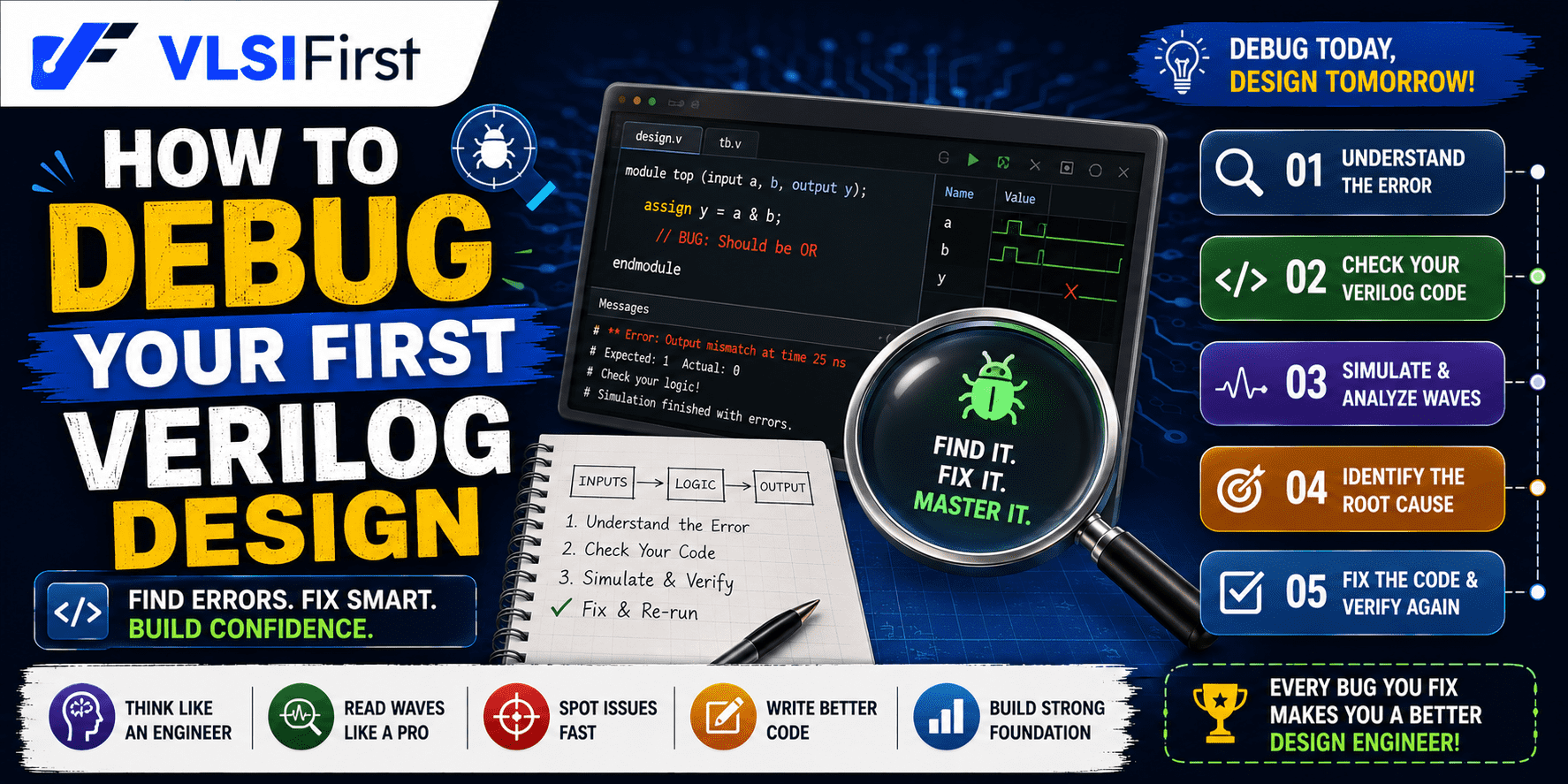
How to Debug Your First Verilog Design
Debugging your first Verilog design with practical RTL debug techniques, waveform analysis, testbench tips, FSM debugging, and common beginner mistakes. Read now!
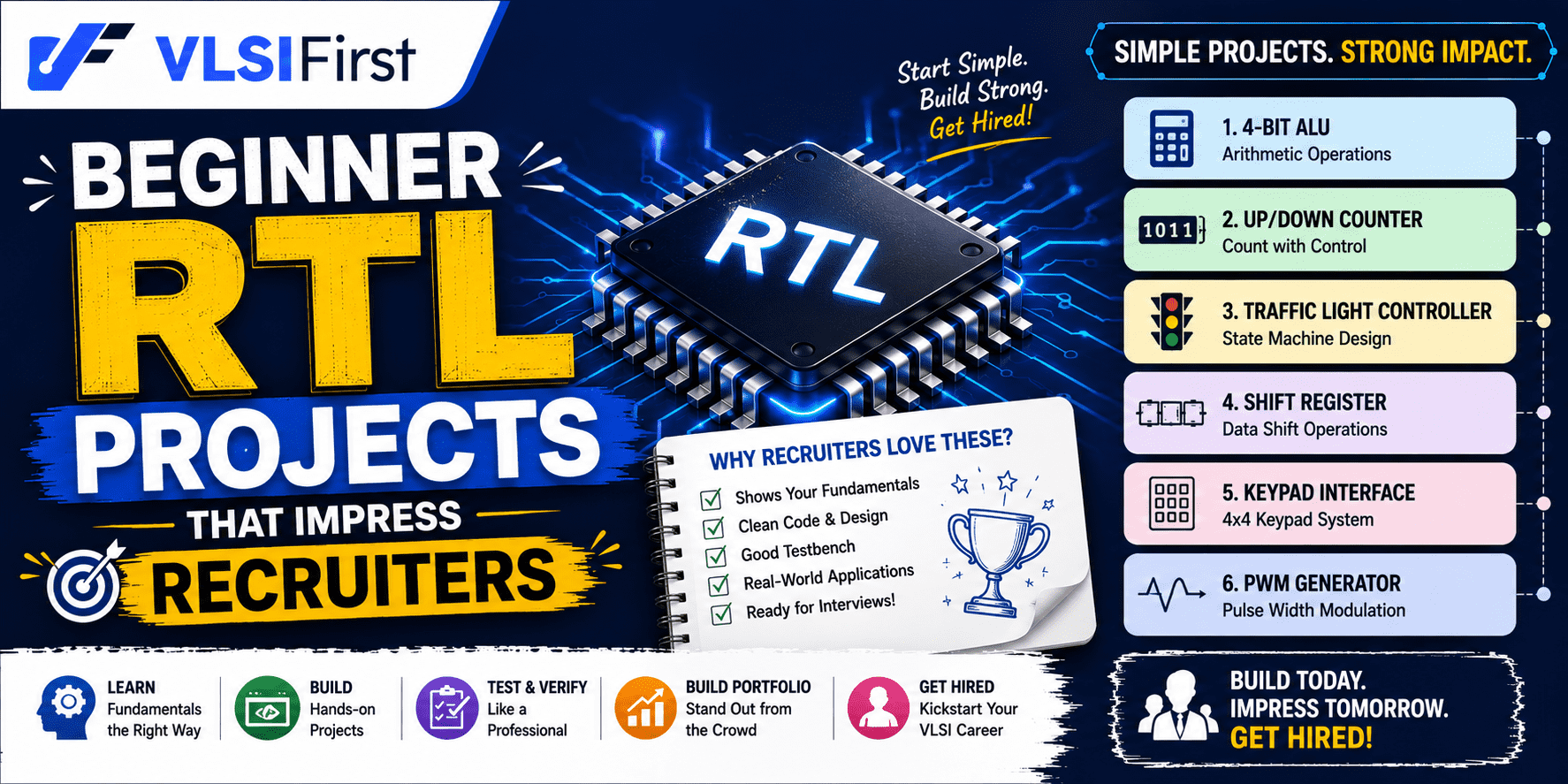
Beginner RTL Projects That Impress Recruiters
Discover beginner RTL projects that impress VLSI recruiters. Learn which Verilog projects build practical skills, strengthen your portfolio, and improve interview success.


Hours
2-98/1, Gurram Guda Road, Gurram Guda, Hyderabad, Rangareddy, Telangana, 501510
Copyright 2025 © VLSI Technologies Private Limited
Designed and developed by KandraDigitalCopyright 2025 © VLSI Technologies Private Limited
Designed, Developed & Marketing by KandraDigital