
One of the biggest misunderstandings among freshers entering VLSI is this:
“If I complete a VLSI course and get a certificate, companies will hire me.”
But when real interviews begin, many students realize something important:
Industry engineers expect much more than certificates.
Semiconductor hiring has become more practical and skill-driven than ever before. Companies are no longer looking for candidates who only know theory. They want engineers who can:
- think logically
- debug problems
- understand workflows
- learn quickly
- contribute to projects
This blog explains the real expectations industry engineers have from entry-level VLSI candidates, based on current semiconductor hiring trends, engineering workflows, and fresher interview experiences.
The Industry Reality
The semiconductor industry is evolving rapidly because of:
- AI hardware growth
- automotive electronics
- chiplet architectures
- advanced process nodes
- high-performance computing
As a result, companies expect freshers to be more industry-ready than before.
At the same time, fresher hiring has become more competitive, meaning companies increasingly prefer candidates who can contribute quickly rather than requiring complete training from scratch.
What Industry Engineers Actually Expect from Freshers
Let’s break this down clearly.
1. Strong Digital Electronics Fundamentals
This is the first expectation everywhere.
Industry engineers expect candidates to clearly understand:
- combinational circuits
- sequential circuits
- FSMs
- timing concepts
- setup and hold
- synchronous vs asynchronous logic
Even in advanced VLSI environments, digital fundamentals remain the backbone of engineering work.
Candidates with weak fundamentals struggle heavily during:
- RTL coding
- debugging
- timing analysis
- verification tasks
2. Practical Problem-Solving Ability
This is one of the most underrated expectations.
Recruiters and senior engineers do NOT want students who only memorize definitions.
They want candidates who can:
- analyze problems
- debug errors
- trace logic issues
- think step-by-step
Modern VLSI engineering heavily depends on debugging and analytical thinking.
For example, during interviews, candidates may be asked:
- “Why is this waveform failing?”
- “How will you debug timing mismatch?”
- “What happens if setup time is violated?”
This is why problem-solving matters so much.
3. Hands-On Tool Exposure
One major industry expectation today is familiarity with EDA tools.
Freshers are not expected to become experts immediately, but they should understand:
- simulation workflows
- synthesis basics
- waveform debugging
- tool navigation
Recruiters increasingly value familiarity with industry-standard EDA tools such as Synopsys, Cadence, and Mentor Graphics environments.
This is because modern semiconductor design is heavily tool-driven.
4. RTL Coding Skills
For design and verification roles, coding expectations are growing steadily.
Industry engineers expect entry-level candidates to know:
- Verilog basics
- RTL coding
- FSM implementation
- testbench creation
For verification roles specifically, SystemVerilog and UVM exposure are increasingly valuable.
However, companies do NOT expect freshers to become expert software developers.
They mainly look for:
- coding clarity
- debugging ability
- logical implementation
5. Project Experience
Projects have become one of the biggest differentiators in fresher hiring.
Industry engineers strongly prefer candidates who have worked on:
- mini RTL projects
- verification projects
- FPGA implementations
- protocol-based designs
Even community discussions show that projects matter more than multiple certificates.
A strong project demonstrates:
- practical understanding
- initiative
- debugging exposure
- engineering thinking
Good project examples include:
- ALU design
- UART protocol
- FIFO implementation
- AXI-based verification
6. Willingness to Learn Continuously
This is a major expectation.
The semiconductor industry changes rapidly with:
- newer nodes
- evolving toolchains
- AI-driven automation
- advanced methodologies
Entry-level engineers are expected to continuously upgrade their knowledge and adapt quickly.
Senior engineers often value attitude and learning ability as much as technical knowledge.
7. Basic Scripting Knowledge
Automation is becoming increasingly important.
Many teams now expect basic familiarity with:
- Python
- TCL
- Shell scripting
Even beginner-level scripting can help in:
- regression automation
- report parsing
- workflow efficiency
Recruiters increasingly value automation skills because they improve engineering productivity.
8. Understanding the Complete VLSI Flow
Freshers are not expected to master the entire ASIC flow.
But they should understand the overall picture:
- RTL design
- synthesis
- STA
- place and route
- verification
- signoff basics
Understanding the complete VLSI flow helps candidates connect concepts better during interviews.
9. Good Communication Skills
This surprises many students.
VLSI teams work collaboratively across:
- design
- verification
- physical design
- DFT
- firmware
Engineers are expected to:
- explain issues clearly
- discuss debugging observations
- document findings properly
Even industry leaders now emphasize that technical skills alone are not enough, communication and collaboration matter significantly.
10. Realistic Understanding of Industry Work
Many students enter VLSI expecting:
- instant high salaries
- quick placements
- easy work
But industry engineers expect candidates to understand that:
VLSI has a steep learning curve.
The field rewards:
- patience
- consistency
- long-term learning
What Industry Engineers DO NOT Expect
This is equally important.
Freshers are NOT expected to:
- know everything
- master all tools
- solve extremely advanced timing issues
- become experts in every domain
Instead, companies want:
- strong basics
- learning attitude
- practical exposure
- debugging mindset
Common Mistakes Freshers Make
1. Over-Focusing on Certificates
Certificates help, but they are not enough alone.
Recruiters care more about:
- projects
- skills
- practical understanding
2. Ignoring Fundamentals
Weak digital electronics knowledge creates major interview problems.
3. Learning Without Practice
Watching tutorials alone is not sufficient.
You must:
- code
- simulate
- debug
- build projects
4. Trying to Learn Everything Together
Students often attempt:
- RTL
- STA
- DFT
- Physical Design
- UVM
all at once.
This creates confusion.
What Makes a Fresher Stand Out in VLSI?
Based on current hiring trends, standout candidates usually have:
- strong fundamentals
- 1–2 solid projects
- tool familiarity
- debugging skills
- clear communication
- consistent learning mindset
Recruiters increasingly prefer practical, project-based candidates over purely theoretical learners.
Conclusion
So, what do industry engineers expect from entry-level VLSI candidates?
They expect candidates who can:
- understand digital fundamentals
- solve problems logically
- work with tools
- debug effectively
- contribute through projects
- learn continuously
Not perfection.
Not expertise in everything.
Just strong foundations with practical engineering potential.
Final Advice
If you are preparing for VLSI roles today:
Focus less on collecting certificates
Focus more on building skills and projects
Spend time on:
- RTL practice
- debugging
- tool exposure
- problem-solving
Because in the semiconductor industry:
Engineers are hired for their ability to contribute, not just for completing a course.

How to Test Your RTL Before Simulation: A Practical Pre-Simulation Checklist for Beginners
Learn how to test your RTL before simulation with a practical pre-simulation checklist. Improve Verilog quality, reduce debugging time, and build industry-ready RTL skills.
From Logic Diagram to Verilog Code – Complete Workflow
Learn the complete workflow from logic diagram to Verilog code, including specifications, RTL architec ture, coding, simulation, debugging, verification, and documentation.
Common Mistakes While Writing Verilog Code
Learn the most common Verilog coding mistakes beginners make and how to avoid them. Improve RTL coding, simulation, debugging, verification, and interview readiness.
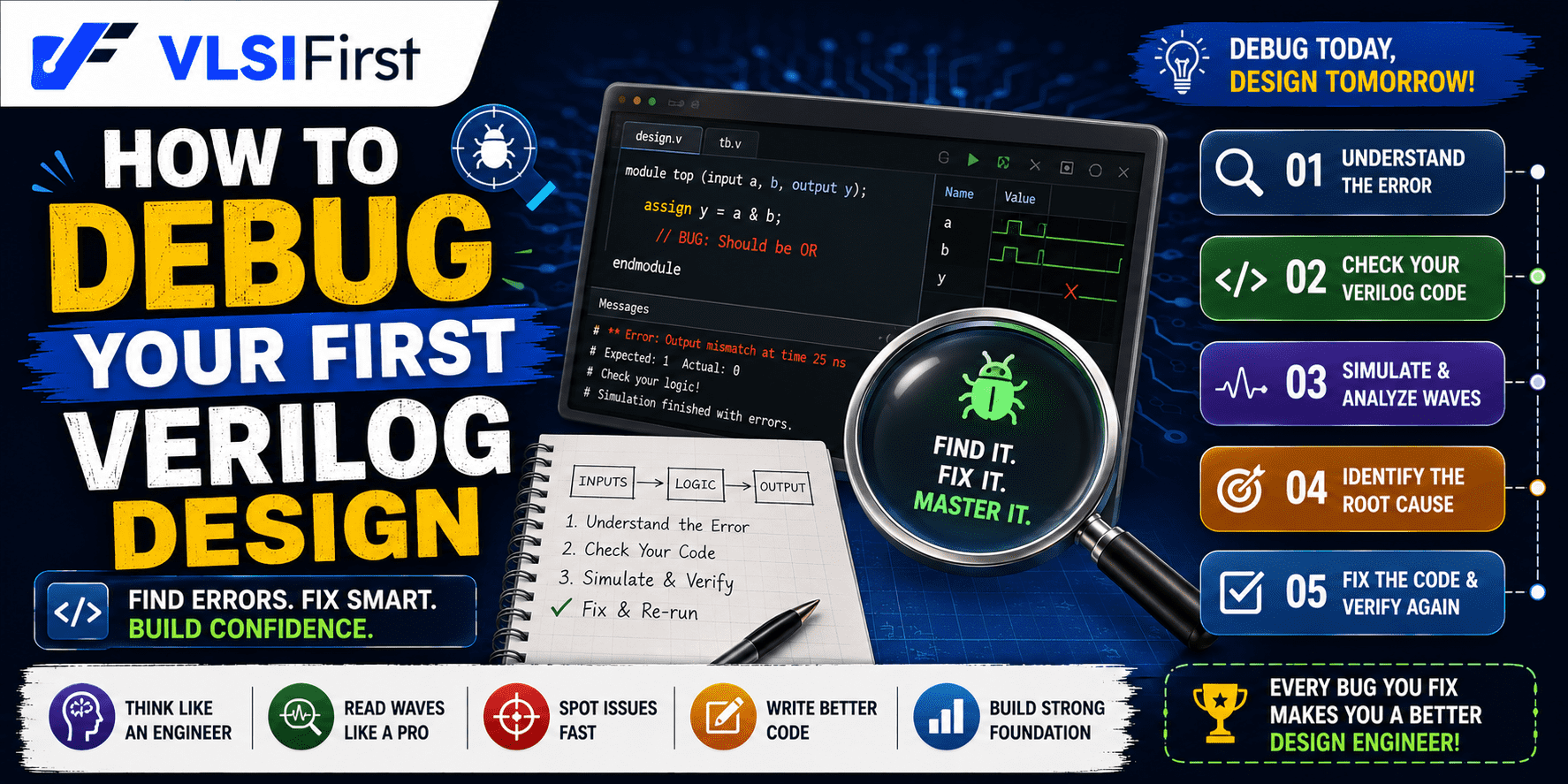
How to Debug Your First Verilog Design
Debugging your first Verilog design with practical RTL debug techniques, waveform analysis, testbench tips, FSM debugging, and common beginner mistakes. Read now!
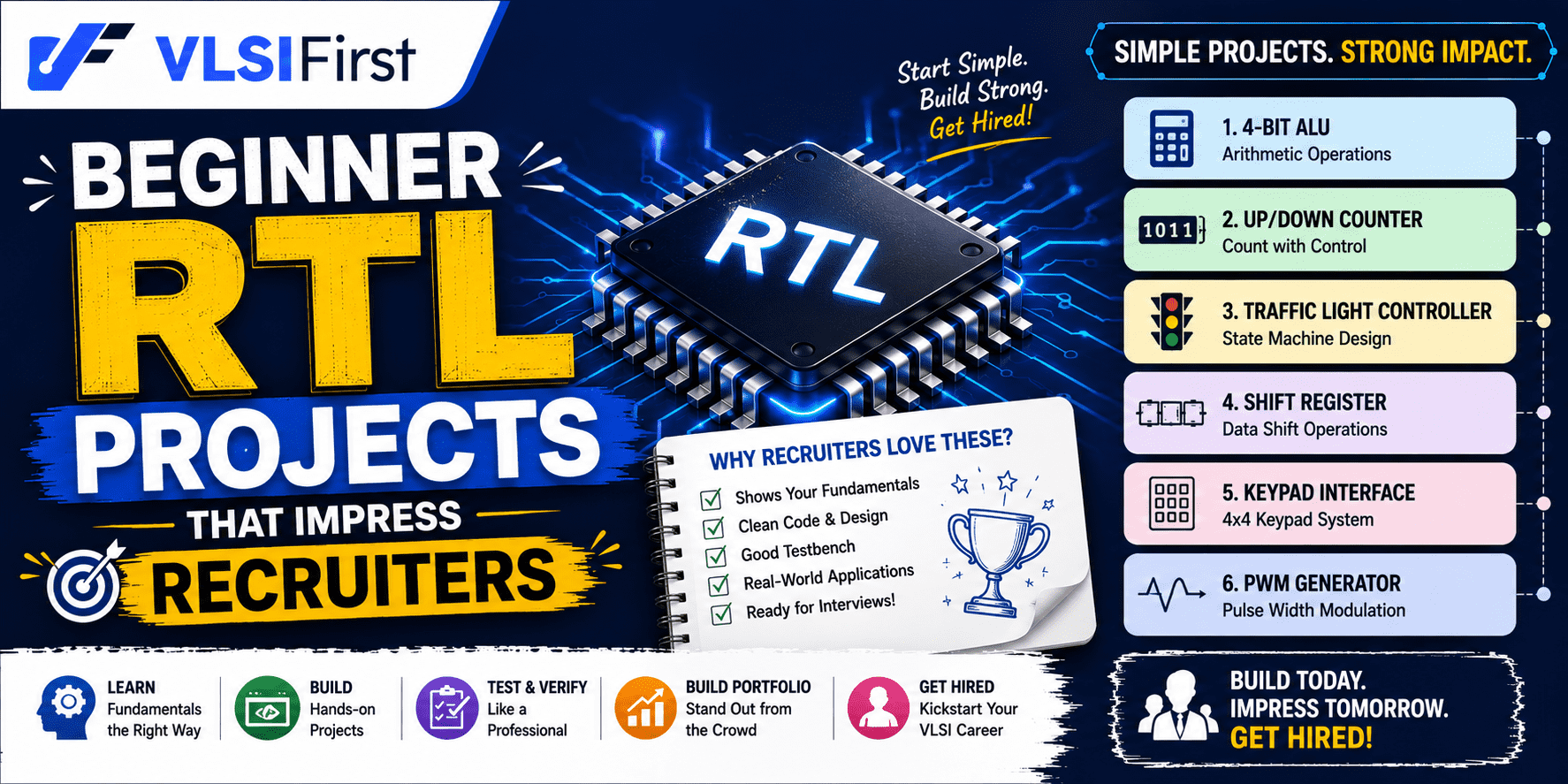
Beginner RTL Projects That Impress Recruiters
Discover beginner RTL projects that impress VLSI recruiters. Learn which Verilog projects build practical skills, strengthen your portfolio, and improve interview success.


Hours
2-98/1, Gurram Guda Road, Gurram Guda, Hyderabad, Rangareddy, Telangana, 501510
Copyright 2025 © VLSI Technologies Private Limited
Designed and developed by KandraDigitalCopyright 2025 © VLSI Technologies Private Limited
Designed, Developed & Marketing by KandraDigital