
In the journey to becoming a VLSI engineer, students often focus on course content, tools, and projects. While these are essential, one factor that can dramatically accelerate or slow down learning is often overlooked:
Mentorship
In a complex and evolving field like VLSI, the right mentorship can make the difference between just completing a course and actually becoming job-ready.
But not all mentorship is equally effective.
Some students attend courses where mentorship is limited to doubt-clearing sessions. Others get access to experienced industry professionals who guide them through real-world problems.
So what type of mentorship actually helps in VLSI learning?
This blog explores the different types of mentorship, what truly works, and how to identify effective mentorship in a VLSI training program.
Why Mentorship Is Critical in VLSI
VLSI is not a field where you can succeed through theory alone.
Students must:
- design RTL modules
- debug simulation errors
- understand timing issues
- work with complex EDA tools
These are skills that cannot be fully learned from books or recorded lectures.
Mentorship helps bridge this gap by providing guided learning, real-world insights, and problem-solving support. Mentors explain complex topics, share industry practices, and help students apply concepts practically.
In fact, mentorship is considered essential in semiconductor careers because many practical skills, like debugging, teamwork, and design thinking, are difficult to learn through formal education alone.
Types of Mentorship in VLSI Training
Not all mentorship models are equally effective. Let’s break down the most common types.
1. Passive Mentorship (Basic Doubt Support)
This is the most common form of mentorship in many institutes.
It includes:
- doubt-clearing sessions
- email or chat-based support
- limited interaction with trainers
Limitations:
- reactive, not proactive
- minimal personalized guidance
- no real problem-solving support
This type of mentorship is not sufficient for mastering VLSI.
2. Classroom Mentorship (Instructor-Led)
Here, trainers guide students during:
- live classes
- lab sessions
- assignments
Students can ask questions and receive explanations in real time.
Benefits:
- better concept clarity
- structured learning
- interactive sessions
Limitations:
- limited individual attention
- same pace for all students
This is better than passive mentorship, but still not enough for deep skill development.
3. Project-Based Mentorship (Highly Effective)
This is where mentorship starts becoming truly valuable.
In this model, mentors guide students through:
- real VLSI projects
- debugging challenges
- design implementation
Students learn by doing, failing, and improving under guidance.
Hands-on training combined with mentorship helps students understand real-world design challenges and build problem-solving skills.
Why it works:
- practical exposure
- real-time feedback
- industry-level problem solving
This type of mentorship is essential for job readiness.
4. One-on-One Mentorship (Most Effective)
This is the most powerful form of mentorship in VLSI learning.
It includes:
- personalized sessions
- tailored learning plans
- direct interaction with mentors
One-on-one mentorship adapts to your:
- strengths and weaknesses
- learning pace
- career goals
It also allows immediate problem-solving and deeper understanding of complex topics.
Benefits:
- faster learning
- better clarity
- customized guidance
This is especially useful for:
- beginners
- career switchers
- students preparing for interviews
5. Industry Mentorship (Game-Changer)
This is mentorship provided by professionals who have worked on real chip design projects.
These mentors bring:
- real-world experience
- practical debugging scenarios
- industry expectations
Hearing about real design challenges, like timing failures or verification bugs, makes learning far more impactful and practical.
Why it matters:
- connects theory to real work
- prepares students for industry environments
- builds confidence
What Actually Makes Mentorship Effective?
Not all mentorship programs deliver results. The effectiveness depends on specific qualities.
1. Real-World Problem Solving
Good mentorship focuses on:
- debugging real issues
- analyzing design failures
- improving design efficiency
This builds engineering thinking, not just knowledge.
2. Continuous Guidance (Not One-Time Support)
Effective mentorship is ongoing.
It includes:
- regular feedback
- progress tracking
- improvement suggestions
One-time sessions or occasional guidance are not enough.
3. Personalization
Every student is different.
Strong mentorship adapts to:
- beginner vs advanced learners
- design vs verification interests
- learning speed
Personalized mentorship significantly improves learning outcomes.
4. Career Guidance
Mentorship should go beyond technical topics.
It should also help with:
- choosing VLSI domains
- building portfolios
- preparing for interviews
5. Industry Exposure
Mentors should provide insights into:
- real job roles
- company expectations
- current industry trends
This helps students align their learning with actual job requirements.
What Students Often Get Wrong About Mentorship
Many students assume:
- “Any trainer is a mentor”
- “Recorded courses are enough”
- “Doubt sessions = mentorship”
These assumptions lead to poor learning outcomes.
Real mentorship involves:
- guidance
- feedback
- accountability
- real-world insights
Without these elements, learning remains incomplete.
Signs of Good Mentorship in a VLSI Course
Before joining any course, look for these indicators:
- Mentors with Industry Experience
- Project-based guidance
- One-on-one interaction opportunities
- Regular feedback sessions
- Debugging and problem-solving focus
How Mentorship Impacts Job Readiness
Students with strong mentorship typically:
- build better projects
- understand design flows deeply
- perform better in interviews
- gain confidence in problem solving
Mentorship also plays a key role during internships, where experienced engineers guide students, provide feedback, and help them grow professionally.
Ideal Mentorship Model for VLSI Students
The most effective VLSI training programs combine:
- Classroom Learning
- Project-Based Mentorship
- One-on-One Guidance
- Industry Mentorship
This combination ensures:
- concept clarity
- practical exposure
- personalized learning
- career readiness
Final Thoughts
So, what type of mentorship actually helps in VLSI learning?
Not passive support
Not just classroom teaching
The most effective mentorship includes:
- project-based learning
- one-on-one guidance
- real industry exposure
- continuous feedback
In a field as complex as VLSI, mentorship is not optional, it is a critical success factor.
Students who learn under the right mentors don’t just complete courses, they develop real engineering skills, confidence, and job readiness.
If you’re planning to join a VLSI course, don’t just evaluate the curriculum.
Evaluate the mentorship model, because that’s what will truly shape your career.
For more insights on VLSI training, career paths, and semiconductor learning strategies, explore expert guides on VLSIFirst.com.

How to Test Your RTL Before Simulation: A Practical Pre-Simulation Checklist for Beginners
Learn how to test your RTL before simulation with a practical pre-simulation checklist. Improve Verilog quality, reduce debugging time, and build industry-ready RTL skills.
From Logic Diagram to Verilog Code – Complete Workflow
Learn the complete workflow from logic diagram to Verilog code, including specifications, RTL architec ture, coding, simulation, debugging, verification, and documentation.
Common Mistakes While Writing Verilog Code
Learn the most common Verilog coding mistakes beginners make and how to avoid them. Improve RTL coding, simulation, debugging, verification, and interview readiness.
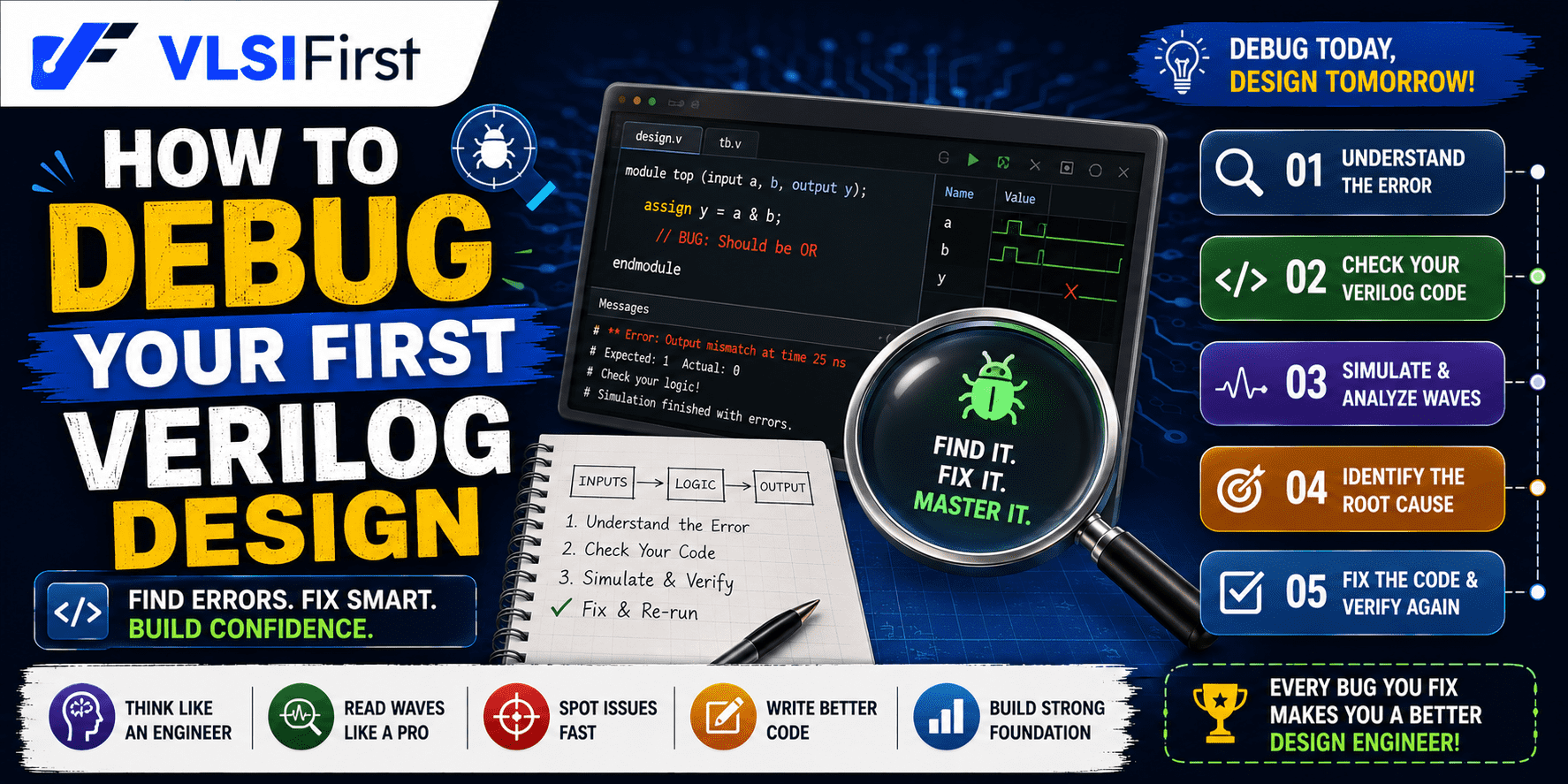
How to Debug Your First Verilog Design
Debugging your first Verilog design with practical RTL debug techniques, waveform analysis, testbench tips, FSM debugging, and common beginner mistakes. Read now!
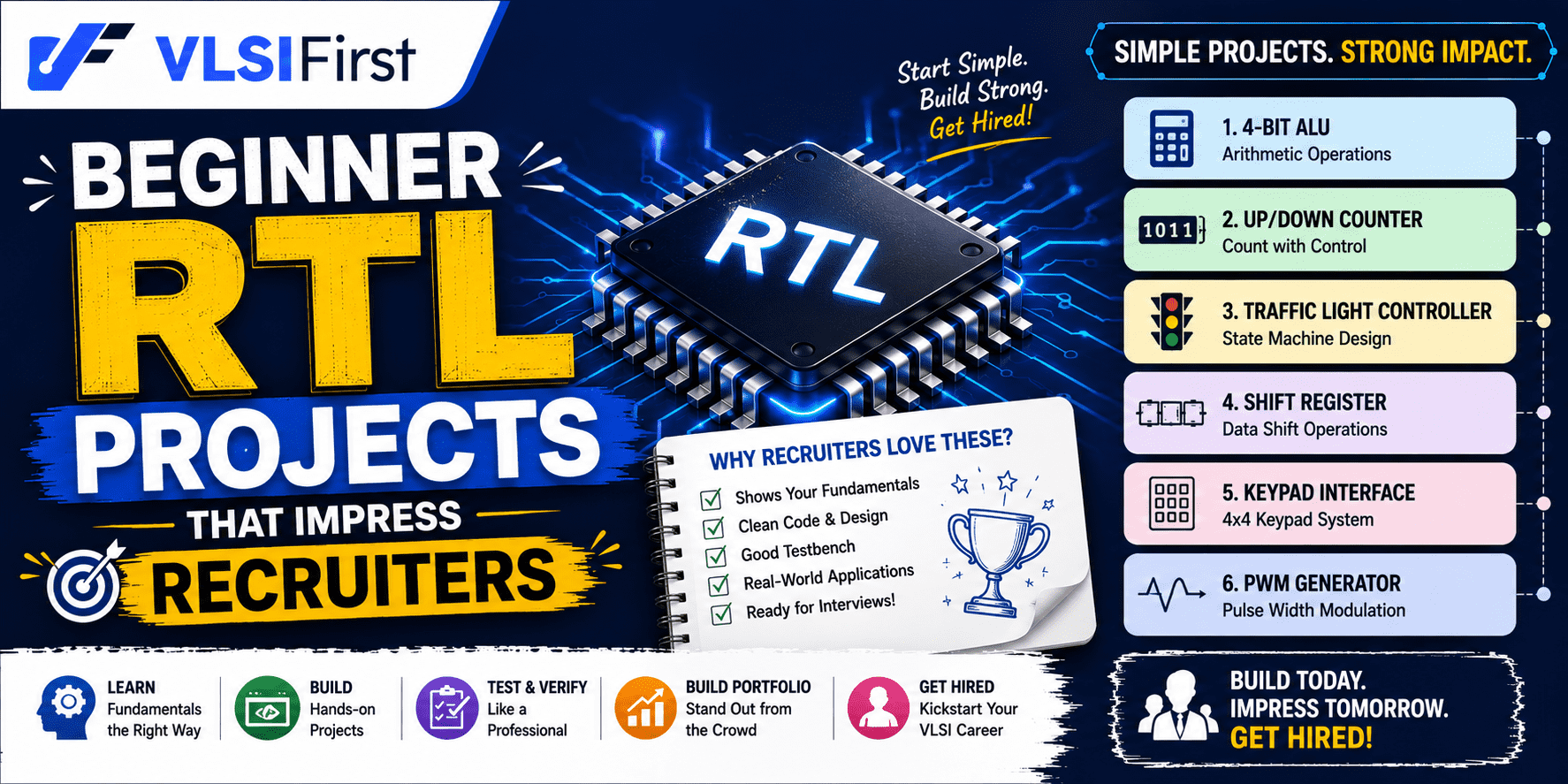
Beginner RTL Projects That Impress Recruiters
Discover beginner RTL projects that impress VLSI recruiters. Learn which Verilog projects build practical skills, strengthen your portfolio, and improve interview success.


Hours
2-98/1, Gurram Guda Road, Gurram Guda, Hyderabad, Rangareddy, Telangana, 501510
Copyright 2025 © VLSI Technologies Private Limited
Designed and developed by KandraDigitalCopyright 2025 © VLSI Technologies Private Limited
Designed, Developed & Marketing by KandraDigital