
One of the biggest concerns students have before entering VLSI verification is coding.
Questions like these are extremely common:
- “Do I need to be a software developer first?”
- “Is verification mostly programming?”
- “How much coding is actually enough?”
- “Can average coders succeed in VLSI verification?”
Because of the word “coding,” many ECE/EEE students assume verification is similar to software engineering.
But the reality is different.
VLSI verification requires coding, but not the same type of coding used in software development.
You don’t need to become an expert software engineer to enter verification roles. However, you do need a practical level of coding comfort, especially with hardware verification languages and debugging logic.
This blog explains:
- what kind of coding verification engineers actually do
- how much coding is enough for freshers
- which languages matter most
- what students should focus on (and what they can ignore)
First, Understand What Verification Engineers Actually Do
Verification engineers are responsible for ensuring that a chip design behaves correctly before fabrication.
Their work includes:
- creating test environments
- writing test cases
- debugging failures
- validating functionality
- checking coverage
In modern semiconductor companies, verification consumes nearly 70% of the overall chip development effort because finding bugs before manufacturing is critical.
This is why verification roles are in huge demand.
Is Verification More About Coding or Electronics?
The answer is:
It is a combination of both.
You need:
- digital electronics fundamentals
- coding ability for testbench creation
- debugging mindset
- logical analysis skills
Verification is not pure programming.
It is hardware-focused coding with problem-solving.
The Biggest Myth: “You Need Advanced Programming Skills”
This is one of the biggest misconceptions.
Many students think they need:
- Data Structures & Algorithms mastery
- Competitive programming
- Full-stack development knowledge
- Advanced software engineering experience
before entering verification.
This is completely unnecessary for beginners.
What Coding Skills Are Actually Required?
Let’s break it down realistically.
1. Verilog Basics (Mandatory)
This is the foundation.
You should know:
- modules
- always blocks
- combinational logic
- sequential logic
- testbench basics
Verilog is still the entry point for most students entering verification and RTL domains.
Without Verilog basics, verification becomes difficult.
2. SystemVerilog (Most Important Language)
Modern verification heavily depends on SystemVerilog.
You should learn:
- classes
- assertions (SVA)
- interfaces
- constrained randomization
- functional coverage
SystemVerilog is considered the backbone of modern verification environments.
3. UVM (Industry Standard)
UVM (Universal Verification Methodology) is widely used in ASIC verification.
You should understand:
- agents
- drivers
- monitors
- sequences
- scoreboards
UVM enables reusable and scalable verification environments for large SoCs.
However, beginners should first become comfortable with SystemVerilog before jumping deeply into UVM.
Community discussions also highlight that UVM becomes more valuable as design complexity increases.
4. Basic Scripting (Helpful, Not Mandatory Initially)
Verification engineers often use scripting for:
- automation
- regression runs
- log parsing
- report generation
Python, TCL, and Shell scripting are commonly used in verification environments.
But beginners do NOT need expert scripting skills on day one.
Basic automation understanding is enough initially.
So, How Much Coding Is Enough for Freshers?
For entry-level verification roles, you should be able to:
- write basic Verilog modules
- create simple testbenches
- understand SystemVerilog syntax
- debug simulation errors
- understand UVM concepts at beginner level
That is enough to start applying for fresher roles.
What Recruiters Actually Expect from Freshers
Recruiters usually do NOT expect freshers to:
- build enterprise-level verification frameworks
- master advanced UVM architecture
- become software engineers
Instead, they look for:
- strong fundamentals
- debugging ability
- clean coding logic
- willingness to learn
The Most Important Skill in Verification: Debugging
This is something students often ignore.
Verification is less about writing huge amounts of code and more about finding and analyzing bugs.
You must learn to:
- read waveforms
- trace signals
- identify failures
- understand design behavior
Industry experts consistently emphasize debugging as one of the most critical verification skills.
Coding vs Logic: Which Matters More?
In verification, logical thinking matters MORE than advanced coding.
Students who succeed usually have:
- patience
- analytical mindset
- curiosity
- debugging ability
Even average coders can become excellent verification engineers if their logic is strong.
What You DON’T Need Initially
Let’s remove unnecessary fear.
1. Competitive Programming
Not required.
You do not need:
- LeetCode mastery
- advanced algorithms
- coding contest experience
for most verification fresher roles.
2. Full Software Development Skills
Verification coding is different from:
- web development
- app development
- backend engineering
You are describing and testing hardware behavior.
3. Advanced C++ Expertise
C/C++ may help in some advanced environments, firmware interaction, or co-simulation workflows, but beginners can start verification without deep expertise.
Ideal Coding Roadmap for Verification Beginners
Here’s a practical roadmap.
Step 1: Digital Electronics
Master:
- FSMs
- counters
- timing diagrams
- sequential circuits
Step 2: Learn Verilog
Practice:
- combinational designs
- sequential designs
- simple testbenches
Step 3: Move to SystemVerilog
Focus on:
- OOP basics
- assertions
- randomization
- coverage concepts
Industry demand for SystemVerilog and UVM remains extremely strong in 2026.
Step 4: Understand UVM Basics
Start small.
Do not try to master everything immediately.
Even professionals say UVM feels overwhelming initially.
Step 5: Learn Basic Scripting
Start with:
- Python basics
- Linux commands
- Shell scripting basics
Automation becomes increasingly useful as projects grow.
Common Mistakes Students Make
1. Over-Focusing on Coding
Students sometimes ignore digital electronics while focusing only on coding.
This creates weak fundamentals.
2. Jumping Directly into UVM
Without SystemVerilog basics, UVM becomes confusing.
3. Learning Syntax Without Projects
Verification must be practiced through:
- mini projects
- simulations
- debugging exercises
4. Fear of Programming
Many students avoid verification because they think coding requirements are too high.
The reality is consistent practice matters more than initial coding expertise.
Summary
So, how much coding is enough for VLSI verification roles?
You need:
- beginner-to-moderate coding skills
- strong digital logic understanding
- SystemVerilog basics
- debugging mindset
You do NOT need:
- software engineering mastery
- competitive coding expertise
- advanced algorithms knowledge
If you are interested in VLSI verification:
Don’t fear coding unnecessarily.
Start with:
- digital electronics
- Verilog basics
- simple testbenches
- gradual SystemVerilog learning
Because in verification:
Strong logic + debugging skills matter more than becoming a “hardcore programmer.”
For more VLSI career guidance, verification roadmaps, and semiconductor industry insights, explore detailed resources on VLSIFirst.com.

How to Test Your RTL Before Simulation: A Practical Pre-Simulation Checklist for Beginners
Learn how to test your RTL before simulation with a practical pre-simulation checklist. Improve Verilog quality, reduce debugging time, and build industry-ready RTL skills.
From Logic Diagram to Verilog Code – Complete Workflow
Learn the complete workflow from logic diagram to Verilog code, including specifications, RTL architec ture, coding, simulation, debugging, verification, and documentation.
Common Mistakes While Writing Verilog Code
Learn the most common Verilog coding mistakes beginners make and how to avoid them. Improve RTL coding, simulation, debugging, verification, and interview readiness.
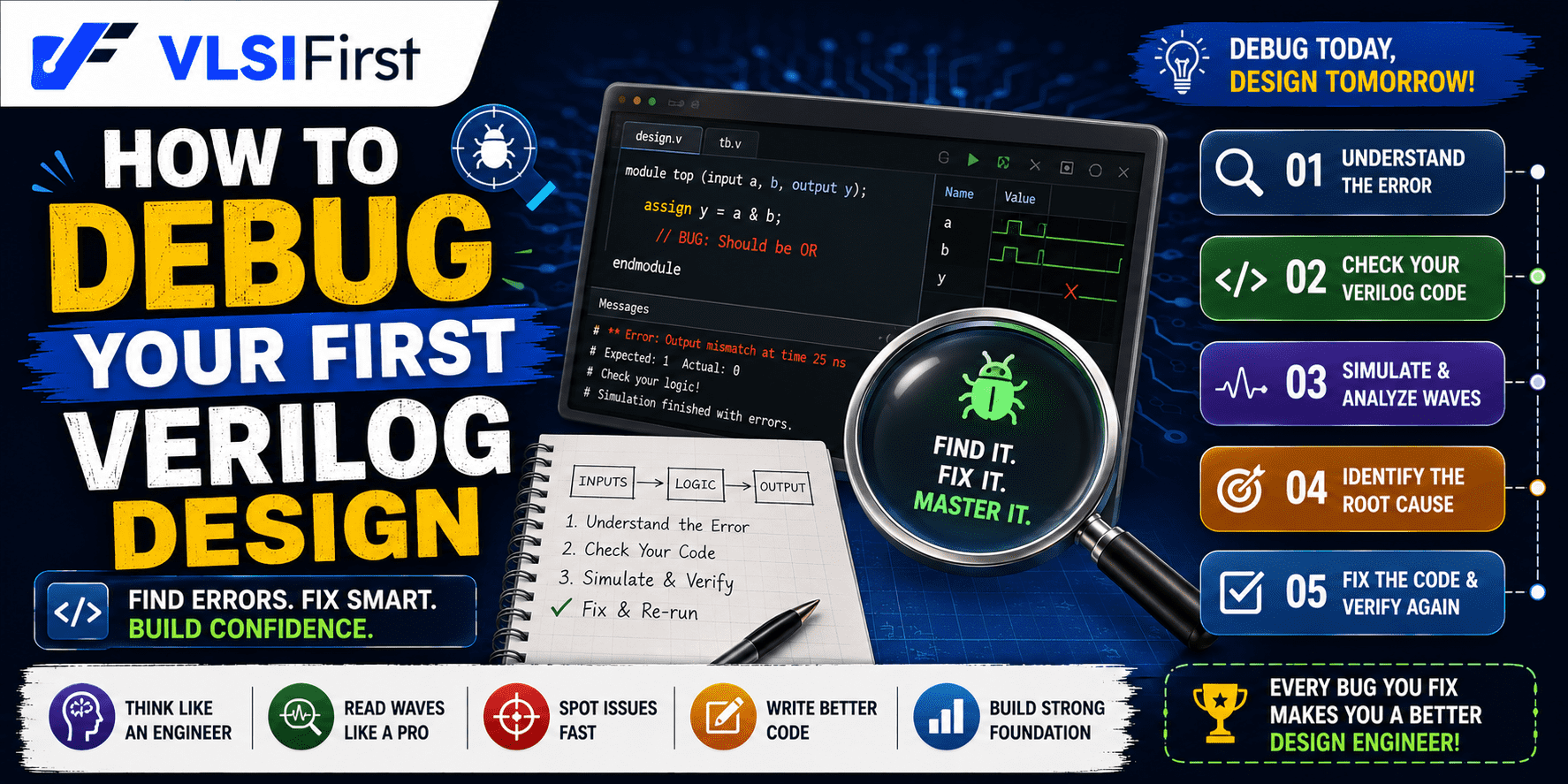
How to Debug Your First Verilog Design
Debugging your first Verilog design with practical RTL debug techniques, waveform analysis, testbench tips, FSM debugging, and common beginner mistakes. Read now!
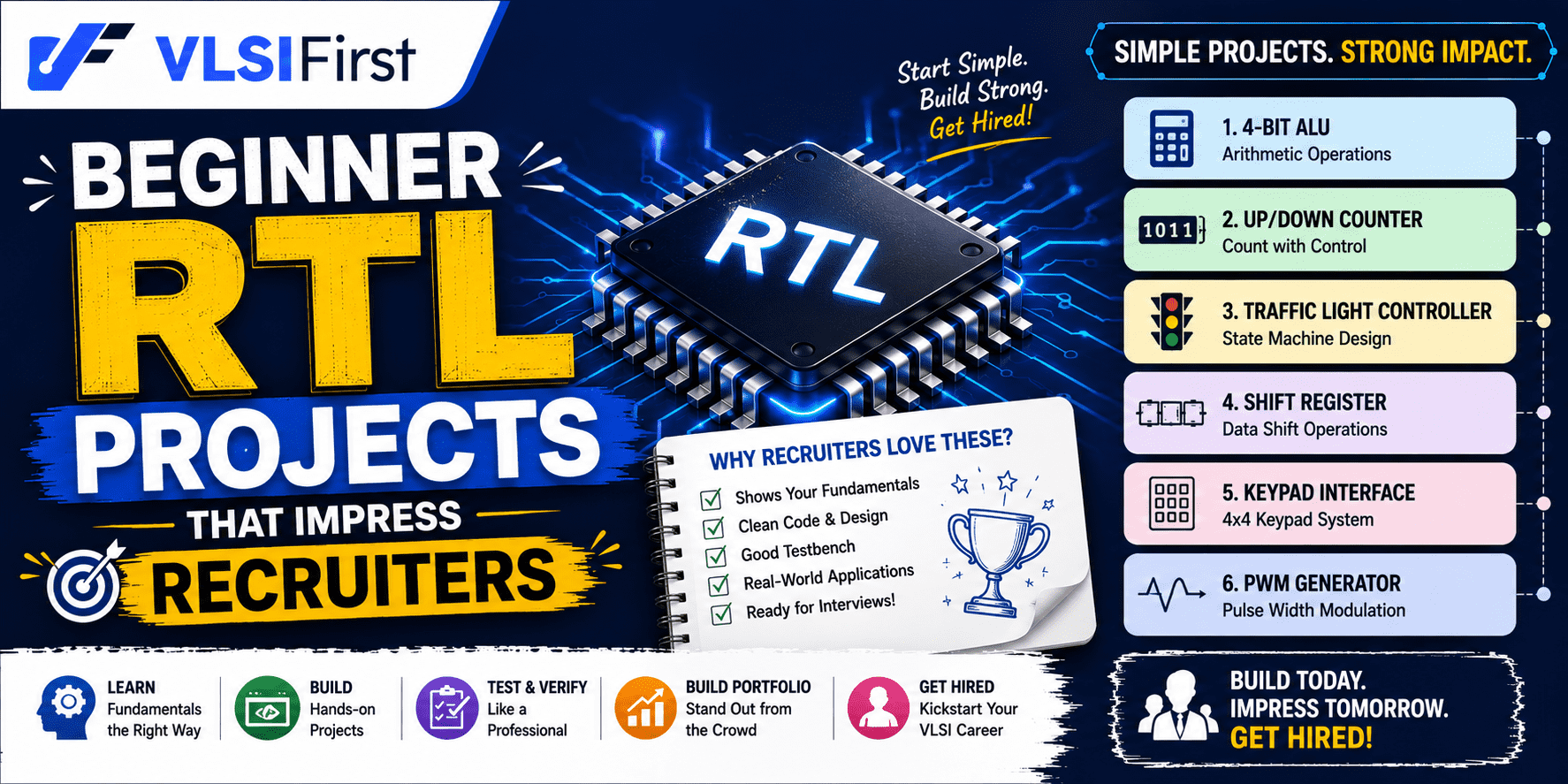
Beginner RTL Projects That Impress Recruiters
Discover beginner RTL projects that impress VLSI recruiters. Learn which Verilog projects build practical skills, strengthen your portfolio, and improve interview success.


Hours
2-98/1, Gurram Guda Road, Gurram Guda, Hyderabad, Rangareddy, Telangana, 501510
Copyright 2025 © VLSI Technologies Private Limited
Designed and developed by KandraDigitalCopyright 2025 © VLSI Technologies Private Limited
Designed, Developed & Marketing by KandraDigital